

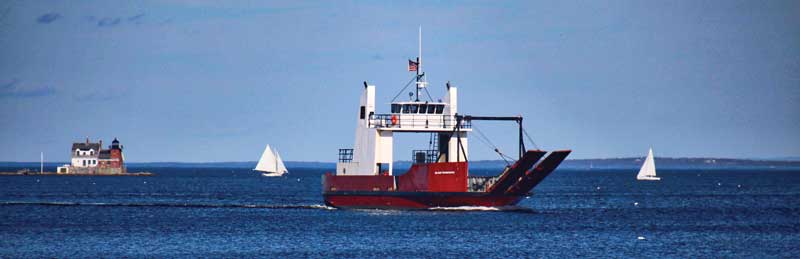
Any large-scale project on an unbridged island can be a challenge, but particularly so on Matinicus, located some 20 miles across the water from Rockland, Maine, and where tons of equipment was needed to install a new power plant for the island community’s electricity customers.
The island receives infrequent vehicle ferries in the best of times, seeing roughly 40 trips a year from the state ferry service, irregularly spaced around tides and demand. All transportation to the island is easily disrupted by weather, be it dangerous crosswinds on the short island airstrip or the ubiquitous summer fog cancelling flights by Owls Head, Maine-based air taxi Penobscot Island Air, or offshore wave heights causing ferry captains to think twice about making a scheduled trip.
The island’s harbor is filled with lobsterboats, but there is no marina or boatyard, and no all-tides, easy-access wharf. Tractor-trailers are almost an impossibility here. Indeed, any freight delivery to Matinicus—even for a small item—gets complicated. But that’s where a company like Rockland, Maine’s Island Transporter, with its vessel of the same name, saves the day.
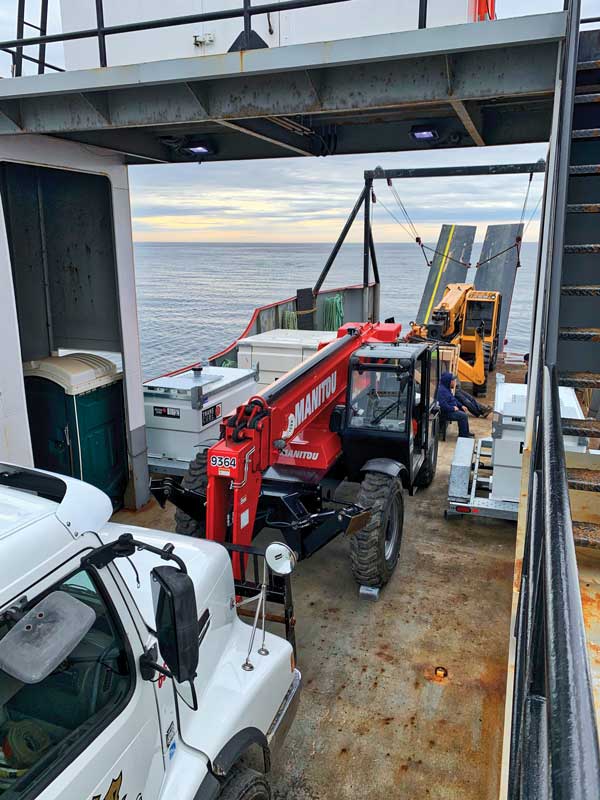
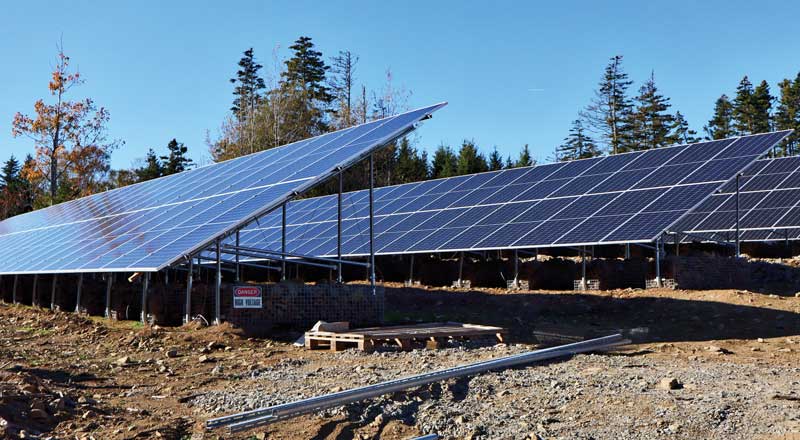
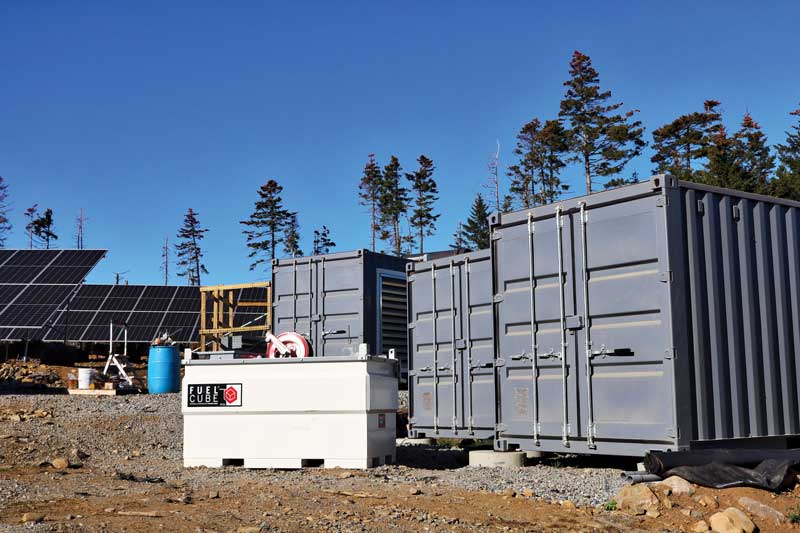
The island’s new electric company installation required moving three 20-foot shipping containers that had been outfitted with diesel generators and related equipment inside; large tanks for diesel fuel; tri-axle dump trucks loaded with material for site prep; a couple of rented heavy-duty material-carriers known as telehandlers to set up equipment on the island; and many truckloads of other gear, including dozens of crates of photovoltaic panels and associated structures to build a two-thirds-of-an-acre solar array.
The solution? Load it aboard the Island Transporter landing craft and leave it to the boat’s crew to manage the delivery.
Nate Roberts, company manager of Island Transporter, a subsidiary of Rockland Marine Corp., said that they made at least 20 trips to Matinicus in 2025, most of them for the power project, though some involved deliveries of road or airstrip surface material—gravel, essentially—or to support a couple of residential building projects.
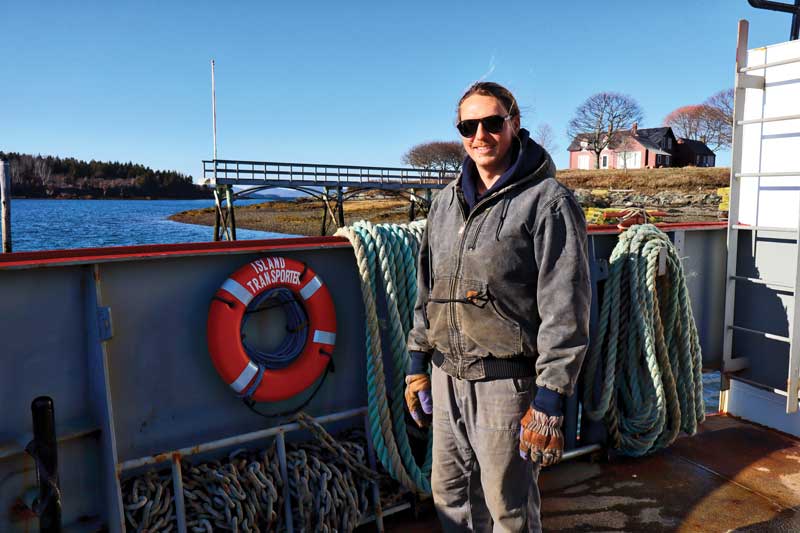
People often refer to the Island Transporter as a barge, because its purpose is moving heavy freight, but its captain, David Kirk, said, “I call it a landing craft. Most of the places we go have no wharf, so we have to put the ramps down, and the trucks unload over a beach.”
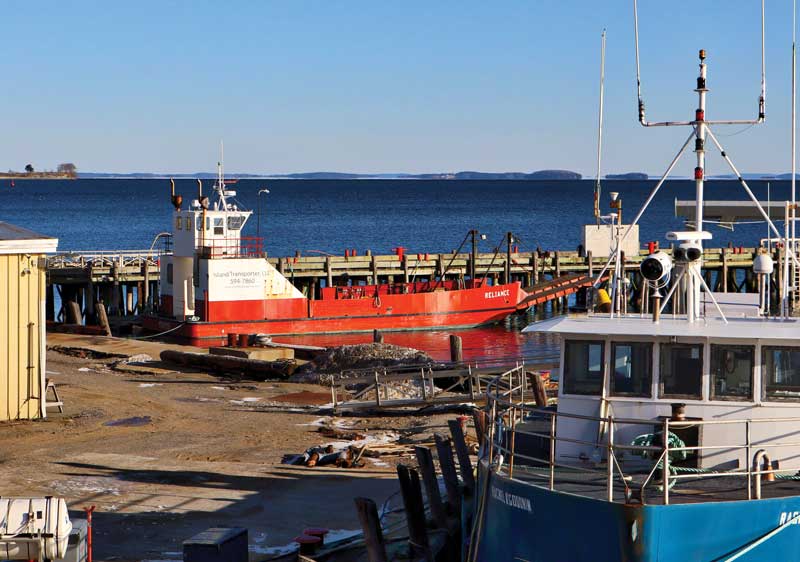
Purpose-built in 1999 at Rockland Marine for the job it does now, the 96-foot Island Transporter, along with the company’s 64-foot Reliance, are important to island communities such as Monhegan and Isle au Haut that do not receive state vehicle ferry service. They also enable building projects on private islands and remote shoreside properties. If the freight is very heavy or the logistics needs very strange, even if a regular ferry does serve your island, these guys are likely who you’ll need to get a big job done.
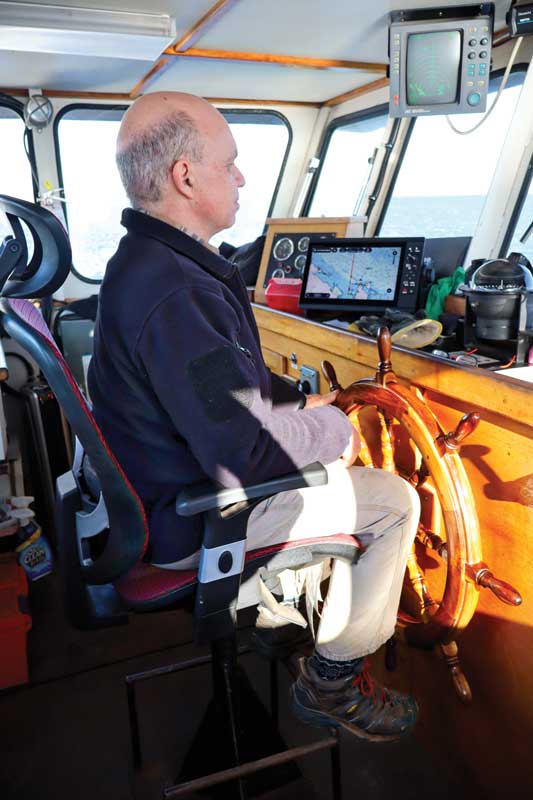
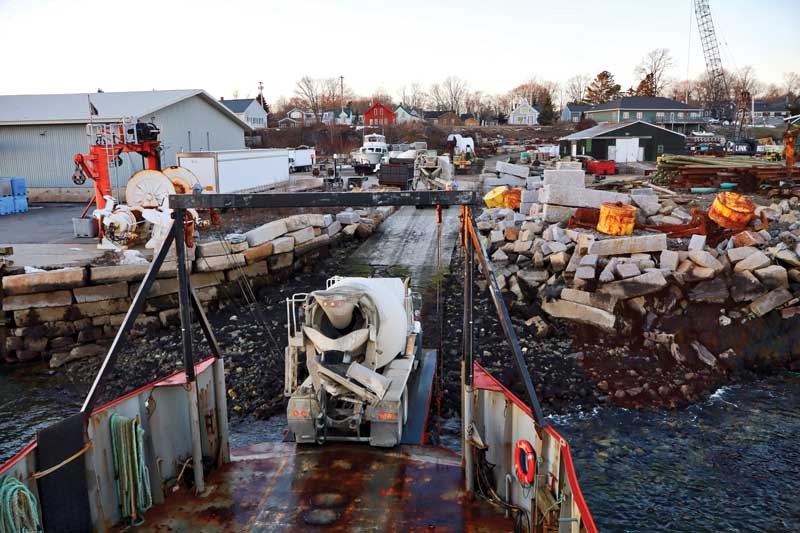
I rode along on one of the Transporter’s runs in December, 2025, as they delivered three cement-mixer trucks to North Haven. The landing craft carefully approached a small bit of beach near Pulpit Harbor, put the ramps down, and under deckhand Peter Brown’s watchful eye the trucks drove off and headed for their construction site. The crew waited three hours for the trucks to unload their concrete and return, with the captain at the helm all of that time, keeping the vessel in place, since there was nothing to tie up to. One mixer had needed to be repaired quickly on the island, delaying its return to the boat. The Island Transporter then returned the empty trucks to Prock Marine’s yard in Rockland, just as the sun began to set.
“My biggest fear,” admitted Kirk, “is the tide going out and some piece of equipment is stuck on the bow with a mechanical problem and can’t move, and the water’s leaving us.”
Serving the coast from Eastport, Maine, to Rye, New Hampshire, the Island Transporter supports a wide variety of businesses and construction efforts. In Eastport, the vessel is needed to fill and service salmon pens for aquaculture. Elsewhere, a homeowner may want rocks that weigh a ton apiece, or full-size trees, or a swimming pool in some remote place.
“We go to Isle au Haut all the time, back and forth from Stonington,” said Brown, “with cars, dump trucks, horses, septic pumper trucks…” He added, “We do what nobody else does. We purposely get in shallow water and sort of run aground. What we do is weird in the marine industry, but it’s critical.”
Capt. Jim McIntyre, one of the company’s other captains, told the story of overhearing some local VHF radio traffic while on the way to an island in thick fog. “I heard this lobsterman on the radio say to his buddy, “You’re not going to believe this, but I just waved at a dump truck!”
According to McIntyre, “One of the biggest Transporter loads I remember was when they were doing repairs to the windmills on Vinalhaven. We took something like 14 tractor-trailer loads to build the crane to change the gearbox on one of the wind turbines. Then it all needed to come back off the island, obviously. One crane boom piece was on one trailer truck, another boom piece was on another truck, and so on. The base to that crane was like 228,000 pounds.”
While serving Matinicus, the Transporter can use the ferry dock, Kirk said, “We don’t go to the ferry terminal on Vinalhaven; we usually go to a beach. About 90-percent of the time, wherever we go, we need the ramps down and yes—there are usually cars parked in the way or other stuff: lobster traps, floats and docks, whatever. “We’ve delivered trucks to islands when there was no way for them to drive off the boat, because nobody had cleared the way. We’ve had to turn around and take trucks back to Rockland. There isn’t usually much of a window with the tide. A lot of the places we go, we need high tide.”
Brown, whose job on deck involves making sure immense vehicles and loads get on and off the Transporter without incident—a high-stress duty, at times—speaks highly of Cote Crane and Rigging, of Auburn, Maine. Cote Crane is one of the few local companies with expertise in heavy load logistics, and a company which was instrumental in making the Matinicus power project possible.
“As far as contractors go, they are the highest grade of professional I’ve dealt with by a large margin,” Brown said. “Best personalities, best attitude—and they bring good weather!” he added with a laugh. “They have the equipment, but they also have a plan, no wasted minutes, they know what it takes. Everything’s loaded and they’re ready to do it.”
Phil Davies of Matinicus, who did the bulk of the work pulling together the Matinicus power company upgrade, cannot say enough in praise of both the Island Transporter crew and Cote Crane. “For logistics, the guys from Cote were fantastic. We simply couldn’t have got the (power project) equipment here without them. They were wonderful. They took a lot of the stress off; this wasn’t exactly an easy unload. They were always calm, which makes a big difference.”
The Island Transporter is also the only other roll-on-roll-off vessel in the area that can substitute for the 105-foot state ferry vessel the Charles Norman Shay, the usual boat that serves Matinicus, should the Shay need maintenance or repair. The other state ferries are simply too long to maneuver inside Matinicus Harbor.
Just as Matinicus was finally ready to receive the major components for the electric company in 2025—and running out of time, as the old system was failing fast—the electric utility found out that the Transporter had been more or less booked solid for the entire summer for a major road-paving project on Vinalhaven. Making multiple crossings a day to the island with truckloads of hot asphalt, all rapidly cooling and making the paving contractors anxious, was the plan, yet somehow the Matinicus trips had to be fit in too. Davies, along with the Cote Crane and the Island Transporter crews made it happen.
“We could not have done this power company project without the Island Transporter,” Davies said.
Island Transporter manager Roberts summed it up best: “It’s a weird business, moving heavy things.”
✮
Eva Murray is a frequent MBH&H contributor and a meter reader for the Matinicus Plantation Electric Company.
New Hybrid Power System Lights Up Matinicus
Maine’s remote Matinicus Island has jokingly been described as “the most Alaskan place in the Lower 48.” With a one-room public elementary school, a microwave telephone signal sent over water to a 100-foot-tall tower, mail that comes by bush plane, no paved roads, and a population that averages around 80—though it’s far smaller in the winter—Matinicus Isle Plantation, its formal name, is just barely a town in most of the usual senses.
But last summer, on Independence Day—with the flip of a switch—year-round and summer residents alike began to enjoy the benefits of a state-of-the art electric system, designed and customized for this unique offshore microgrid. With no electrical cable connecting Matinicus with the mainland, the island’s electricity is generated by the Matinicus Plantation Electric Company, a municipally owned utility. MPEC is regulated by the Public Utilities Commission, like any other power company, but this utility is tiny—serving about 100 residences and a handful of lobster harvester’s trap shops and other workplaces.
The island’s electricity demand is not high, generally under 100 kilowatts, and sometimes well under, creating a challenge when it comes to load management. In the mid-1960s, when the first iteration of an electric company—then called Matinicus Light and Power—was started, its generating equipment was mostly second-hand and installed with no particular engineering or design expertise. Prior to that, any homeowner who wanted electricity had a personal backyard generator.
Then in the 1980s, a new diesel plant was installed, designed to adapt to the ups and downs of electricity demand over the year and through each day, with three Detroit 3-71 generators, which were eventually replaced by 4-71s, and electronic switchgear that enabled the second and sometimes third gensets to automatically start or shut down as needed.
But after more than four decades of 24-hour service, all the power generation equipment in the power house was badly in need of replacement. Maintaining the existing power plant by simply fixing engines and switchgear was no longer possible, given the trouble finding quality parts for obsolete equipment and recent regulations around diesel emissions.
A new design was proposed by island resident Philip Davies, incorporating a photovoltaic array, a battery storage bank, and a Tier 4 Perkins diesel, with a Tier 3 generator as backup.
Energy storage—something new for the island—would be a significant upgrade, as would moving the entire setup inland, away from the harbor, where the storms of 2024 had brought salt water too close for comfort.
Designing the new power generation system was just the start. Islanders had to come to grips with the pending changes, the prospect of large expenses, and untried technology—none of these are easy sells in any small town. Other challenges, besides mustering up community support, included organizing such a project when nothing similar had been done before; cutting wood and developing a site for the new facility; figuring out how to pay for the whole thing (the project is a public-private partnership involving a complex assembly of funding sources, but it is primarily island ratepayers’ money in the long run), and the onerous administrative work associated with the relevant regulatory agencies. And then there was the electrical and engineering knowledge required. But most of all, there was the question of how to get all the necessary parts and equipment 20 miles out into Penobscot Bay from the mainland.
That last hurdle was overcome by turning to the Island Transporter. Thanks to its team, tons of engines, solar panels, batteries, other assorted parts, and construction equipment arrived as needed so work could progress on pace.
From the start of the design until the solar field was up and running in August, 2025, took roughly 20 months. Davies said he began building computer simulations of the new system in January, 2024, and design work was mostly completed the following January, which is when workers began clearing land. Equipment from the mainland began arriving in the spring.
Besides Davies, who acted as project leader, Gary Peabody of Ubetcha Offshore Engineering, and Nick Philbrook of Matinicus handled earthwork and site prep. Others involved with the project included electrical engineer Spencer Egan from RLC Engineering; Ted Fountain and Ben Hall of Massachusetts-based New Day Energy; Powerhouse Diesel Generators of Georgia; and New Sun Road, a California software company. Cote Crane and Rigging was involved in material handling.
Prior to July 2025, electricity on Matinicus was generated by one and sometimes two (synchronized) diesel gensets, controlled by early-1980s-era electronic switchgear to regulate voltage, frequency, etc. and which ran 24 hours a day to directly power the island’s grid. With the new system, power is generated by both a 2/3-acre, 160-kilowatt photovoltaic array and by a diesel generator, which no longer has to run all the time. Supercapacitor energy storage allowed the island’s utility to add the renewable component (the solar panels) and use far less diesel fuel. Rather than switchgear (banks of relays and lots of wiring) proprietary microgrid software manages power production.
At last, on July 4, 2025, the Matinicus power company shut off the old, failing Detroits and shifted over to the new diesel-powered system. A few weeks later, the newly-installed solar panels were making electricity for islanders.”
—Eva Murray
✮