

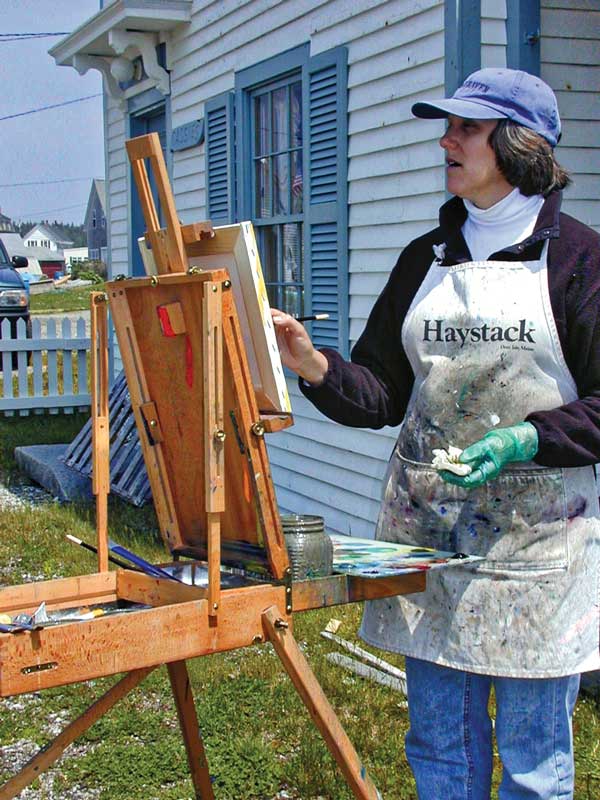
The plein-air artist has paints, will travel.
Portland painter Connie Hayes must be one of the most mobile painters in America today. While other artists may cover a wider swath of territory, Hayes has probably painted more individual sites. It’s not a competition, mind you. It’s called “Borrowed Views.”
In the spring of 1990, while working at the Portland School of Art, Hayes sent out a card to board members, staff, and faculty asking if they might consider lending her a place to paint in the summer and fall. The arrangement was simple: in exchange for a painting, they would allow the artist to spend a weekend or a week or two at their homes, by herself, painting.
Hayes had been offered a show at the Greenhut Gallery in Portland in the fall, and she needed to produce work for it. She yearned for rural, off-the-beaten-track views. When she made the final tally of offers that spring, she was flabbergasted and delighted: 15 sites to visit and paint in three or so months! The Borrowed Views project was born.
A simple MO was quickly established: “land and paint.” Hayes discovered that she was blessed with what she calls “intuitive radar,” which allows her to paint anywhere. To each location she brings her color preferences, scale choices, and process of negotiating forms. These elements “stabilize” her as she explores unfamiliar geography.
Hayes’s brand of representation is tied more to the feel of a site than to its actual particulars. At the same time, she remains true to the motif -- true enough that the lenders of a house and property immediately recognize the view. The main goal is to render the energy of the natural world, and Hayes often resorts to a semi-abstract mode to do so. Like one of her heroes, Fairfield Porter, she enjoys walking the line between abstraction and representation.
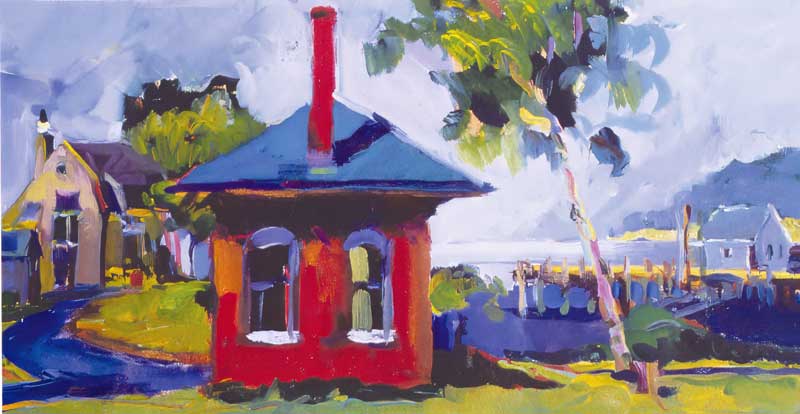
Hayes is a plein-air painter of the first rank. She is able to set up in just about any environment—the woods, a marsh, a deck, a dock—and go to work. Her paintings often have the immediacy of an oil sketch, the paint applied in a spirited yet controlled manner. This work is the very opposite of the labored studio creation, yet the brushwork displays an assuredness that gives each canvas a finished feel.
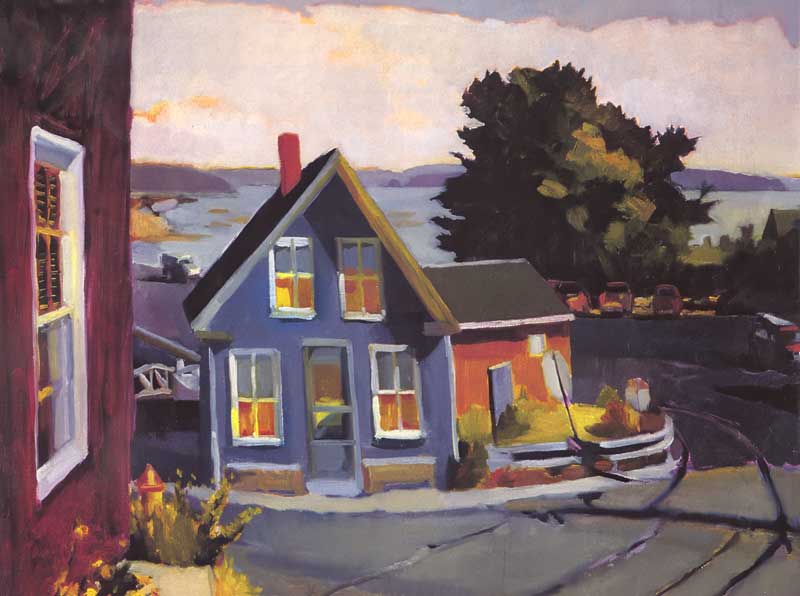
That Hayes emphasizes the emotions she experiences through sight she readily admits. Her colors, she says, “overstate the greenness of a sky, the pinkness of a building.” She frequently uses color to create psychological jolts.
Changes in weather or light or season are often the focus of Hayes’s painterly attention. She is attracted by bright spots in the landscape, such as a forsythia bush in full bloom, a clump of tiger lilies, or a crowd of sunflowers. Paths, walkways, roads, and rivers lead the viewer into and across the landscape.
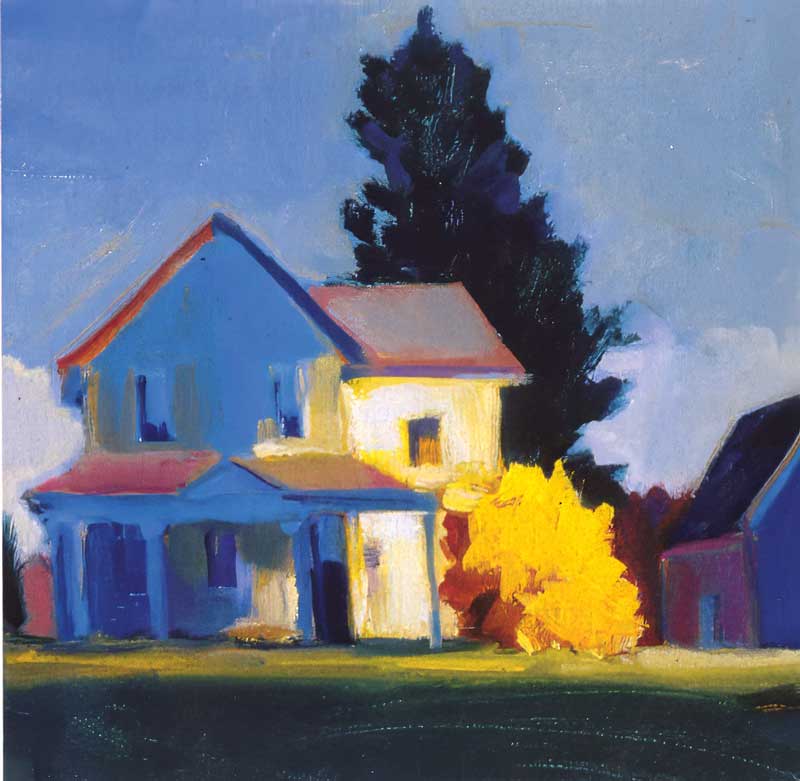
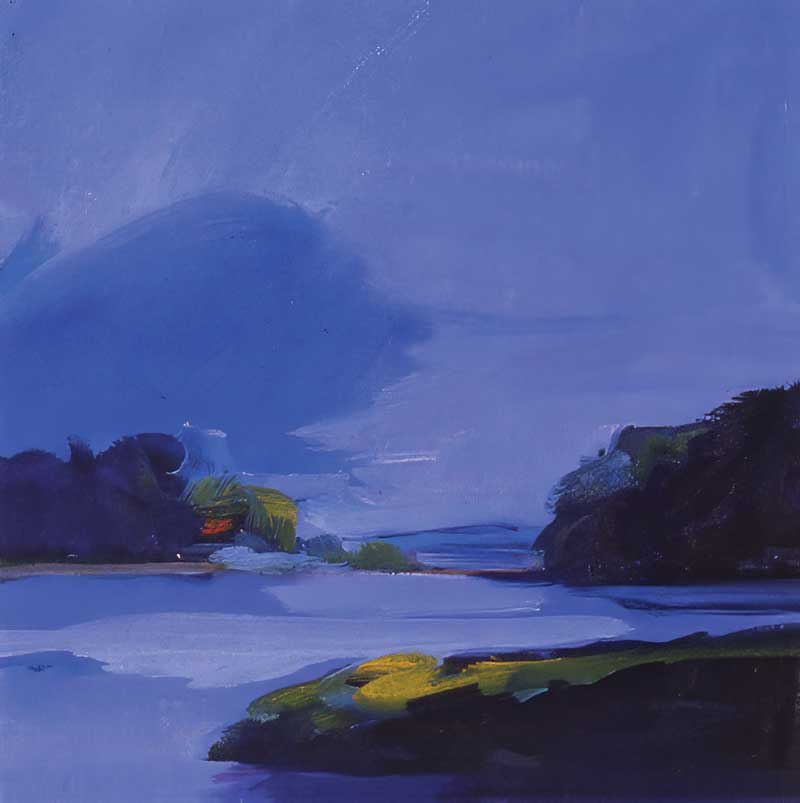
At times, Hayes’s views seem entirely atmospheric, in a line of romantic vision that goes back to Turner. She is always seeking, in her words, to amplify the “merely seen” into the “really felt.” At times, the viewer feels that she has actually captured the sun, fog, and weather on the surface of the canvas.
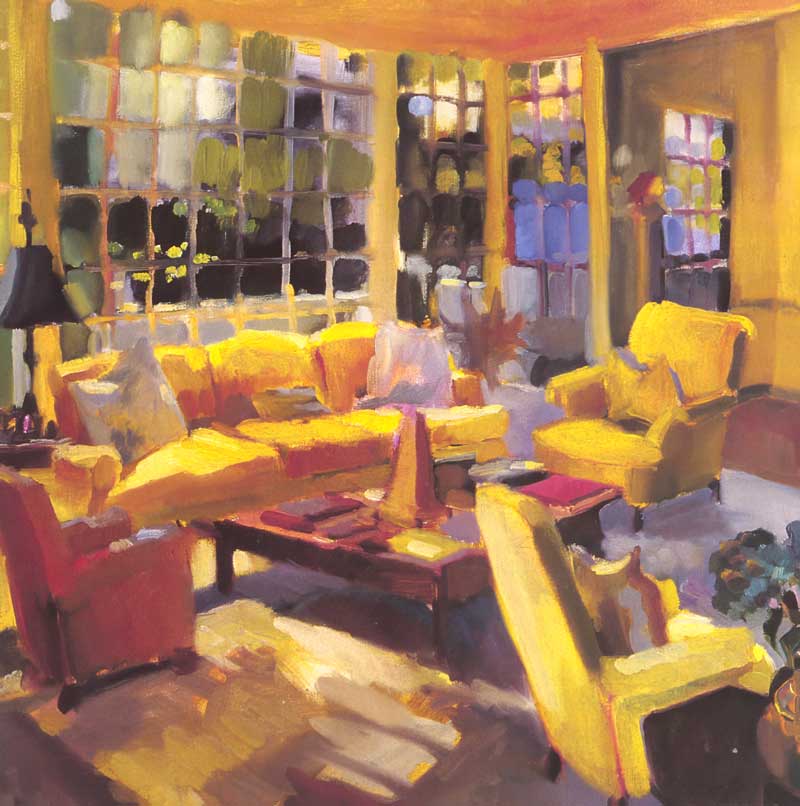
Not all of Hayes’s Borrowed Views are landscapes. Over the years she has painted many interiors, attracted to the arrangements of furnishings, the way light falls across a tablecloth or the floor, the halo of a lamp. Frequently these interiors will include the view through a picture window, the panes of glass creating a series of small vistas.
Summer houses are often built to take advantage of seasonal light and panoramas. Hayes recognizes the beauty of these sight lines; many of her most complex and intriguing canvases feature an inside/outside perspective.
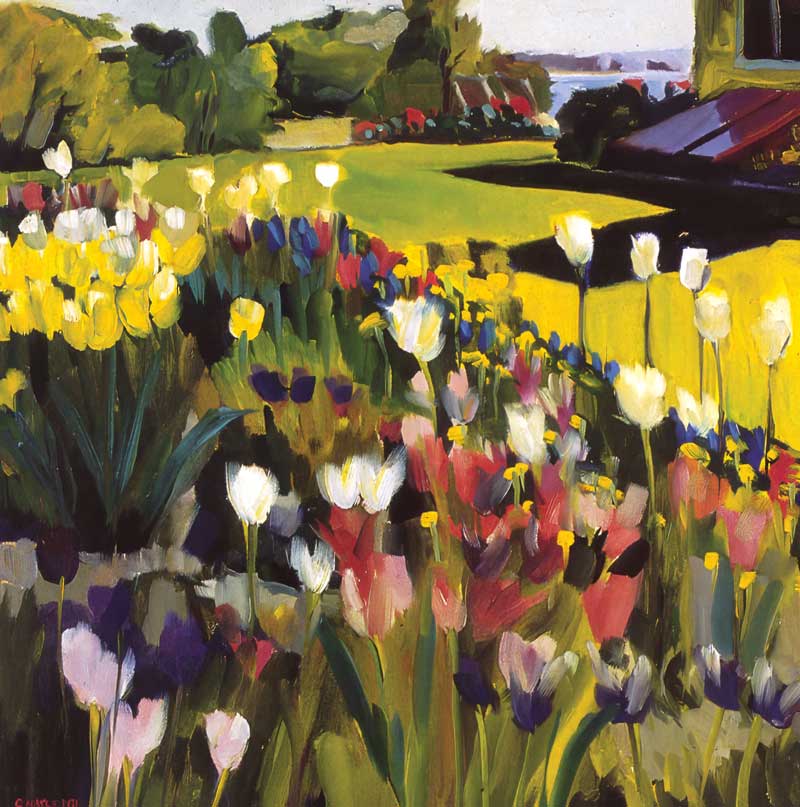
The Borrowed Views project has provided Hayes with extraordinary entrÈe {Jodi: accent on second e} to different worlds, many of them coastal. She traces her fascination with the edge of Maine to childhood camping trips with her family to Small Point in Phippsburg and high-school outings to Popham Beach. She remembers feeling the wildness of the ocean, exploring tide pools, and swimming for hours.
Islesboro, Chebeague, Cliff, Great Diamond, Vinalhaven, Little Cranberry, Monhegan, Deer Isle, North Haven: the archipelago that runs from one end of the coast of Maine to the other has been a rich source of painting material in the years Hayes has been borrowing views. She has made six trips to Vinalhaven, four of them to the same house. “I like that island for its social complexity,” she notes, “and because there’s a compatibility between the lobstering people and the summer folks.”
Some of these places hum with the history of American art, yet it has never bothered Hayes that someone may have painted a place before her. On Monhegan, for example, during her Carina House Fellowship in 1991, she was treading on ground hallowed in the history of American art.
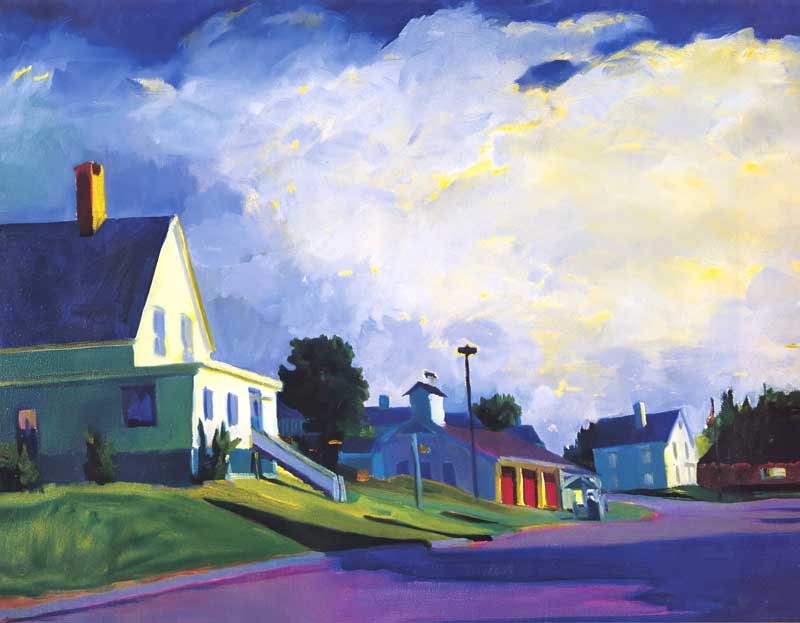
For a Borrowed View in the mid-1990s, Hayes lived in the studio of Winslow Homer at Prout’s Neck. At first, there was a chill in the house; doors would slam upstairs. Once she started to paint, the chill disappeared and the doors stopped slamming, and she felt “a sudden approval by the house spirits.”
Hayes was born and brought up in Gardiner, Maine, that village immortalized in the Tilbury Town poems of E.A. Robinson. She was troubled with eye problems as a child and had an operation at age three to correct a strabismus. Wearing a patch after the operation, she was “the envied pirate on the first day of school at age four.”
“To have my visual discoveries arrested and in limbo at a time when the world was so full of stuff to encounter,” she wrote in a personal essay, “set me up to relish in it forever and more intensely as an adult.” One wonders if the drive she displays in her Borrowed Views project owes something to this early deprivation.
Aside from painting lessons given by a neighbor, Hayes had little exposure to art in her formative years. She likes to point out that the sewing classes that her mother held in the basement of their house helped her develop fine motor skills.
Hayes attended the University of Maine at Orono, where she majored in art. Painter Michael Lewis’s seminars, which explored questions related to art-making, had a lasting impact on her, as did lively art history classes with Vincent Hartgen, who was known to slam his hand on a table when the room grew too quiet. She graduated in 1974 with a degree in art, with minors in education and English.
While teaching art classes in the towns of Waldoboro and Union, Hayes took advantage of a Saturday program offered to junior high and high school students at the Portland School of Art. An administrator suggested that she slip into a class while waiting for her students. She subsequently discovered her soulmates, people committed to making art. She ended up extending her undergraduate studies three years.
In her final year at the school, Hayes was enticed by a visiting artist, John Moore, to attend Tyler School in Philadelphia. She spent the first year painting in Italy, then finished work on her graduate degree in the city of brotherly love.
Hayes worked at the Portland School of Art/Maine College of Art for ten years, going from part-time to full-time and back again (“I probably had four going away parties,” she explains with a smile). Her most recent role at the college was as a member of the search committee for the new president, Christine Vincent.
While her manner of representation springs from a tradition deeply rooted in Maine, Hayes has painted in Spain, Italy, Florida, Vermont, New Hampshire, and New York City, where she lived for six years. She has also been visiting artist at San Francisco State University, Alfred University, and Bowdoin College.
In recent years, Hayes has done a few Borrowed Views in winter, although she admits that white is not her color. She has painted the deep woods around the Sunday River ski resort and a winter portrait of the Blaine House, the Governor of Maine’s mansion in Augusta.
The Borrowed Views project has been something of a marathon. One summer Hayes ended up with a frozen shoulder because she was painting so much. She has found herself foregoing meals to be present for a certain light. She does a lot of yoga and considers a weekly visit with a massage therapist part of her budget for painting supplies.
Nowadays, Hayes does between seven and ten Borrowed Views each year. She continues to get a kick out of setting up temporary quarters in some of the loveliest spots in the country. The “Borrowed Views Club,” as she calls her circle of patrons, grows steadily. The home owners, she says, look upon her as having the gift of creativity. She, in turn, sees them as having given her “the gift of access to a place very private.”
This not-grand island is a family and community treasure. In the introduction to Curry’s book of Chatto Island paintings, nature writer Terry Tempest Williams notes, “Curry’s gift to us is always the return, the return to the island.” Returning to Chatto, again and again and whether visually or by oar or paddle, is indeed a gift, for all of us.
✮
Contributing editor Carl Little organized the exhibition of contemporary marine artists currently at the Penobscot Marine Museum in Searsport, Maine.