

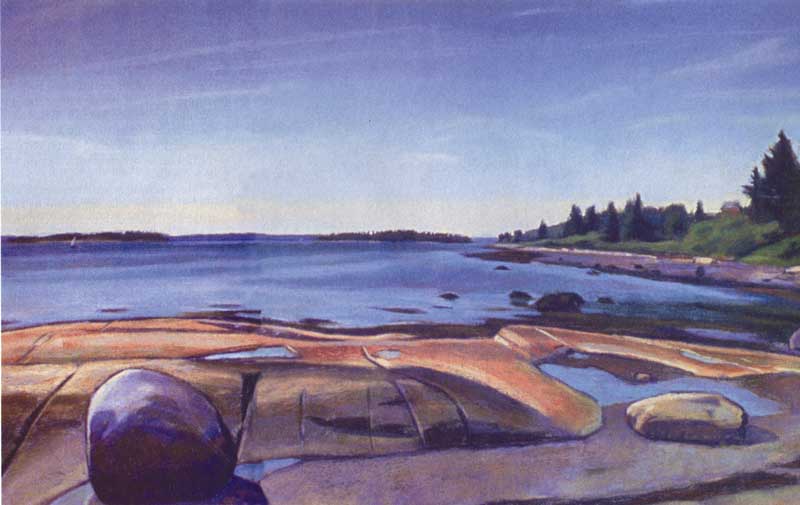
A Boston artist moves to Maine, discovers the power of the coastal landscape, and becomes energized as he never was before. His pastels are infused with color, brightness and light.
When When Tom Curry, a tall, thin man, is not directly involved in his art, he is constantly on the move; his thoughts dart around, his sentences are often clipped, his fingers fidget. But at work his energy is harnessed. Then, whether he is alone with his easel in the middle of a Maine landscape, or in his studio teaching an evening course to a roomful of students who have become infected and inspired by his passion, he is totally focused, totally absorbed, totally engrossed.
Curry was raised in the eastern states by a father who was a corporate manager and a mother who was a Montessori teacher. He was not academically gifted.
“About the only thing I could ever do was draw,” Curry says of his school days.
After a year at prep school studying English, history and the classics, Curry was accepted at the Rhode Island School of Design (RISD).
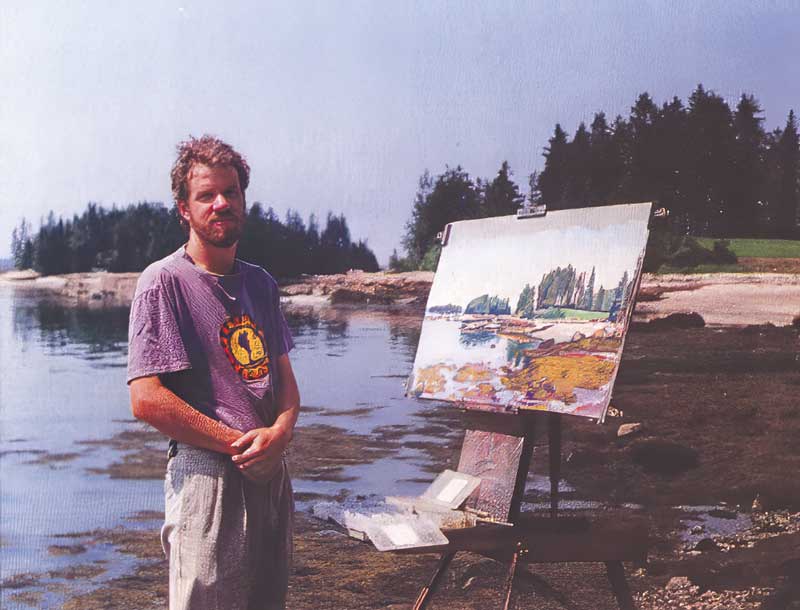
Curry flourished in the RISD environment, first majoring in sculpture and then switching to painting in his sophomore year. Graduating in 1981, he was accepted into graduate school at Yale University. “I lasted three or four weeks at Yale,” Curry says. “They wanted to rip me up and rebuild me to their design. It had taken me 10 years to get where I was, and I didn’t want to go back and do it the ‘Yale Way’, so I quit. I sold all my possessions, cashed in all my savings, and went to Hawaii for six months.”
In Hawaii, Curry turned to landscape painting; he was without a studio and was forced to paint from nature. Eventually the money ran out, and six months later he was back east. He rented a loft in a poor Boston neighborhood, and became a fulltime artist. He painted figures, all day, every day. He trailed his work in and out of galleries. No one was interested. It seemed he had “no gimmick, was doing nothing different.”
“If I’d been a doctor or a banker,” Curry says, “and I’d put that much into my work, I’d have been a wealthy man. But if your business is art: it doesn’t quite pan out like that. I painted myself down into nothing.”
In the end Curry was saved, at least financially, by computer technology. “I was teaching at the Cambridge Center,” he says, “and met a woman who was a computer illustrator of children’s books. She offered me a job, with training, and that led to another job and then another. Eventually I started out on my own creating computer graphics. It paid the bills and allowed me to keep working as an artist.”
By the early 1990s Tom was married and living with his wife, Kimberly, in Somerville, Massachusetts. Then Kimberly was offered a job as a magazine editor in Brooklin, Maine.
“Brooklin may as well have been the end of the earth,” Curry says, “it was so far from the world of computers and all my art contacts. I didn’t want to go, but we did it. We packed up and moved north.”
“This place is incredible;” Curry says. “We’ve been here three years, and I still can’t believe how gorgeous it is. It’s beyond me: It’s serene but disheveled; it’s not overly organized; it’s raw. Before we came here, I was trying to paint landscapes in the city. I was driving out to Mt. Auburn Cemetery, but it lacks depth so my paintings were shallow. When we arrived up here, it was like someone took the shades off the window and I could see out, I could breathe... I needed to breathe.”
Since moving to Maine Curry’s work has been primarily landscapes in pastels. “I enjoy the medium’s immediacy,” he says. “It allows me to capture the ever changing colors.”
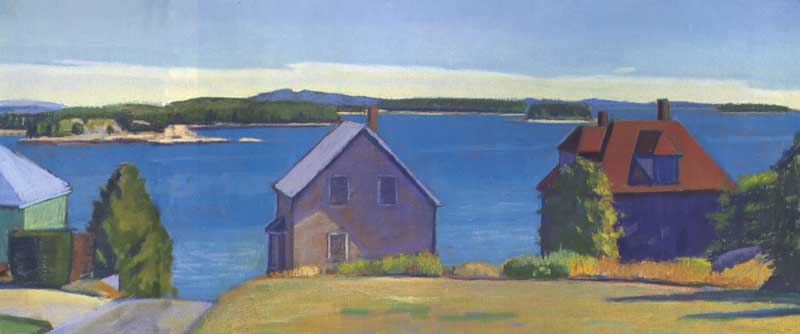
Tom Curry is energized by his surroundings, by the geology, the water, the changing seasons and the light. “I love the light,” he says, “the way light comes through things, making them bright. When I work, I try to capture that brightness.”
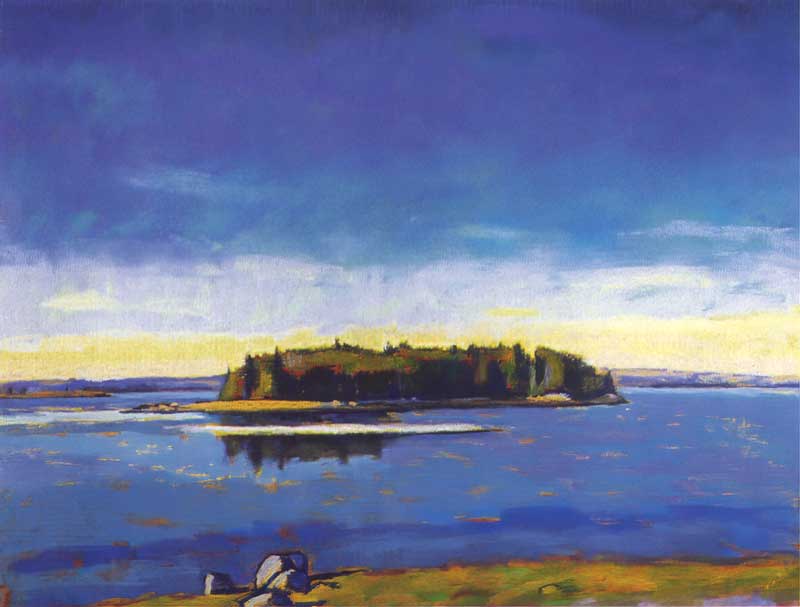
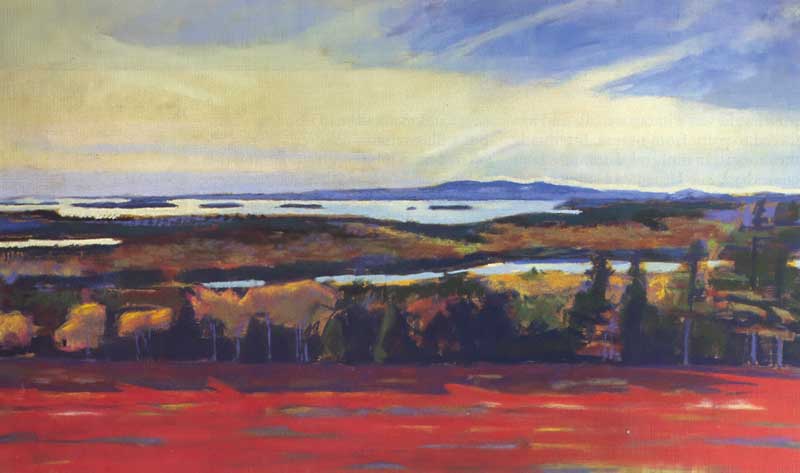
Given Curry’s frenetic character, his passion for brightness, it is wholly appropriate that he has chosen to work in pastels. “They’re not like watercolors,” he says. “With pastels every color has to ‘zing’ off the paper. On the whole, what I’m doing isn’t very fashionable. I charge my work with color; my style of expressionism is filled with exuberance. I find the language of color to be wonderfully intuitive. With pastels you can use the marks of the sticks to echo textures, and the colors can be blended to evoke the humidity of the air, the reflection of sunlight on Eggemoggin Reach, the stillness of the evening.”
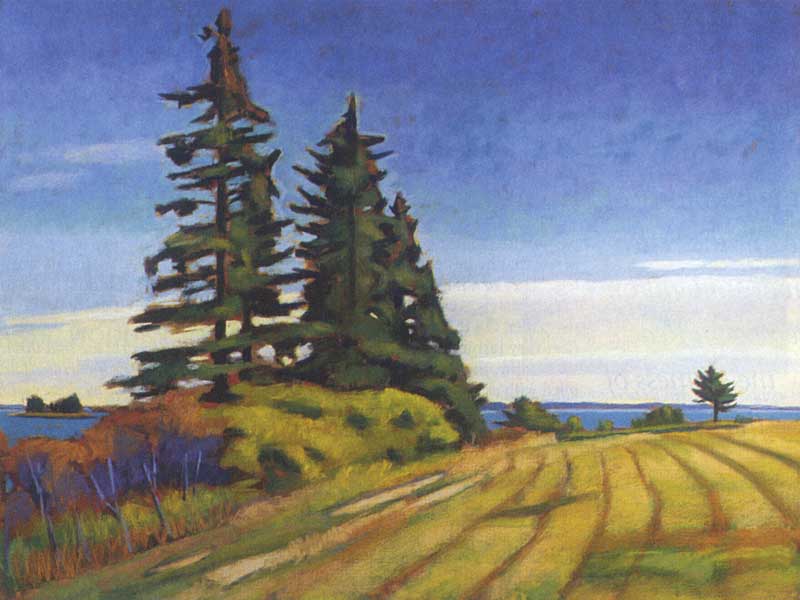
Like all artists using one medium more than any other, Curry has developed something of his own technique for pastels. “I adapted it from studying Italian master painting when I was doing a European honors program in Rome,” he says. “I start by drawing my piece in complementary colors-orange for the sky, red for the grass-before layering the actual color. Take the blueberry barrens in the fall when they’re bright red: Your final color is going to be warm, so you start with warm-colored paper, maybe brown. Then you draw the barrens in cool colors -greens, blues-and you finish with the actual colors. But you don’t completely cover the cool tones; you let the under colors shine through and by doing that the picture is charged with light.”
To look at an original of Curry’s work is to drown in a landscape so familiar it is like an old friend, yet its presentation is so rare it’s as though you are seeing that landscape for the first time. One’s first sight of low autumn sunlight dancing on the waves of a Maine cove is enough to knock the wind out of your lungs, its beauty is so intense. There is not a photograph yet taken that can produce that overwhelming emotion, but a Tom Curry original will do it every time.
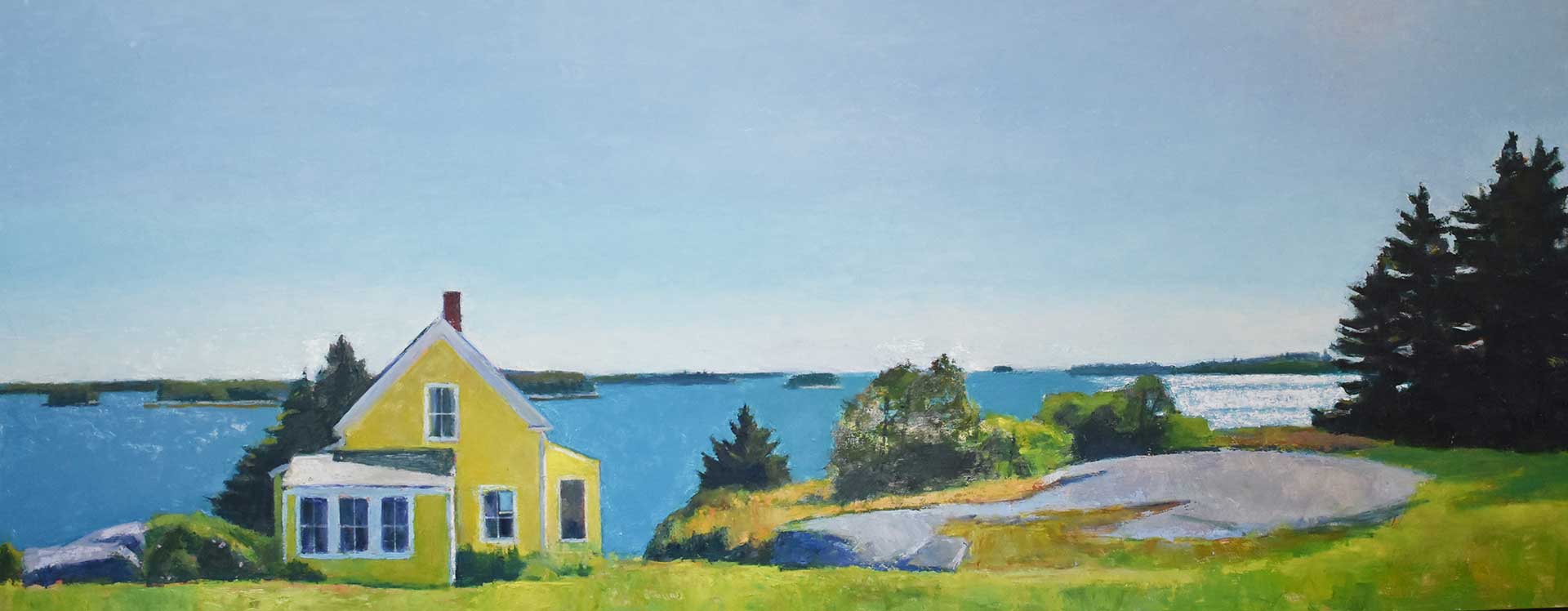
Tom Curry’s works are sold through the Leighton Gallery, Blue Hill, Maine. Curry teaches evening pastel classes for beginners during the winter; this fall he will be offering a weekend pastel workshop in his studio, September 17-19, 1999. Tom Curry, Reach Road, Brooklin, ME 04616; e-mail: curry@hypernet.com.
Having lived in Brooklin, Maine, for three years, Jenny Bennett returned to her native England in 1998 and is now editor of the magazine Maritime Life and Traditions.