

This landscape artist has roamed the state of Maine, along the coast and inland, creating paintings that are memorable for their gentleness, impressionistic stillness, and quietude.
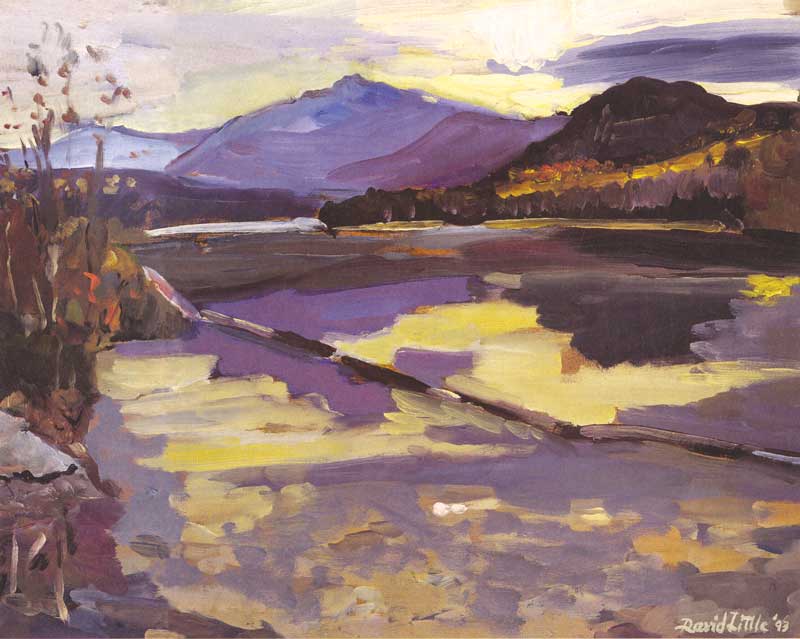
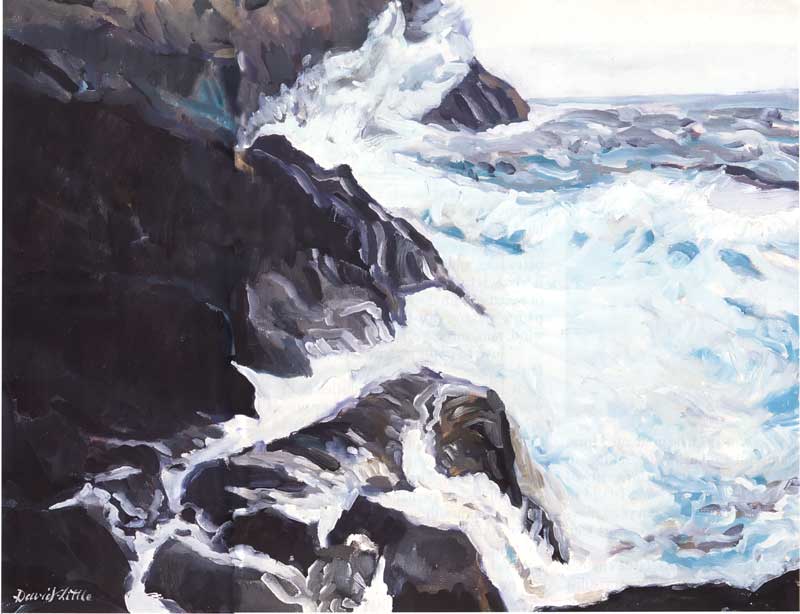
When I visited painter David Little in his Portland studio back in July 1998, he had Just returned from five weeks on Monhegan Island, and the elemental forces of that mighty little island seemed still to have him in their thrall. Though he did not want to talk about the intense experience of self and nature he had had on the island, I could almost see the residual sunlight and fog, wind and rain, rock and surf, isolation and loneliness in his artist eyes.
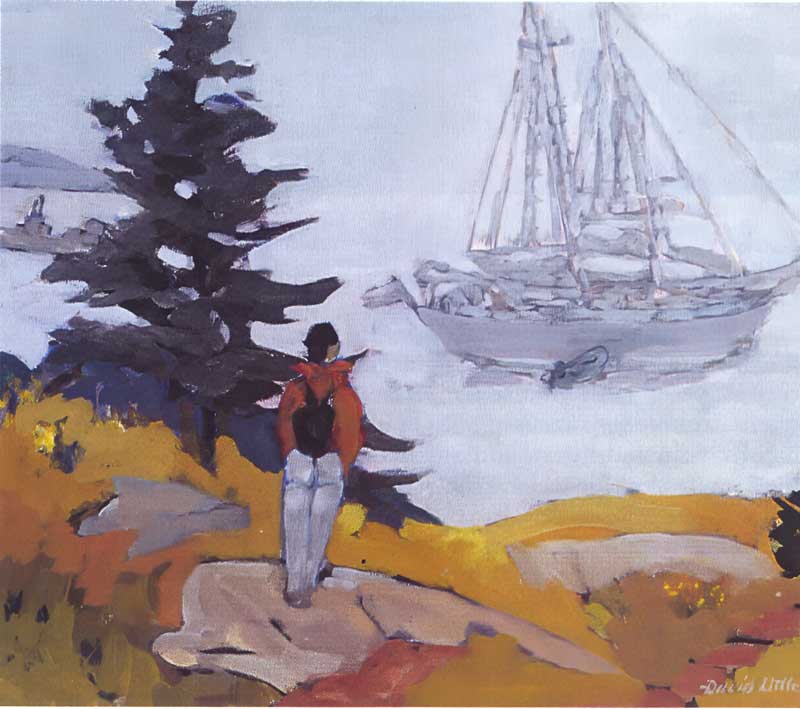
One of the recipients of this year’s Carina House residency grants-which enable artists to spend time working on Monhegan, a well-established summer art colony now financially out of the reach of most working artists—Little spent long days alone wandering the island from Blackhead to Gull Rock, Lobster Cove to Fish Beach, painting scenes that have been painted a hundred times over by such Monhegan masters as George Bellows, Robert Henri, Rockwell Kent and others.
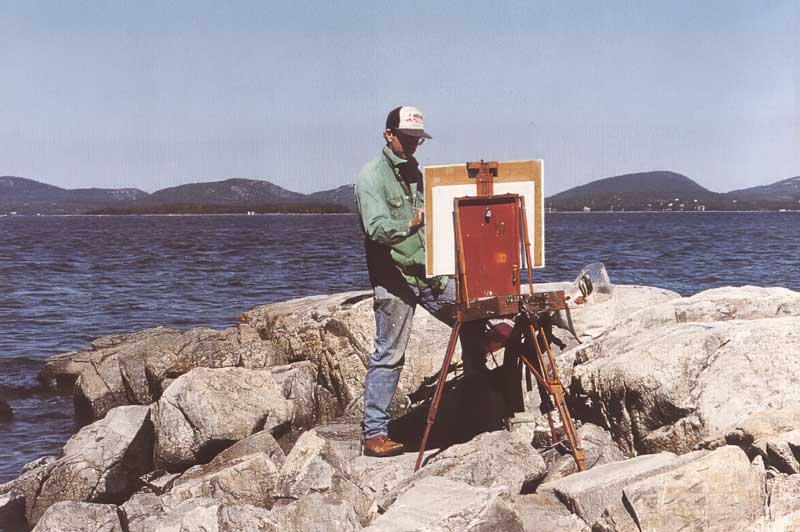
At 47, David Little is a soft-spoken, very private man with a boyish, narrow face accentuated by a well-clipped mustache and goatee. A soldier in the army of Maine landscape painters, his paintings of the Maine coast and interior woodlands are distinguished by their quietude, their gentleness, their peacefulness.
“I look for small, intimate subjects,” Little says.
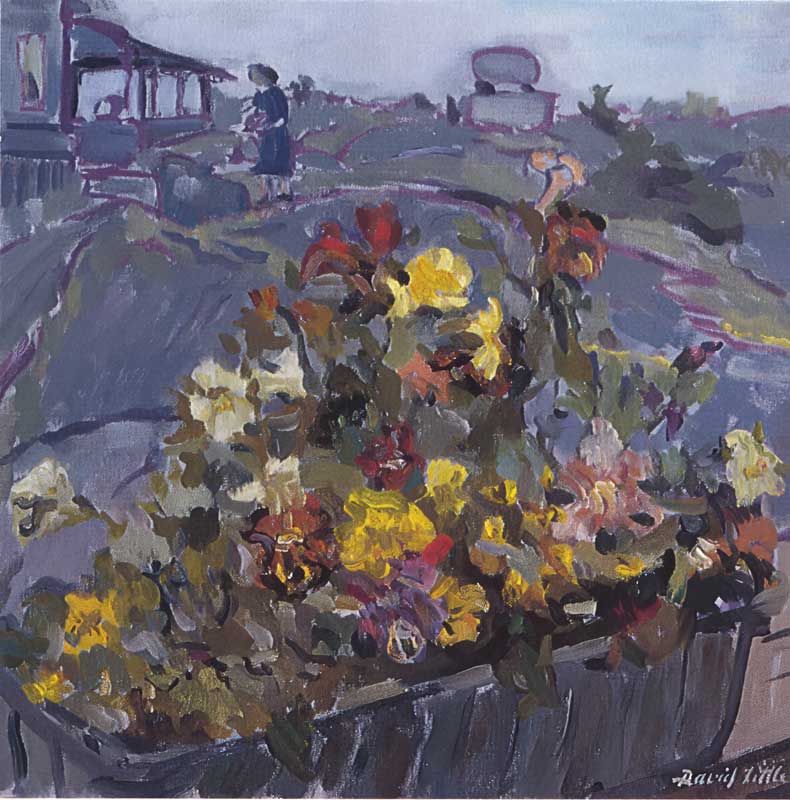
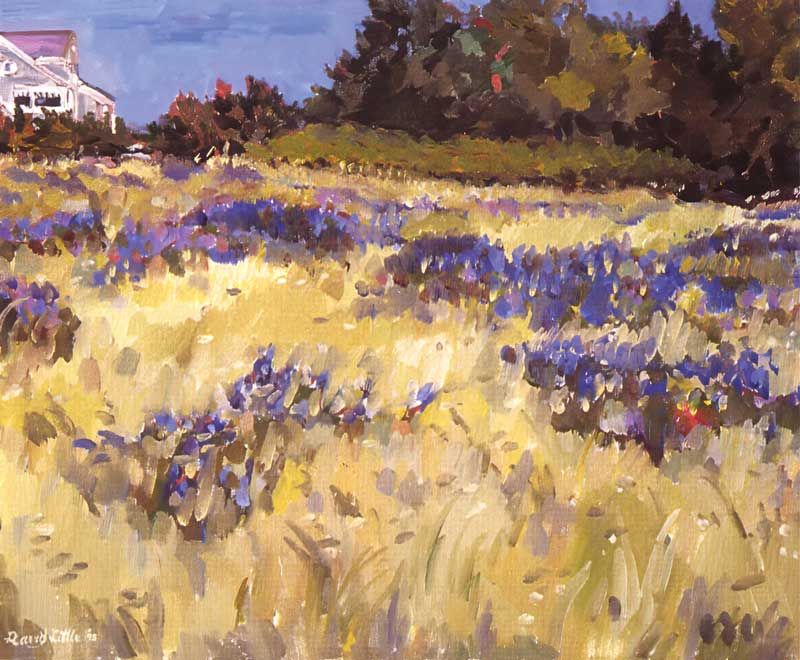
Where others find elemental drama in the landscape, the large forces of nature in conflict, David Little’s Maine is measured out in harmonious sweeps of hillside and harbor, field and forest. Looking upon their impressionistic stillness, however, it is difficult to imagine how hard Little has worked at developing his mature, contemplative style and virtually impossible to detect the stylistic and technical influences that have enabled him to tame the wilds of Maine with his brush.
David Little first saw Maine in 1978 when he drove his uncle, the painter William Kienbusch, from New York City to Kienbusch’s summer cottage on Cranberry Isle. One of the few Maine painters to preserve an abstract impulse in the face of Maine’s overpowering realism, Kienbusch was one of his nephew’s earliest role models. When Uncle Bill died in 1980, he left his island cottage to David and his brother, the poet and art critic Carl Little.
Though he now seems to have absorbed the Maine landscape into the marrow of his being, Little is, in fact, a New Yorker born and bred. He grew up in Manhattan and spent summers on Long Island where, in 1974, he graduated from Southampton College. After taking an M.A. and an M.F.A. at the University of Iowa, Little returned to Long Island in 1976 and spent the next dozen years moving back and forth between New York City and Long Island.
During his student days, Little’s heroes were not landscape painters but surrealist and abstract artists such as Yves Tan guy, Salvador Dali, Joan Miro, Wassily Kandinsky and Paul Klee. He began to gravitate toward landscape, however, while working at the Metropolitan Museum of Art bookstore from 1981 to 1984. At the Met, Little saw major exhibitions by such European giants as Edouard Manet, Claude Monet, and Vincent Van Gogh, and by such past American landscape masters as George Inness, John F. Kensett, and Charles Burchfield.
Little says, however, that paramount in his education and development as a landscape artist were the two successive summers, 1981 and 1982, that he spent painting and studying at the Skowhegan School of Painting & Sculpture on Lake Wesserunsett. There, Little confirmed his vocation as a landscape artist; the following year he published a “Field Guide for Landscape Painters,” which detailed landscape motifs in the central Maine area for future Skowhegan students.
Having split his time between New York and Maine during much of the 1980s, Little moved to Portland in 1988 with his wife, Mikki. There, he put his three-years’ expertise as the registrar at the Terry Dintenfass Gallery in New York into service as the assistant manager of the Pine Tree Shop and Bayview Gallery in Portland, and began exploring the landscape of Maine in earnest.
From a home base in Portland, where he maintains a spacious barn-loft studio, Little has ranged widely across the state, painting and exploring the greater Portland area and points north and east to Bethel, Rangeley, Shin Pond, the Cranberry Isles, and Monhegan. His endeavor, it seems, is to balance the natural elements of a picture with the aesthetic dynamics of paint, making oils behave as sun, fog, wind, rain, snow, ice, land, and sea. “I love to paint inclement weather,” Little says.
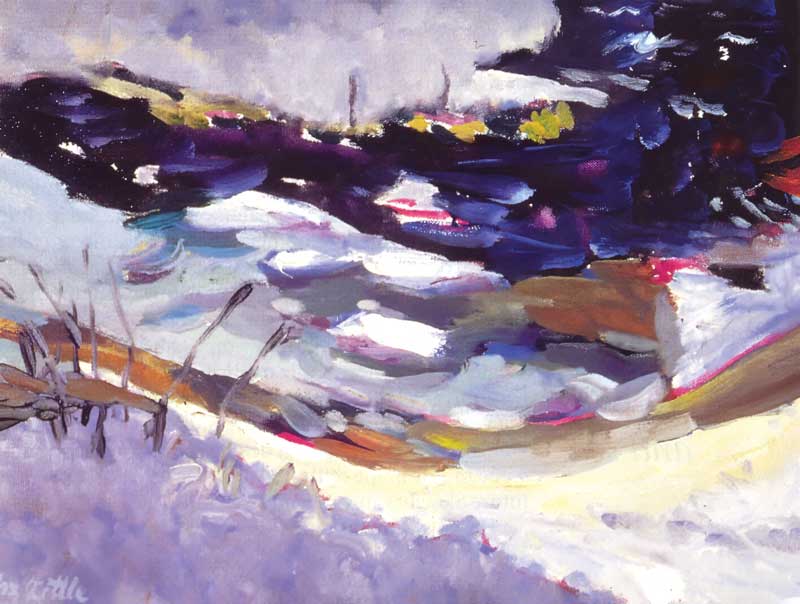
It is in the chromatic subtleties of weather that David Little excels. His paintings, for instance, will pick up on the fact that the sunny side of a Maine coastal fog has a green tinge, while the shady side has a cool blue to it. Though he is red-green color blind-or perhaps because he ishe has a unique, though subdued sense of color. A unifying factor in many of his paintings is a soft lilac undertone that seems at once artistic license and subliminal perception.
Most of Little’s landscapes are executed in short dabs and strokes that owe a great deal to the six years he spent studying Chinese calligraphy in New York with Professor Leon Chang. He has, in fact, created paintings that are all about the brush strokes, landscapes in which Little has disciplined himself to use every color on his palette in every area of the canvas. In the past few years, David Little has become a close friend of Christopher Huntington, another landscape painter. Under Huntington’s influence, Little has discovered the art of the modernist Carl Sprinchorn, and together Little and Huntington have painted a great deal around Shin Pond and Patten where Sprinchorn lived and worked in the 1930s, 40s, and 50s.
The Huntington-Sprinchorn influence translates as greater vigor and bolder compositions in some of Little’s most recent paintings, but then that may just be Monhegan Island asserting itself in the gentle art of David Little.
Edgar Allen Beem is a freelance writer. David Little’s work can be seen at the Bayview Gallery, Camden and Portland.