

Happy Sails
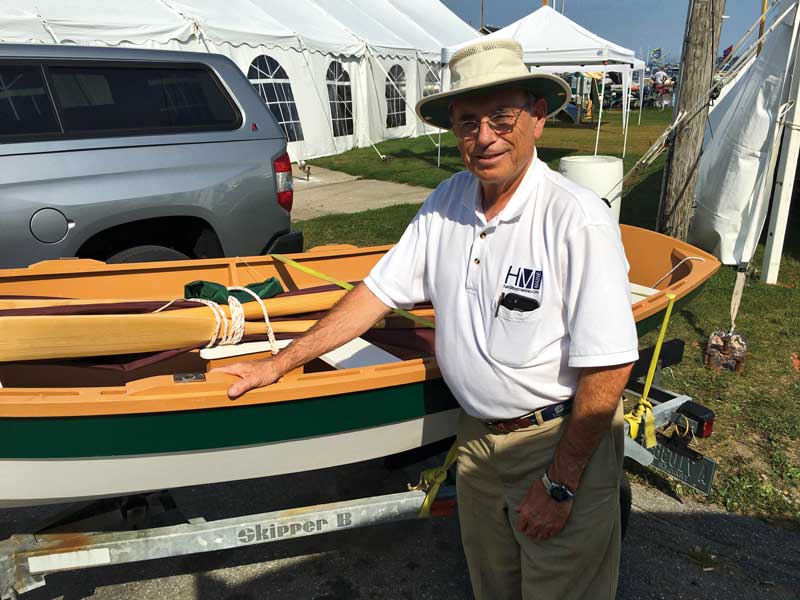
After 40 years overseeing activity on the Searsport waterfront, Wayne Hamilton has stepped down as harbormaster. The longest serving harbormaster in the state, he was honored by the State of Maine Harbor Masters Association with two awards. One, accompanied by a brass bell mounted to a plaque, made him a life member of the association, the other established a new award in his name.
“The Wayne Hamilton Lifetime Achievement Award recognizes an individual’s sustained commitment to the maritime community, safe navigation, stewardship of Maine’s harbors, and support of the Maine Harbor Masters Association,” the award plaque states. “Recipients of this award embody and exemplify Wayne Hamilton’s legacy as a founder of the Association.”
A man of few words, Hamilton said he was awed by the honors.
“It was great. I didn’t expect it.”
Hamilton, who served as Searsport’s harbormaster from 1985-2025, helped start the association in his first year on the job. Concerned that the state was trying to draft one-size-fits-all laws regulating harbors, Hamilton wanted to find a way to promote local control. He remains active with the association, teaching classes on mooring setting and rigging.
Hamilton, who for many years also transported harbor pilots out to ships transiting Penobscot Bay, retired from that job a few years ago.
When asked what’s next, the founder and owner of the Hamilton Marine ship chandlery replied succinctly “work.”
But keeping Wayne off the water is not an option. He remains a familiar sight on the bay in his Wesmac Cilloway (an amalgamation of the names of his former basset hound Cindy, his late wife Loraine, and Wayne).
Congratulations, Wayne. You are a true champion of the waterfront.
Underwater AI center
A new tidal power project being proposed off Eastport would include an underwater artificial intelligence data storage center. Along with planning to provide electricity to local communities, the company, DeepGreen Western Passage SPV LLC, is seeking to power AI computer server racks, according to stories in the Quoddy Tides and Portland Press Herald newspapers.
The company has submitted an application to the Federal Energy Regulatory Commission for preliminary work on a 51-megawatt tidal energy and subsea data center in Eastport’s Western Passage. The company is seeking a 48-month permit to conduct environmental baseline studies and engineering work, according to the news outlets.
The project as proposed would include 170 marine hydrokinetic turbines hooked up to 34 modular, air-tight computing pods via standardized docking cradles. Those cradles would be universal in their size and shape, meaning third-party turbines could be attached with relative ease—slipping in like plugs into an electrical wall socket, according to the Press Herald. The idea is to harness both the immense energy of the tide and the cool Atlantic water to address two of the biggest challenges with data centers: their electricity consumption and cooling needs.
The project, estimated to cost $415 million, would be financed initially through the company’s cash reserves and as-yet unsecured private equity, according to the application. The project also would seek federal tax credits through the Inflation Reduction Act.
While Microsoft piloted underwater data centers a decade ago off Scotland, the company, which pulled its model up after two years, has not announced follow-up plans for similar projects, according to the Press Herald.
Experts interviewed by the Portland paper said DeepGreen’s application lacks many details and that its success depends on undetermined technology.
New Hood LM in the works
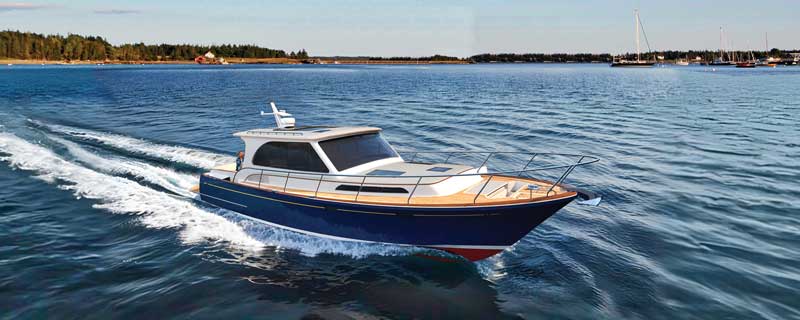
Lyman-Morse Boatbuilding Co. is expanding its acclaimed LM Series with the addition of an all-new Hood 46 LM, designed in partnership with Chris Hood of CW Hood Yachts.
Positioned between the Hood 42 LM and the Hood 57 LM, the 46 is designed to deliver New England styling, advanced composite construction, and refined
performance—while introducing a fresh platform tailored to the expectations of today’s owners. With construction now underway, the Hood 46 LM reinforces Lyman-Morse’s commitment to building bespoke yachts that blend heritage design with contemporary capability.
Seaweed string
Seaweed is showing up in all sorts of products these days as businesses seek to promote environmentally friendly gear.
Take Viable Gear, a 2021 Portland-based startup. According to a recent story in Mainebiz, the company is preparing to introduce a seaweed-based agricultural twine. Designed as an eco-friendly alternative to petroleum-based plastic trellising and crop twine, SeaTwine is engineered to offer durability, water resistance, and handling performance, according to the story.
“In terms of durability, our material performs on par with conventional plastic during use,” Katie Weiler, the company’s founder and CEO, told Mainebiz. “It is hydrophobic, meaning it resists water absorption and degradation in wet conditions. This sets it apart from natural fiber alternatives like hemp, jute, and sisal, which can weaken or rot over the course of a growing season.”
The company is among 12 Maine startups chosen for the next cohort of the Dirigo Labs accelerator program in Waterville.
The company is sourcing much of its seaweed from South Africa and Panama but hopes to use Maine and/or U.S.-based seaweeds at some point.
Weiler said the company is initially targeting vegetable and fruit farmers with direct-to-consumer sales. “Our next phase will be to start selling with distributors like farming and gardening supply stores to get SeaTwine on their shelves,” she said.
String dress
Speaking of string, you’ve heard of string bikinis. Now along comes a string dress—but not one made out of seaweed twine. This one was fashioned from abandoned fishing ropes, and it received a high-profile boost at the Fishermen’s Forum in Rockland last March.
Conservation groups and others have been working diligently to remove millions of feet of abandoned fishing lines and gear from the Maine seafloor for several years. Jordan Hudson, best known as former Patriots coach Bill Belichick’s much younger girlfriend, added a touch of glamor to the effort when she wore a rather skimpy dress fashioned from 36 pounds of abandoned fishing line to a dinner at the forum. Hudson, whose father fishes for lobster, posted a photo of herself wearing the backless halter-neck dress on her Instagram account, telling her followers that she hoped “to elicit conversation about the Gulf of Maine’s sexiest problem, ghost gear, aka abandoned, lost, or discarded fishing equipment.”
Ghost gear, including lengths of rope, nets and parts of lobster traps and buoys, is one of the main sources of marine debris worldwide, according to the National Oceanic and Atmospheric Administration.
According to a story in the Midcoast Villager, the dress was a collaboration between marine conservation nonprofit Rozalia Project and environmentalist fashion designer Runa Ray. Ray wanted to show the effect of marine debris on the ocean and showcase the cleanup work done by Rozalia Project.
Hudson found out about the dress when she saw it on display at a booth at the Fishermen’s Forum, and was happy to tie it on.
Lobster trap removal
The effort to clean up old traps and gear isn’t just confined to the ocean bottom. Last spring on Vinalhaven, volunteers and local fishermen worked with the non-profit OceansWide to collect 3,251 old traps that were scattered around the island. According to a release from OceansWide, island fishermen have estimated there may be as many as 60,000 old traps scattered across the island, some sitting in fields, others that have been there so long trees have grown through them. The recovered traps, which weighed a total of 104 tons, were hauled to the mainland to be recycled.
Over the past five years, OceansWide has removed more than 22,500 lobster traps total; 17,000 were end-of-life traps from land, and 5,500 were lost traps from the seafloor.
Eel farm shuts down
American Unagi—the first-of-its-kind aquaculture business that grew elvers into full-sized eels—has closed its doors after filing for bankruptcy last fall.
The Waldoboro-based business remained open over the winter while looking for a buyer. But no one stepped up. About a dozen fisherman who netted glass eels for the company last spring are owed thousands of dollars each, according to a story in the Portland Press Herald.
Maine Community Bank, which provided the business $5.5 million in credit secured by $12.5 million in assets, purchased those assets in late December using $1 million of its incurred debt, the newspaper reported.
“The bank is working toward a sale of the facility and has several interested parties,” a spokesperson for the bank told the newspaper.
Sara Rademaker started the company in 2014, seeking to grow tiny elvers harvested in Maine to maturity here rather than shipping them to Asia. The business began in her basement and expanded to a new $10 million facility in Waldoboro in 2022.
Maine is one of two states with a baby eel (also known as elver or glass eel) fishery. The elver fishery was the state’s sixth most lucrative in 2025.
Winning tall ships
The educational non-profit Sailing Ships Maine, based in Portland, has won two major national awards, according to a news release from Tall Ships America and the American Sail Training Association.
Sailing Ships Maine Senior Captain Anna Maria Hansen has been named the U.S. Young Sail Trainer of the Year, and Sailing Ships Maine, the program she leads, was named the U.S. Sea Education Program of the Year.
Hansen has sailed four seasons with Sailing Ships Maine, two as captain and two as mate prior to earning her USCG Captain’s license.
Sailing Ships Maine, which partners with high schools and nonprofits, was selected specifically for its partnerships with Brunswick, Maine-based Seeds of Independence and Providence, Rhode Island’s MET High School.
Ring the bell
Fifty years after the fog bell disappeared from Camden’s Curtis Island lighthouse, townspeople are looking forward to getting it back as part of ongoing efforts to restore the historic structure.
The bell, which had been installed in 1886 and was rung by hand until it was electrified in 1935, disappeared in 1970 when the Coast Guard decommissioned the light station, according to a story in the online Penbay Pilot. In 2023 when the town began talking about restoring the historic lighthouse, members of the Curtis Island Lighthouse Foundation began looking for the bell. Eventually they found it displayed on the grounds of the Deer Isle-Stonington Historical Society. But getting it back proved complicated.
The Historical Society trustees agreed to swap their bell for one at Camden town landing that was on perpetual loan from the Coast Guard. But the Coast Guard would not agree to convert that loan to a donation for Deer Isle, according to the Pilot story. After everyone went back to the drawing board, the historical society trustees voted to return the Curtis Island Bell to Camden without asking for any bell in return.
“The world needs people looking out for each other. That is the only way to get anything done,” Deer Island historical society president Susan Greenlaw said, according to the news outlet.
If all goes as planned, the bell is scheduled to be re-installed on Curtis Island this summer.
Grants support innovation
Two marine-focused businesses downeast were among the recipients of $25 million in interest-free loans recently from the Maine Technology Institute’s Technology Asset Fund. Businesses provide a match for the loans, which can be partially forgiven based on financial results, according to the institute.
Bold Coast Seafood, a seafood startup at the site of the former Prospect Harbor sardine cannery, received a $1.25 million loan to invest in infrastructure needed to buy, process and sell Jonah crabmeat. The award required a $2.25 million match. The 100,000-square-foot facility on 13 acres has a deep-water dock, buying station, refrigerated tanks, a processing floor, loading bays for tractor-trailers, office space, and a research lab. The company has 20 employees.
Brooklin Boat Yard received a $1.5 million loan to add more room for 3D printing, mixing wood and composite material, and for continuing to develop that technology. The yard employs 65 people building custom high-end vessels and servicing about 160 more.
“I think I can honestly say that we’re the best yard in the world” in how it integrates wood and carbon fiber composites, said chief designer Will Sturdy. “There’s literally nobody else doing what we’re doing here.”
With a new 7,520-square-foot building replacing a 1960s-era metal shed, the yard will have room for more building, restoration, and service projects. The facility will also include a machine workshop and 3D printing workshop with space for composite projects. Brooklin Boat Yard hopes to open it next year.
PETA 0, Lobster Festival 1
Efforts by the animal rights group People for the Ethical Treatment of Animals to shut down the Maine Lobster Festival have hit a dead end.
A state judge dismissed a lawsuit filed last summer by the animal rights group that sought to stop the steaming of live lobsters at the Rockland-based event, according to the Midcoast Villager.
PETA had argued that members had to avoid the festival to avoid the trauma of seeing live animals being steamed to death. The organization also argued that steaming live lobsters constitutes animal abuse.
Suit filed over horseshoe crabs
The Center for Biological Diversity has sued NOAA Fisheries after the agency missed its deadline for responding to a petition to list horseshoe crabs under the Endangered Species Act.
The conservation group claims populations of horseshoe crabs have declined by more than 70 percent in recent decades due to overharvesting and habitat loss. The invertebrates are valued by the biomedical industry for their unique blood, which clots when exposed to biotoxins. Conservation groups would like the medical industry to switch to using synthetic alternatives.
In 2024, the center, along with some two dozen conservation groups, petitioned NOAA to list the horseshoe crabs as endangered and to designate critical habitat for the species.
A 90-day initial finding on the petition was due in May 2024; however, no finding has been issued to date.
The lawsuit asks the court to force the agency to finally complete the filing.
“Horseshoe crabs have saved so many people, and now it’s up to us to pay back that debt and save them,” CBD Senior Scientist Will Harlan said in a release.
Maine’s most valuable fisheries
While lobster remained Maine’s most valuable fishery in 2025, overall landings of the crustacean continue to decline, according to preliminary data from the Maine Department of Marine Resources.
Overall, Maine’s commercial fisheries harvesters earned $619 million in 2025, which was the 14th consecutive year commercial fishery earnings surpassed $500 million.
Maine lobstermen landed 78.8 million pounds in 2025, with an overall landed value of $461 million on the strength of a $5.85 per pound boat price, which is the third highest boat price on record. However, while the boat price and overall value for lobster remained relatively high, inflation took a toll. “When adjusting for inflation, the overall value of lobster in 2025 was more in line with the value earned in 2008,” said DMR Commissioner Carl Wilson.
According to DMR, Maine lobster harvesters took over 21,000 fewer fishing trips in 2025 than in 2024, a nearly 10-percent decline in fishing effort. “This combination of factors likely contributed to the decline from 2024 to 2025 in the lobster harvest of more than eight million pounds and a decrease in the overall value of more than $75 million, Wilson said.
Maine’s softshell clam fishery was again the state’s second most valuable with an overall value of $21.6 million, a jump of nearly $6 million over 2024. Maine clammers increased their harvest and saw an increase in price at the dock. Atlantic menhaden, a favorite bait for lobster harvesters, was the state’s third most valuable fishery in 2025, earning fishermen $18.9 million, an increase of more than $5 million over 2024. Landings in the fishery jumped from 26.7 million pounds in 2024 to 31.4 million pounds in 2025. Oysters were the fourth most valuable at $16.2 million. Scallops came in fifth, earning both fishermen and aquaculturists $9.3 million. Elver fishmen harvested 7,797 pounds of baby eels and earned $6.9 million, placing the fishery in sixth place.
Lobster fishing game
So you want to go lobster fishing but don’t have a boat or a license? A new board game in development promises to let you experience the ups and downs of the fishery without ever leaving your living room. Corker, a new board game inspired by Maine’s lobster fishing industry and coastal communities, held its first public playtest recently in Vinalhaven, according to a story in the online Penbay Pilot.
The game puts players in the role of lobstermen placing and hauling traps, with gameplay shaped by harbor locations, shifting lobster prices, and the rhythms of a fishing season. For the game’s creators, holding the first public playtest on Vinalhaven was especially meaningful because the game draws heavily from the culture and working life of Penobscot Bay, according to Cindy Wren of Anchor Point Games. Corker’s creators, including Wren and Greg Birgfeld, continue refining the game and planning future events. Feedback from players at the Vinalhaven event will help shape the next phase of design.
Right whale baby boom
The population of endangered North Atlantic right whales got a small boost this spring as researchers have identified 22 calves born by mid-March. The right whale calving season begins in mid-November and runs through mid-April, according to NOAA.
Every female North Atlantic right whale and calf is vital to this endangered species’ recovery, NOAA staff wrote in a release. Since 2017, the whales have been experiencing what scientist refer to as an “unusual mortality event,” which has resulted in more than 20 percent of the population being sick, injured, or killed. The primary causes are entanglement in fishing gear and vessel strikes. In the last decade, there have been more North Atlantic right whale deaths than births.
Measures to protect the whales have been hotly debated. Conservationists have argued for more stringent measures, including restrictions on fishing gear and vessel movement, while many fishermen and other commercial operators have contended that they are being unfairly targeted.
Ice Follies
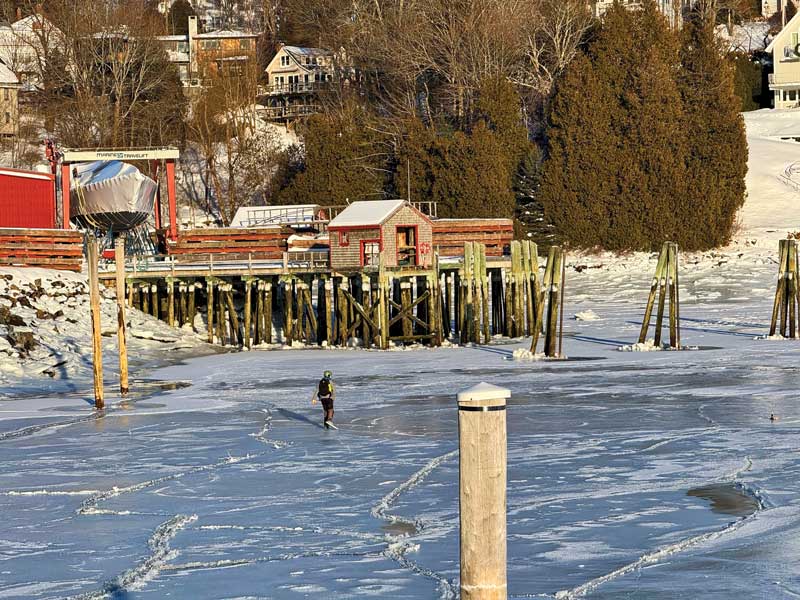
It’s not every winter that you can carve a shortcut across Rockport Harbor, but those
who shivered through the long and very cold season know that 2026 was a doozy.
✮

An Exhibition Celebrating Art & Furniture in Freeport
Thos. Moser, Handmade American Furniture, will host “Dedicated to Art: The Artists of Maine Boats, Homes & Harbors,” a summer-long exhibition at its Freeport showroom. More than a gallery setting, the exhibition places paintings and prints together with handmade wooden furniture, offering a view of how art and objects might live together in the home. As part of the company’s ongoing program of showcasing Maine art, the exhibition features work from more than 20 artists profiled in Maine Boats, Homes & Harbors magazine over the past two decades, allowing visitors to experience the artwork in a setting where it can be understood as part of everyday life. Visitors will be able to link directly to the original magazine profiles for each artist, many of which were written by Maine author, artist, and longtime contributing editor, Carl Little, who plans to attend the opening reception. A public opening reception will be held in the showroom at 149 Main St. on Thursday, June 4, from 6 to 8 p.m. The collected works will be on display through October 31. More information can be found at maineboats.com.