
For Stephen Florimbi, painting has always been a means—“a process”—to fill a certain need in his life. Over the years, he has turned to brush and canvas as a release from stress and as a balance to the sometimes repetitive and planned woodworking he has been involved in for much of his life.
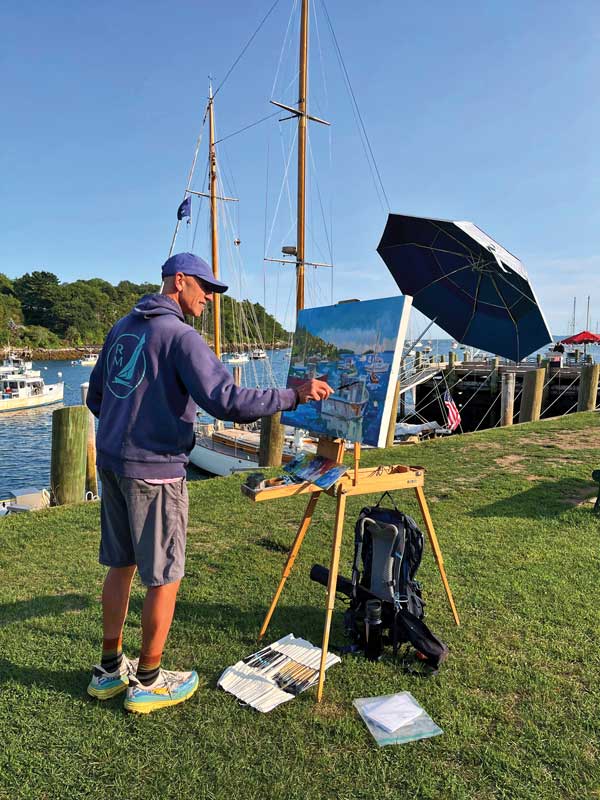
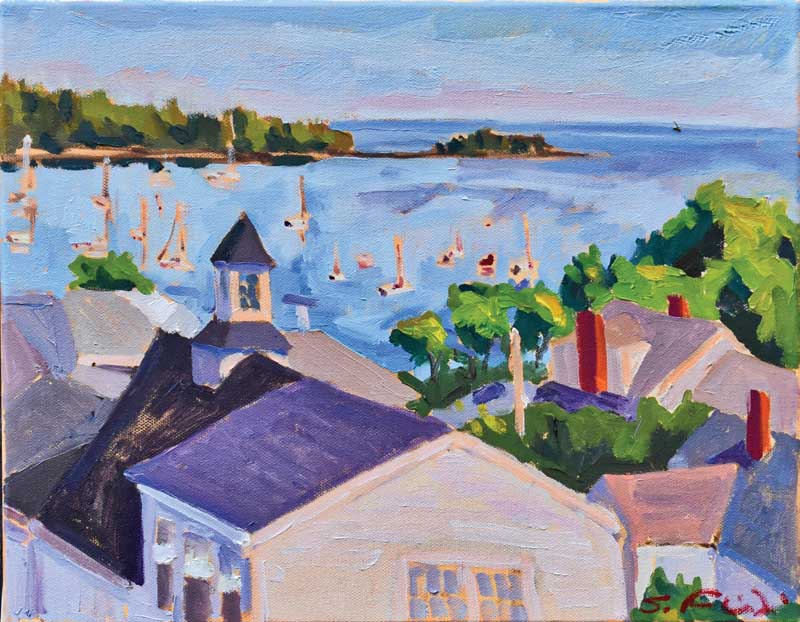
In recent years, Florimbi has become a devoted plein air painter. Searching for the next motif gets him out of the studio and into the world. Outdoor painting also provides a community: No longer surrounded by 60 people every day at the boatyard—he retired from Rockport Marine in 2022—he welcomes working alongside other local painters and attending plein air events.
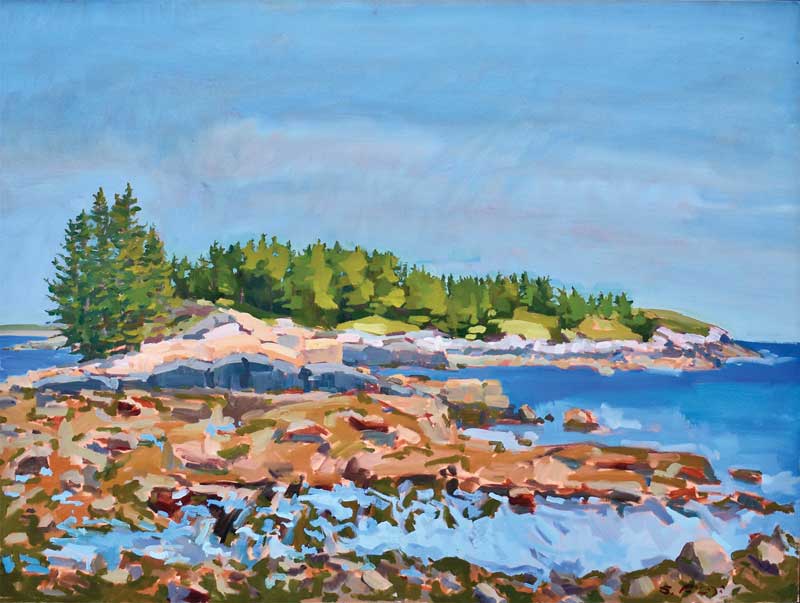
What is more, Florimbi enjoys dealing with the elements: wind, rain, sun, snow. He also welcomes the opportunity to slow down to observe his surroundings, to be able to notice the changes in the light, the weather—“the whole energy of the place,” he says. Such immersion can affect him deeply. He hopes his paintings reflect his sense of a place.
Florimbi likes subjects that challenge him. For example, he loves the complex nature of trees and trying to distill that chaos into shapes and colors. Avoiding the woods in summer due to fear of Lyme disease, he mostly visits in the winter, which, he explains, “works out great because snow makes an amazing foil to work against to create depth.”
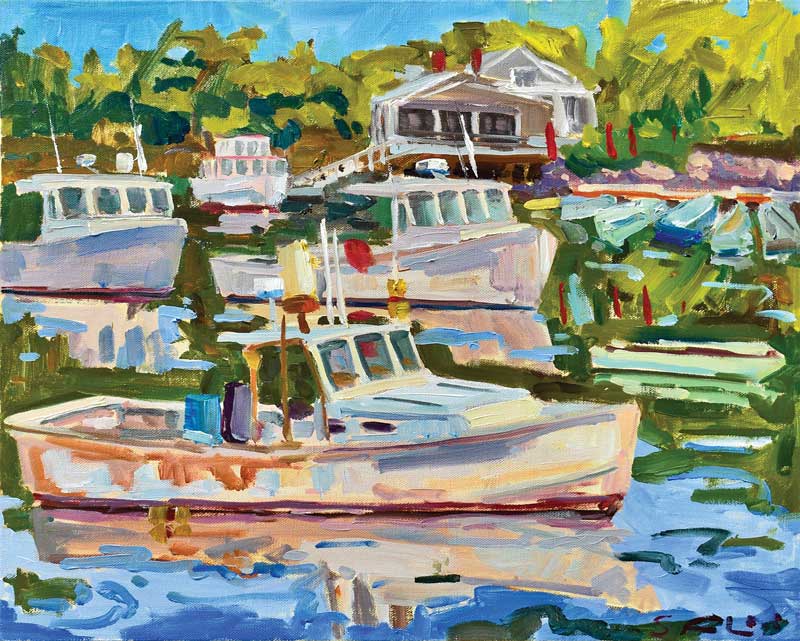
Asked what draws him to Maine’s working waterfronts, Florimbi offers a one-word answer, boats, but quickly qualifies it. He has always loved working boats, which he describes as complex, beautiful, and functional. They are, he posits, “extremely animated—exhibiting real personalities.” Their interactions with water—and the water itself—have led him to explore ways to render the subject in “deliberately abstract ways.”
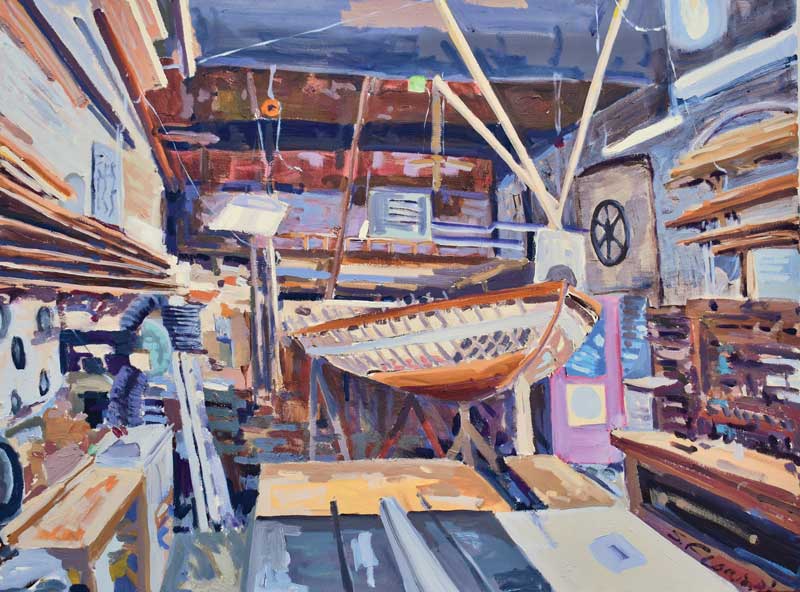
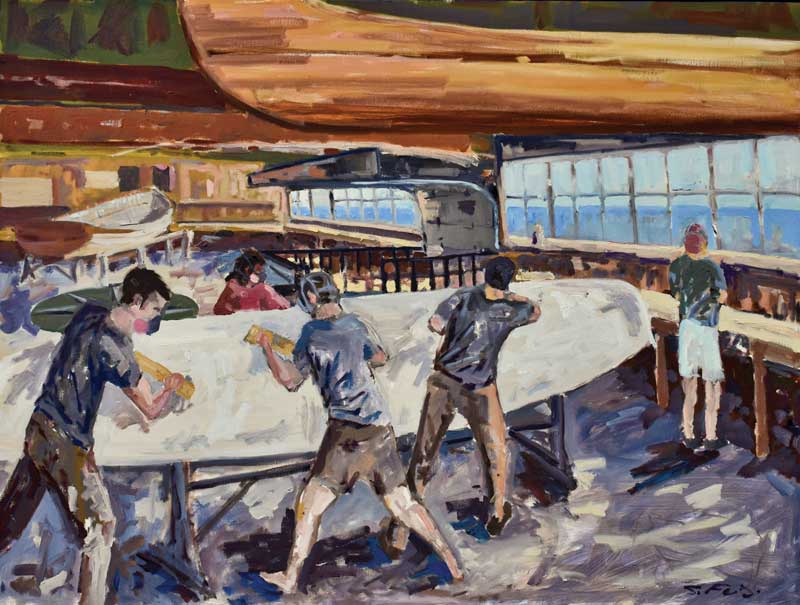
In 2023, Florimbi set out to highlight his relationship to boatbuilding through a six-month residency at the Apprenticeshop in Rockland. For a month, he sketched in the shop and then moved to paintings, working from drawings and composites of photos, but mostly from direct observation.
Florimbi ended up focusing on the builders. “To me the best and most inspiring part of building boats is the people,” he writes, noting that it requires “real cooperation,” something he knows first-hand from years managing and supporting a team. The Apprenticeshop paintings proved to be a wonderful way to transition into his new career as a painter while honoring the time-honored craft and his boatbuilding teammates.
Florimbi’s day typically starts with a workout and a 3- to 5-mile run, after which he packs a lunch and sets out to find a place to paint. After some scouting, he will settle down somewhere and usually spend the next three to five hours painting there. Returning home, he does chores, eats dinner and, in the summer when the days are long, maybe goes back out for an evening painting session. Some days he stays in the studio to work on canvases that need touching up or varnishing. He may practice drumming, update his website, “stuff like that.”
Florimbi designed and built the studio, a two-story 20-by-30-foot shingled building that sits behind his house, in 2009. The first floor is a wood shop, the second, painting studio and office. Track lighting running the length of both sides of the studio illuminates large white panels on which he hangs work, and which double as easels. “I guess you could say that the whole building and its contents are an expression of who I am in one way or another,” he notes. The structure serves as his sanctuary and creative space.
Every season comes with different commitments. During the summer, Florimbi takes part in plein air events in Maine and beyond: Ogunquit, Cape Elizabeth, Cape Ann, the Adirondacks. In the fall, he usually hosts an open studio and teaches a plein air class through the local adult ed program. Come winter, he submits work to juried events, while in the spring he will teach another painting class and build his own frames.
In recent years, Florimbi has shown his work at the Garage Gallery in Rockport, Pen Bay Hospital, and the Steel House in Rockland. One of his paintings, Teamwork, appeared in Tui Motu InterIslands Magazine in New Zealand. Another painting made the cover of “The Road to Hell is Paved,” an album by a local band called Rural Electric.
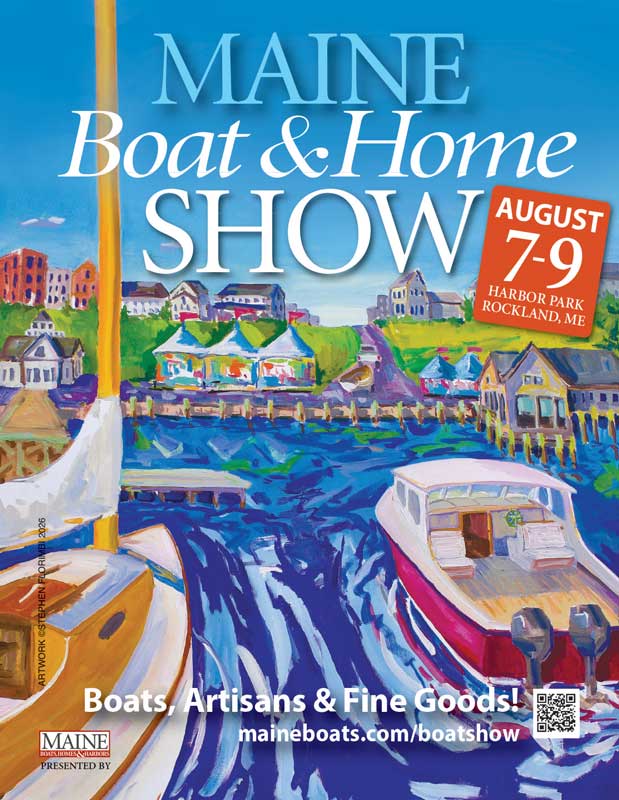
This summer, for the second year running, this magazine will feature one of Florimbi’s paintings on its Maine Boat & Home Show poster. It’s a brilliant fit: a light-filled canvas created by a boatbuilder-turned-painter.
Born in Philadelphia, Florimbi moved with his family to Spain at age 6. His father, Michael, worked for the Burroughs electronics company, which had designed the air traffic control system for the Madrid airport. He was there to implement it.
The family stayed for five years. On tourist visas, they were obliged to get their passports stamped every six months. They usually headed to Italy or back to the U.S. Florimbi was nearly 12 when they returned for good to the States, near Boston, then to northern New Jersey during his high school years.
Florimbi’s mother, Gloria, was born in Philadelphia, his father, in Italy. His grandparents, Guido and Irma Florimbi, were tailors and could, he recounts, “make anything with needle, thread, and some fabric.” His parents had great respect and appreciation for art; he remembers going to museums on birthdays. While they encouraged creativity, a good job and a “practical education” came first.
At the University of New Hampshire, Florimbi studied resource economics. Although a science major, he was required to take some humanities. “It was under this pretense that I convinced my father that all the art and writing classes I was taking were required,” he recounts.
While at UNH Florimbi took his first formal drawing class with Grant Drumheller, who taught him how to see, “and that’s what drawing is all about.” Another UNH professor, Craig Hood, introduced him to painting. Together, Drumheller and Hood laid a solid foundation for the future artist. “They were,” he avers, “undoubtedly the most influential teachers I ever had.”
During his years at UNH, Florimbi worked as a carpenter to help cover expenses. He built his first boat in his backyard the summer after graduating. That winter, he enrolled at the Rockport Apprenticeshop, then located in the Penobscot Boatworks building. He has pretty much lived in the area ever since, building and restoring boats and houses.

Having taken sculpture and 3D design at UNH, Florimbi approached boatbuilding as an artist might, “wanting to know how to craft a complex shape out of wood.” He worked on a lot of classic wooden sail and powerboats, “from full-rigged ships to lapstrake dinghies,” designed by the likes of Sparkman & Stephens, K. Aage Nielsen, and the Herreshoffs.
The artist looked upon boatbuilding as a fun way to support his painting habit. “At the end of the day,” he writes, “I was always eager to get back into the studio.”
Florimbi recently built some 6-by-8-foot stretchers, much larger than his usual canvases. He intends to take them into the woods to create more immersive pieces. He also expanded his painting territory in 2024, loading his car with canvases for a trip out west to visit his brother in New Mexico and a friend in Marin County. He produced 15 paintings. “I’d like to do more of that kind of thing,” he says. On the road, at home: Florimbi is happy if he gets to paint en plein air. So are we.
✮
Carl Little is curating “Francis Hamabe’s Maine: A Lifetime in Art” for the Castine Historical Society this summer. He contributed a chapter on photographer George Daniel for Fire Island Art: 100 Years, forthcoming from Phaidon.
For More Information
You can see more of Stephen Florimbi’s work on his website, stephenflorimbi.com.
For the second consecutive year, the Maine Boat & Home Show poster features a Stephen Florimbi painting. Last year’s poster was based on a painting titled, Coming and Going. This year’s poster draws from his painting, Show Time. “Stephen’s paintings capture the vibrancy of the wide variety of boats to be found along the Maine Coast. It’s these boats, along with all other aspects of coastal living, that our show celebrates,” said Ted Ruegg, publisher of Maine Boats, Homes & Harbors magazine, which launched the show in 2003. The 2026 Maine Boat & Home Show runs Aug. 7-9, in Harbor Park, on the Rockland waterfront. It’s Maine’s largest in-water boat show and includes on-land exhibits of additional boats, nautical supplies, fine arts and furniture, and more. For details and tickets, visit maineboats.com/boatshow.