

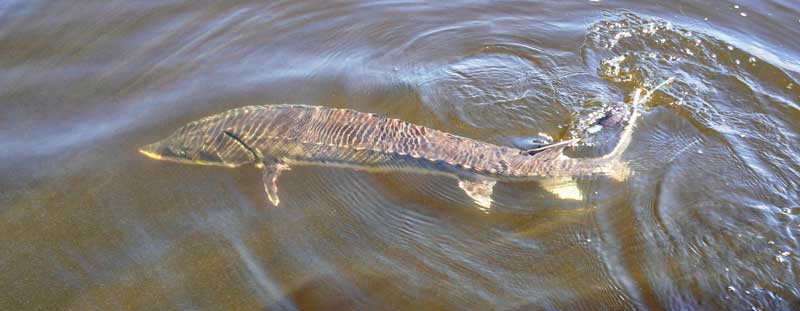
If you pay a visit to one of Maine’s larger rivers this spring—and if you’re lucky—you may see a fantastical prehistoric-looking fish—a sturgeon—leaping from the water as it returns to spawn.
For 200 million years, these enormous and legendary fish have shared our coasts and rivers. Overfishing and habitat loss greatly reduced their numbers, but their populations are starting to rebound here in Maine, thanks to cleaner water and the removal of structural barriers such as dams.
The state’s waters are home to two species of sturgeon: the Atlantic sturgeon (its scientific name is Acipenser oxyrinchus oxyrinchus) and shortnose sturgeon (known to biologists as Acipenser brevirostrum). Acipenser is Latin for sturgeon, while oxyrinchus translates to “sharp snout,” and refers to the fish’s distinct, pointed head. Brevirostrum is a Latin-derived word meaning “short snout” or “short-nosed;” it combines the Latin words “brevis” (short) and “rostrum” (snout).
Sturgeon are anadromous, meaning they live in coastal salt waters and migrate into major rivers along the U.S. East Coast to spawn. Atlantic sturgeon range nearly the length of the eastern coast of North America, roughly from Hamilton Inlet, Labrador, Canada, south to the St. Johns River in Florida.
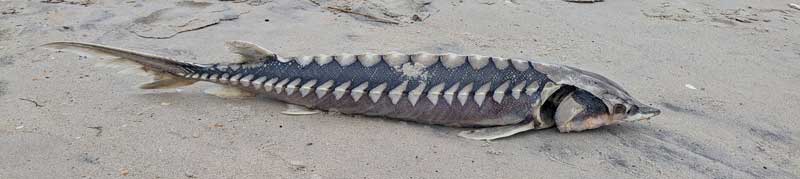
Atlantic sturgeon are much larger than their shortnose relatives; they can grow to be 14 feet long, weigh as much as 800 pounds, and they have a lifespan of up to 60 years. Atlantic sturgeon are dark, bluish-black, or olive-brown on top. They have a long, pointy snout, a shark-like tail, and rows of hooked plates called scutes instead of scales. The scutes are what protects the sturgeon’s primarily cartilaginous skeleton, and they provide a “bony armor” for these fish. Sturgeon were originally all bones and are evolving to adapt the shark and ray’s lighter cartilage-based skeletons to carry all that weight.
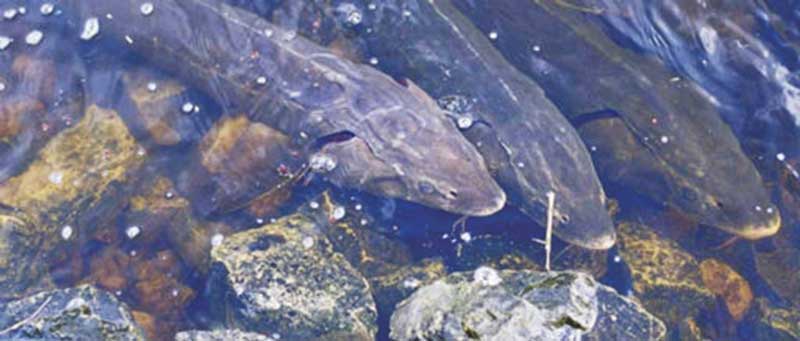
Shortnose sturgeon are homebodies. They stay close to rivers and estuaries, and are only in the ocean for short periods of transit time. They are lighter than Atlantic sturgeon, and typically brownish yellow with pinkish tones. The shortnose sturgeon are petite in comparison, weighing up to 50 pounds and reaching lengths of 4 1/2 feet, with the oldest recorded at 67 years. As their name suggests, they have a shorter, blunter, V-shaped snout and a wide mouth.
Beneath the Atlantic sturgeon’s snout are four dangling protrusions, or barbels, used to help detect food on the murky sea floor. Sturgeon possess a unique, toothless, and highly protrusible (extendable) tubular mouth located on the underside of their head. The mouth is adapted to vacuuming food off the bottom of rivers and the ocean. Their diet primarily consists of crustaceans (crabs, shrimp, and amphipods), mollusks (clams and mussels), marine worms, and small fish.
Scientists recognize Gulf of Maine Atlantic sturgeon as being what’s known as a distinct, separate segment, or population, from other Atlantic sturgeon along the U.S. East Coast. This genetic distinction make sense when you consider that sturgeon return to the rivers in which they were spawned. Gulf of Maine Atlantic sturgeons are listed as “threatened” under the Endangered Species Act; Atlantic sturgeon south of the Gulf of Maine, and shortnose sturgeon are listed as endangered. Currently, there is still a small Canadian fishery for sturgeon.
The sturgeons found in the Gulf of Maine are two of the state’s 12 species of diadromous fish that divide their time between fresh and salt water. Both Atlantic and endangered shortnose sturgeon are frequently sighted—often jumping—in Maine’s tidal rivers, particularly the Kennebec, Penobscot, Saco, and Androscoggin, between May and June. Recent records include a 13-foot specimen in the Kennebec that was seen in 2025, and multiple sightings near Augusta and Bath. They can also be found spawning in the Merrimack River to the south.
According to News Center Maine, “Sturgeon, including Atlantic and shortnose species, are frequently sighted leaping in the Kennebec River near downtown Augusta, particularly around the former Edwards Dam site, the rail trail, and near the Memorial Bridge.”
So why do these creatures breach? Scientists have determined that the fish jump to communicate with other sturgeon and to refill their swim bladder so they can maintain neutral buoyancy. Experts say they may also jump to dislodge parasites, like a bronco trying to buck a rider, and to avoid predators. Because we are most likely to see sturgeon when they come upriver to release their eggs, most breaching activity has been associated with spawning. Scientists are also studying whether rainfall, higher river levels, or temperature changes have an influence in reproductive activity and the ongoing recovery of their numbers.
Species on the Rebound
What happened to the abundant populations of this fish? Native Americans hunted sturgeon for their meat and roe (eggs), as did settlers and colonists. In fact, sturgeon were vital to the survival of the early Jamestown colony, established 1607, acting as a primary food source during the “Starving Time” in 1609 and 1610. By the mid 1800s sturgeons were a booming fishery with oil, roe, and meat harvested to such a degree that this became known as the Black Gold Rush. Caviar was the main source of monetary return, and the sturgeon were hunted almost to extinction for this luxury good. Even their bladders were extremely valuable. A material called isinglass is made from sturgeon bladders and was used in manufacturing glass, waterproofing agents, adhesives, and lubricants.
In Maine, sporadic exploitation of sturgeon, which may have included the shortnose sturgeon, began earlier and declined earlier, with the first documented fishery in 1628. The largest recorded harvest—approximately 145 metric tons—occurred in 1849. By 1880, the harvest had declined to just 5.7 metric tons.
Maine’s sea-run fish are so essential today that the Maine Department of Marine Resources has established a Bureau of Sea-Run Fisheries and Habitat (for information). The DMR conducts research on population estimates, habitat recovery, and spawning behavior.
Today, sturgeon prefer to spawn in the Kennebec River because it provides high water flow, deeper water depths, a gravelly bottom, and improved water quality following the removal of the Edwards Dam. This removal restored access to historic spawning areas, while Clean Water Act improvements have helped create a crucial, thriving habitat for both threatened Atlantic and endangered shortnose sturgeon.
According to Sean Ledwin, who heads the sea-run fisheries program at the Maine DMR, there were at least 200 sturgeon counted in 2023 just upstream from where Cobbossee Stream flows into the Kennebec River in Gardiner. Cobbossee means “The place where the sturgeon are” in the Abanaki language, which indicates these sturgeon are right where they should be.
Currently, the primary threats to both of Maine’s species of sturgeon are entanglement in fishing gear, habitat degradation, habitat impediments, such as dams and other barriers, vessel strikes, and changing environmental conditions. Meanwhile, it will take a long time for these populations to recover. Atlantic sturgeons are sexually mature at around age 12, and the females produce eggs only every two to six years.
As an aside, a giant sturgeon was a suspect for many years in the search for a viable explanation for the Loch Ness monster. Recent technology disproved this theory when environmental DNA sampling of the waters of the loch did not detect any evidence of sturgeon DNA. Currently, a monstrously large eel is the next likely suspect.
So, have you seen a sturgeon here in Maine? If so, the DMR encourages Mainers to report dead or alive sturgeon sightings to help them understand the population range and gauge recovery efforts.
One thing is for certain, it is extremely hard to forget spotting one of these majestic dinosaur-like creatures leaping through the air. Kayakers, paddleboarders, boaters, and fishermen have all reported them in our rivers and estuaries. My advice? Keep your eyes open this spring for these giants in the rivers of Maine.
✮
Sarah Oktay is the executive director of the Herring Gut Coastal Science Center in Port Clyde. She has a doctorate in Chemical Oceanography and has been involved in the administration of biological field stations, educational centers, and marine labs for 25 years. She lives in Waldoboro with her husband, Len Germinara.
Ahoy Fishermen: Catch and Release
If you are fishing and hook a sturgeon in Maine, you must release it immediately, unharmed, and without removing it from the water. Use pliers to remove the hook while in the water or cut the line if deeply hooked. The National Ocean and Atmospheric Administration website has further tips for returning a sturgeon back safely at fisheries.
Come Meet the Bride
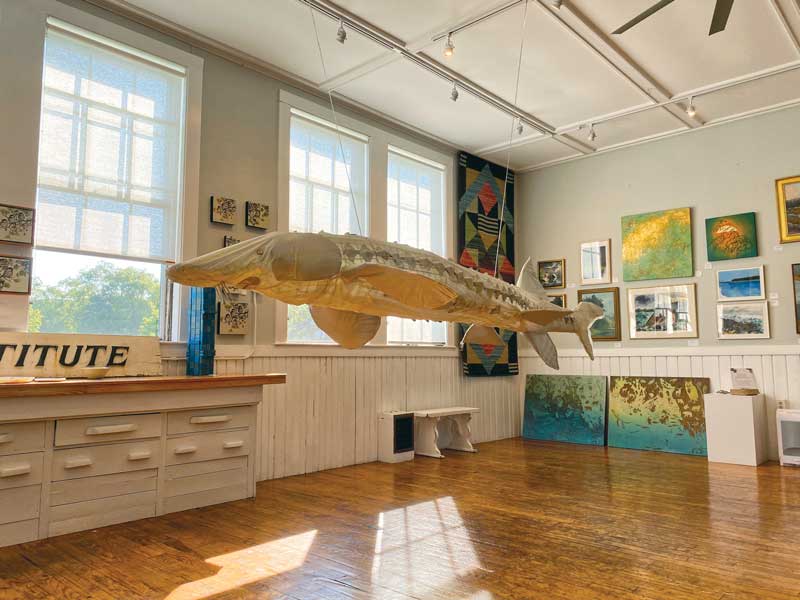
If you don’t spot a sturgeon in the wild, you can head to the Herring Gut Coastal Science Center in Port Clyde, where you can view the 12-foot “Sturgeon Bride.” This beautiful sculpture is made from lobster traps, sail material, and 3D-printed scutes that were designed and created by artist Julie Crane in collaboration with Herring Gut aquarist Ava Travis. Curriculum created by Herring Gut senior science educator Alaina Zyhowski guided the project with eighth-grade students at St. George Municipal School Unit, led by teacher Alison England. The students created natural dyes and painted each individual scute. Students in the class studied sturgeon anatomy and life cycles and used NASA data to look at changes in ocean characteristics that could affect sturgeon populations. Learn more HERE.