

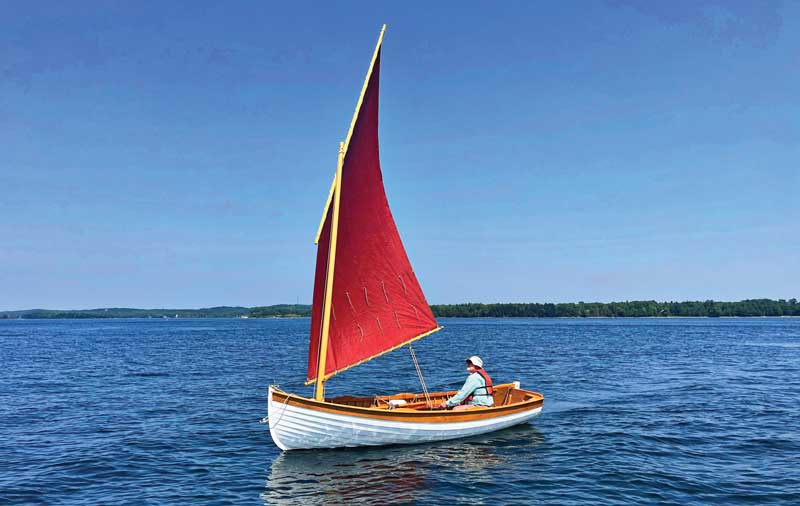
Twenty-five years ago, I was bent over my drawing board at my twin brother Chuck’s yacht design office when my neighbor from Bernard, Maine, Jean Beaulieu, came in and hired Chuck to design an updated version of the Herreshoff Fish. Beaulieu named the new design the Pisces, and his Classic Boat Shop has built 51 of them thus far.
The buyer of the very first Pisces was Jonathan Ogle, of Oakland, California. Although both the designer and builder recommended a carbon-fiber mast, Ogle wanted solid spruce. So, Jim Elk’s Mt. Desert Island-based Elk Spar and Boat Shop was subcontracted to build the spars.
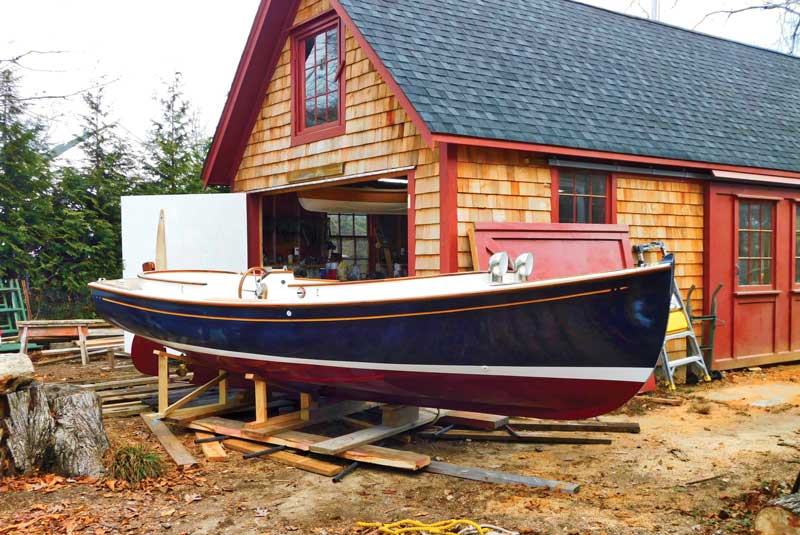
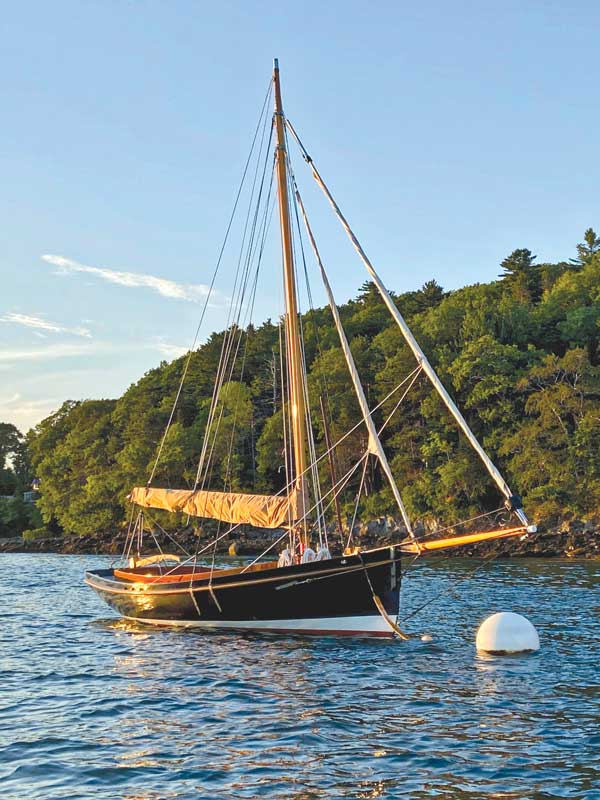
Ogle summers in Castine, but his Pisces is kept on San Francisco Bay. For his Maine sailing, on lakes and sea, he acquired a Paul Gartside-designed 14-foot Skylark. After a few summers with the boat, Ogle wanted to try the alternative, single sail, balanced lug rig shown in Gartside’s plans, while retaining his sloop rig for different conditions. To do this, he needed new spars and rigging, and so he circled back—with the Skylark in tow—to Elk’s shop, where I work these days, even at age 81.
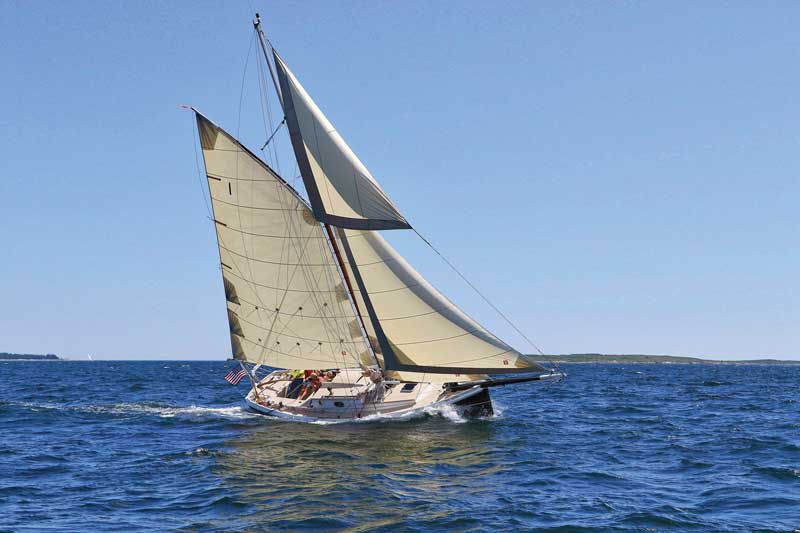
Upon first inspection, Elk and I agreed it’d be a challenge to match the build standard of that boat. It had been constructed at the Rockland Apprenticeshop, under the watchful eye of Kevin Carney, but nothing about it spoke of amateur work. In fact, in both design and execution it was near perfect.
And, the instant I laid eyes on the Skylark drawings Olge obtained from the designer, I tagged it as a Paul Gartside creation. I’d followed Gartside’s career for years. I knew he had started building and designing small boats in his native England, down in Cornwall, and I was aware that he was responsible for a great number of custom designs, stock plans, and a tremendous variety of boats built in his own shops in Malpas, Cornwall; Sydney, British Columbia; Shelburne, Nova Scotia; East Hampton, New York; and in Brooklin, Maine, owing to his summertime instructor career at the WoodenBoat School. Gartside has gotten around.
I used to do some reviews of wooden boats, whose plans were available, for another magazine. From that, I learned there are many very creative, artistic, and occasionally quirky small-boat designers in the world, many of whom are boatbuilders too. Often, they specialized in plans for the home builder. Think of Nigel Irens of England on the featherweight artistic end; Iain Oughtred for beautifully lined-off lap-strakers; Sam Devlin for stitching and gluing into the middleground; and Phil Bolger out on the quirky left border. For me, ever since I spied a drawing of his Itchen Ferry, I had found my champion in Gartside.
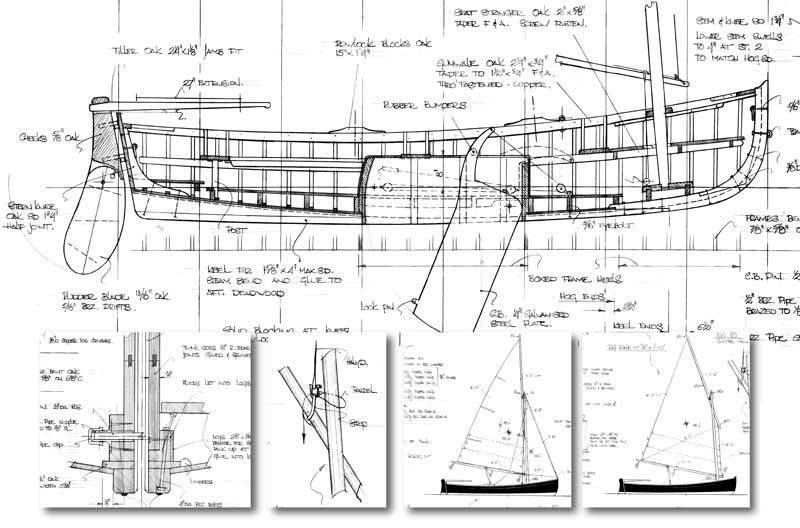
His Skylark plans, I pointed out to Elk, showed us in great detail more than we ever needed to know. It was both a boatbuilder’s drawing and a work of fine art.
Now, About Drawings
This column is named “Off the Drawing Board,” so first a bit about drawing. A yacht designer’s products are mechanical drawings that show exactly how to construct a boat. Yacht designers can—and must—accomplish this with competence. But some designers have so much creativity and art bursting from within that their plans become artwork atop of invention.
Many of us who love yacht design know the drafting-room masters: Howard I. Chapelle, William Garden, L. Francis Herreshoff, William Atkin, Walter McInnis, and, across the pond, Don Pye from Holman and Pye. Then there are some unsung heroes we only know by their initials, found in the title blocks of blueprints from Sparkman and Stephens, Rhodes, Alden, Hood, and other firms.
Famous designers like Nat Herreshoff, Dick Carter, Starling Burgess, and many others would do light pencil drawings first, then rely on drafting artisans who used ink, varied line-weights, and added a touch of flourish. A specialty in this trade is lettering. Precise words and instructions are necessary for clarity, but design fanatics like yours truly laud the best in the trade: Garden, Chapelle, and L. Francis Herreshoff chief among them.
Nat Herreshoff carved scale models and used his pantograph to take offset figures, made preliminary drawings in light pencil, and made notes in his famous notebook. He then passed his final work off to a separate drafting room at the yard in Bristol, Rhode Island. Probably—though not unquestionably—the lettering master was George Owen, who after graduating from the Massachusetts Institute of Technology in 1894, was a draftsman for Herreshoff and later took charge of the yacht design specialty in the Naval Architecture department at his alma mater. The point here is that Nat did not do the fine lettering himself, because he demanded true artistry.
This is as appropriate a place as any to say that the moment I first unrolled that black-print plan of the Skylark, I resolved it was long past time to give Gartside his due in this magazine. I feel that he tops the heap nowadays for his super creative designs and the flourish of his presentation and lettering, at least for boats under 50 feet. (As an aside, when I praised him to that effect in a recent phone call, he was quick to display his characteristic modesty. A self-effacing yacht designer—is that an oxymoron?)
All About the Wood
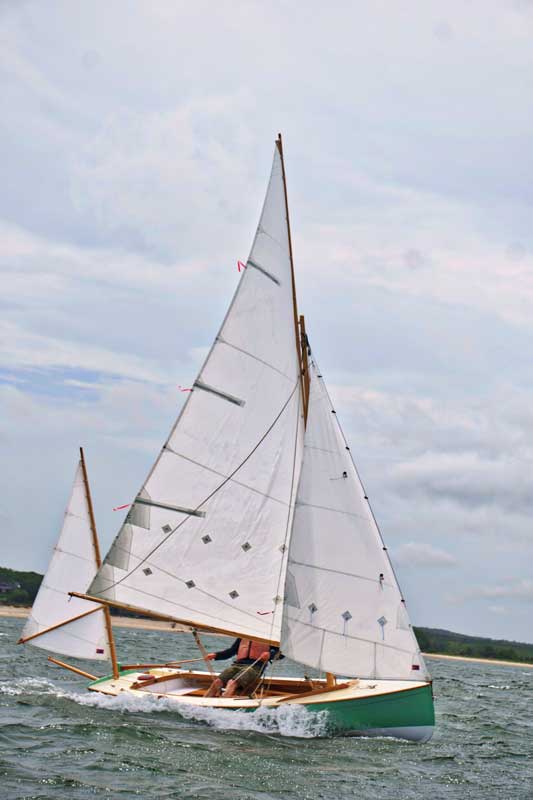
For Skylark’s balanced lug rig, Elk and I used black locust for the parts of those spars needing exceptional strength and beauty. We were instructed to build a hollow, “bird’s mouth” main mast, which is a much more elaborate and expensive construction method than is typical for a spar that’s only 13 feet high and quite skinny. This saves, Gartside explains in one of his books, about 30 percent in weight.
But how important is that savings in a short mast that probably didn’t top 25 pounds, and in a boat that’s crew-ballasted anyway, I’d ask?
Only later did I discover that Gartside is a fanatic about the benefit of hollow spars for anybody who can accomplish and afford them, no matter how small or stable a boat may be. I also found that the designer, who is a wood-appreciator par excellence, didn’t discover black locust until he moved from the west coast to the Canadian Maritimes. He quickly came to it in the same way that Elk and I do.
Much as I’d admired every single boat design of Gartside’s, until the Skylark mast job came along, I didn’t know all that much about him or his huge portfolio. So, I began buying books featuring his designs from the WoodenBoat Store and online.
I was also aware that he writes a column, “Plans and Dreams,” for England’s Watercraft magazine, to which I subscribed. That led to frequent back-and-forths with Gartside at his design studio in East Hampton, New York. I even attempted to buy his three wonderful books featuring ready-to-build boat designs, called Plans and Dreams (Volumes 1, 2, and 3). Characteristically, he wouldn’t take my money, and included a precious Volume 1, which is currently out of print.
Power of the Pen
There are great yacht designers, but a few of them were so creative that not only could they invent, draw, calculate, sometimes build, and more rarely paint pictures of their boats, a few of the very finest were masters of writing too. L. F. Herreshoff’s book, The Common Sense of Yacht Design, comes first to mind, and he was also a great storyteller in Rudder magazine. Chapelle’s Yacht Designing and Planning is a classic. Uffa Fox, great dinghy designer, racer, and adventurer, wrote two books that were an inspiration to this author. Bruce Kirby qualifies, too. If you consider Joshua Slocum any kind of a boat designer (which I defer from), his writing overwhelms whatever he might’ve lacked in draftsmanship. Still, he could build a boat on a beach or a riverbank that could demonstrably go the distance, and his words cajoled whole flotillas of escapists onto the briny blue. Starling Burgess was a rare bird, as well. He could build airplanes, design boats, do great sketches, but also spin compelling yarns.
(Here in Maine, we have our own masters of the pen, on vellum, mylar, or the printed page. Bruce King, Joel White, and Doug Hylan come quickly to mind. And I am remiss in truncating what could be an exhaustive list and apologize for leaving many worthies out.)
But now hear this: If you read Gartside’s bi-monthly Watercraft essays or buy his Plans and Dreams books and devour them, as I did, you will be entertained as well or better than you’ve ever been by a nautical publication.
To a degree that I would love to emulate—but can’t—he manages to express his compelling, generous, varied knowledge of everything from history to philosophy to science, to ecology, and even to parenting, in a manner that braids in boat design and construction in a way that is just short of magical.
It must be stressed that he’s always been at least as much a boatbuilder as designer. He built his first boat, a John Atkin schooner, on the Fal estuary, on England’s coast, at age 16. It was a stout, carvel over sawn oak cutter with typical long bowsprit and gaff rig. That’s quite the challenge for a smallish kid after school, behind an adze, spokeshave, and caulking mallet.
Today, Gartside hires himself out as much to build boats as to draw them, and he’s built at least the prototype boat of a great many of his designs. For that reason, as many people I’ve interviewed have reported, any minor bugs or builder difficulties have been discovered and addressed before he markets a set of plans.
And he’s prolific. Whereas clients for many famed yacht design studios are a dying breed, he keeps correspondence with a legion of admirers, and has many repeat boatbuilders, all around the watery world. His clientele is as varied as his designs. He’s designed a boat for a man in prison, making droll comments about boat-dreaming “as a means of escape.” He designed and built a pair of identical mini-peapods, sized right for rowing lessons for his two kids.
His books overflow with respect and appreciation for the sometimes strange and often amusing proclivities of his clientele, and he is up-front honest about the realities of their oncoming challenge and the costs they’ll encounter.
Still, he writes, “Making is more fun than buying,” and “I believe the enjoyment boatbuilding brings to lives increasingly divorced from sustainable manual work is priceless. It’s soul food at its best.”
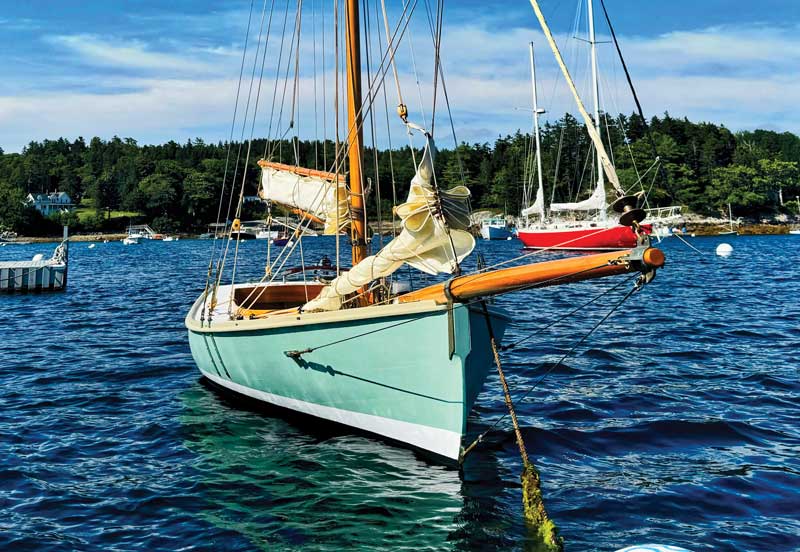
Gartside is presently working on design number 295. Though not every drawing finds a builder—or is numbered, a portfolio approaching 300 is noteworthy. Gartside is refreshingly honest about the value of boats as dreams, even if they never get begun or finished.
Design Number 295, for a French builder, leads, perhaps characteristically, to a road seldom taken: a large bilgeboard boat that’s driven by a Chinese lug rig. It is just the latest eddy in the stream.
Gartside’s equally competent with dinghies, rowboats, pocket cruisers, gigs, raid racers, canoes powered by paddle, oar, or even steam, powerboats with outboards or inboards, vee drives, and diesels way forward, aft, or even off-center.
He is expert in all ways of wood construction: carvel plank-on-frame; clinker (framed initially or afterward); boats built upside down or otherwise up; cold molded by strip and veneer, or multiple veneer over bulkhead and intercostals. Even steel!
And that gorgeous launch he last built, powered by an electric motor—wouldn’t it be the ideal thing for Penobscot Bay!
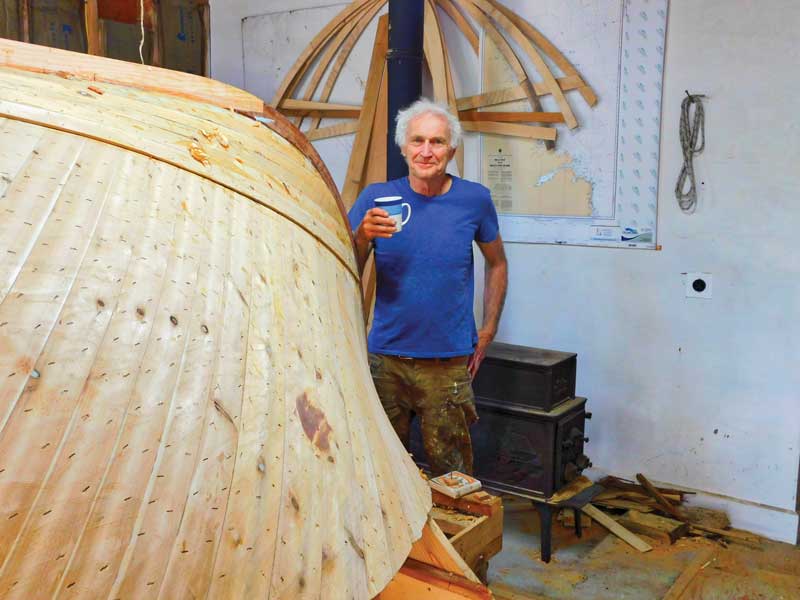
Gartside is a registered naval architect with basic training from Southampton College of Technology in the ’70s (now Southampton Solent University). Gartside remains a strictly pencil and paper designer with no desire whatsoever to spend his days in front of the computer. “It’s hard enough to be in an office at all,” he said. “My natural environment is the workshop.”
In an increasingly regulated world, that’s not an easy choice to make, but fortunately the kind of complex calculations that computers do so easily—stability and flooding if damaged for example—are also easy to subcontract as needed these days.
When probed on the question of computer-assisted design, Gartside added: “My feeling about the computer is rather like that of Woody Allen about death: ‘I’m not afraid of it, I just don’t want to be there when it happens.’ Luckily, I think I will just get under the wire in time to outrun them.”
As I said, Gartside’s been around. Born in North Wales, shaped by Cornwall, mentored by Bill Garden in British Columbia, introduced to new wood species and old traditions in Nova Scotia, and now at work in East Hampton, on the outer reaches of Long Island, he seems the finestkind for Maine. I wonder if he’d consider one final hop down to Brooklin. He would receive the warmest welcome if he did.
✮
Contributing editor Art Paine is a boat designer, artist, and writer who lives in Bernard, Maine.