

David Wyman and I hovered over a 16-foot white-painted sheet of plywood marked with a growing spiderweb of 2-dimensional lines that when complete will define the lovely shape of a 3-dimensional boat. It’s the third winter in a row that he has joined me in the shop behind my house in Blue Hill for a boatbuilding project. While I’d planned to be building small vessels in retirement, sometimes life works out even better than hoped for.
A few years ago, as retirement age approached, the Blue Hill Peninsula seemed the logical choice for a boater to resettle. I had attended the WoodenBoat School many years before, and my wife, Susan, and I had sailed in the Small Reach Regattas, which took place in Brooklin. Once we settled on a plan, Susan and I bought a 1900s farmhouse situated on the shore at the north end of Blue Hill Bay. It even had a boatbuilding shed and a small workshop with a woodstove!
As we settled in, the next question was to see if ours was a good plan. It didn’t take long to find out yes, it was.
Susan loves the snow, and our drive is lined with mature sugar maples, which makes gathering sap for her sugaring hobby about as easy as can be. Me? I managed to immerse myself in the local boating community, which was easy to do since Brooklin, a short drive away, is the self-proclaimed “wooden boat building capital of the world.”
I volunteered, worked for food during the WoodenBoat School’s Alumni Weeks, and took classes during the summer. Soon after we moved, I attended an annual meeting of the Downeast Chapter of the Traditional Small Craft Association; being the new guy, they promptly turned the reins over to me. It was at that meeting that I reconnected with David, a naval architect and engineer from nearby Castine. I’d met him while participating in the Small Reach Regattas, as he was one of the organizers of that event. Turns out that like many in the TSCA, David and I shared a love—more like an obsession—for boats, specifically small traditional vessels.
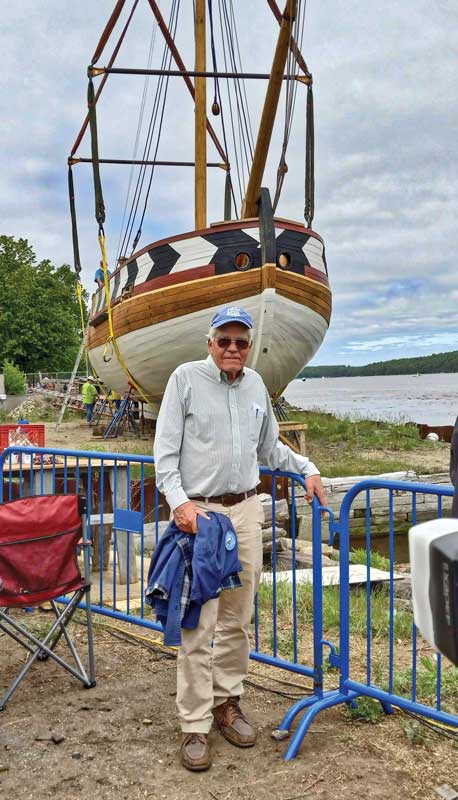
We made an odd couple. David spent a career designing and surveying boats of all sizes, from small submarines for the Navy to more recently, Maine’s first ship, a 51-foot pinnace named the Virginia. He doesn’t recall how many boats he’s built, while I never thought I’d build one—until I got the bug about 15 years ago. I had enough ship-orientated engineering courses while at the Naval Academy to have a basic understanding of boat design. That, combined with a lot of book learning and the experience of living aboard and cruising sailboats in the U.S. Virgin Islands, Maine, and along the eastern seaboard was my background. Having few tools and little woodworking skills made me an unlikely candidate to start a boat shop hobby, but having someone with David’s experience as a friend and mentor was ideal for a learn-as-you-go novice boatbuilder.
Tender Desire
After that TSCA meeting, I mentioned to David that I needed a tender, and within a week he had drawn plans for a 12-foot flatiron skiff. That was the start of our boat building partnership. It was a relatively simple build: two cedar planks wrapped around a thwart, with a plywood bottom.
It was a perfect boat for taking Susan and our two golden retrievers out to the nearby islands, setting moorings, and leisurely rows around the bay.
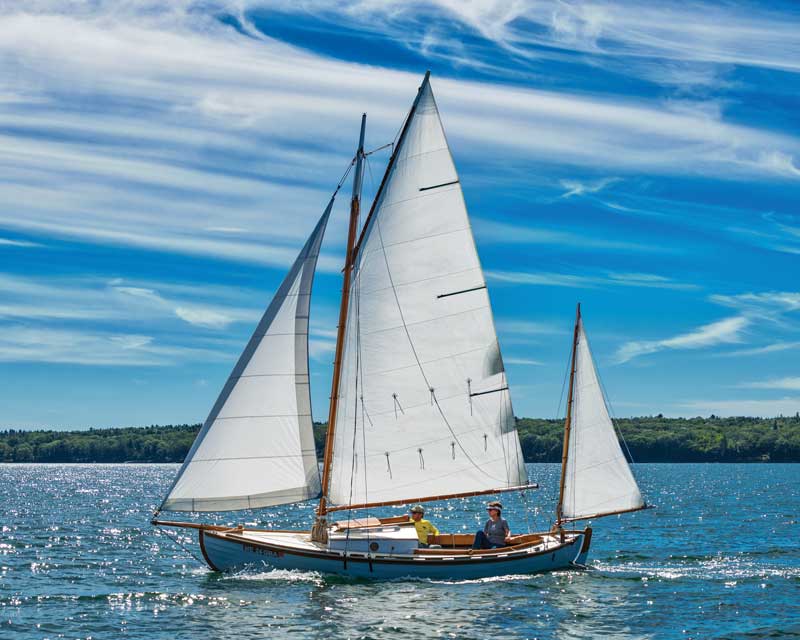
Later, David was instrumental in helping with what would be my most ambitious project, building Sojourn, a Paul Gartside-designed Sjogin III. While we were still living in New Jersey, several of us had hired Gartside to draw the lines of Russ Manheimer’s beautiful Sjogin, a 22-foot double-ender of unknown origins. I was relieved when shortly thereafter Gartside drew the plans for a smaller version, Sjogin III, a 19-foot centerboard daysailer. While only a few feet smaller, it was less than half the size, displacement-wise, of Sjogin II. It would still be a major undertaking but more in line with what I thought I could accomplish, or wanted to.
To start out, I spent many hours at David’s house, where in his office he redrew the lines and used his planimeter to calculate vital stats like displacement, center of gravity, and stability. David is old school—no CAD software was used and his computer sat idly on his desk while his pencil, rulers, and curves worked overtime.
Building Sojourn took four years, and David continued to advise throughout, ensuring that I didn’t do anything ill advised, or possibly unsafe. And, having a highly experienced engineer coordinate turning the hull over was a big relief for that big task. David would regularly check in, often tactfully suggesting that there might a better way to do something that I was attempting. After launching my boat, he even put on his surveyor’s hat and calculated the vessel’s stability and even the efficiency of the electric outboard.
Another project that David spearheaded was the building of a model of the Revolutionary War privateer Defence, which was scuttled in nearby Stockton Harbor. He discovered it while teaching at the Maine Maritime Academy in the 1970s and participated in recovering artifacts and recording construction details. Over several winters, I joined David and three of his Castine neighbors as we built the 5-foot model based on David’s discoveries that showed how it was constructed. The model is now on display at Castine’s Wilson Museum.
The Next Big Thing
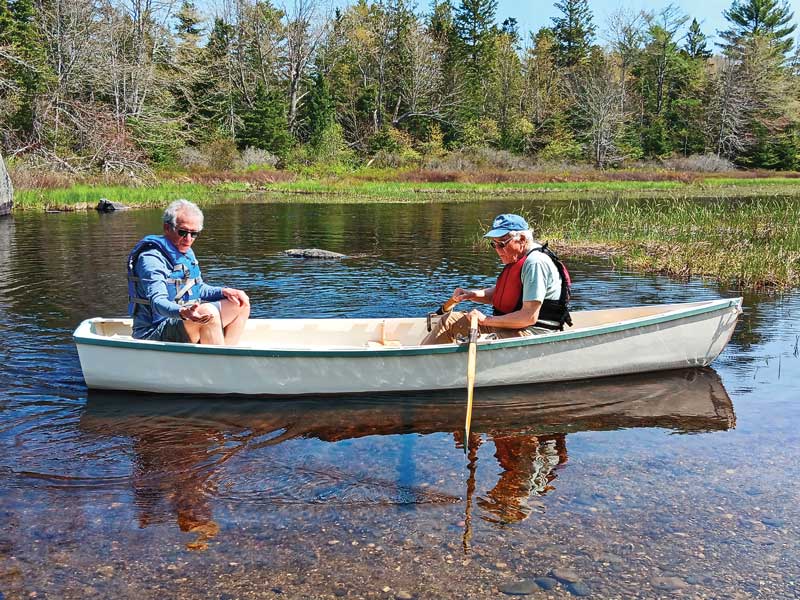
David called one day with another of his design ideas. He said what we really needed was a small, lightweight rowboat that we older types could easily load into our trucks and launch.
I told him that I had so many boats that storing them and finding time to use them was a challenge. His response: “Just one more boat and you’d really be happy!”
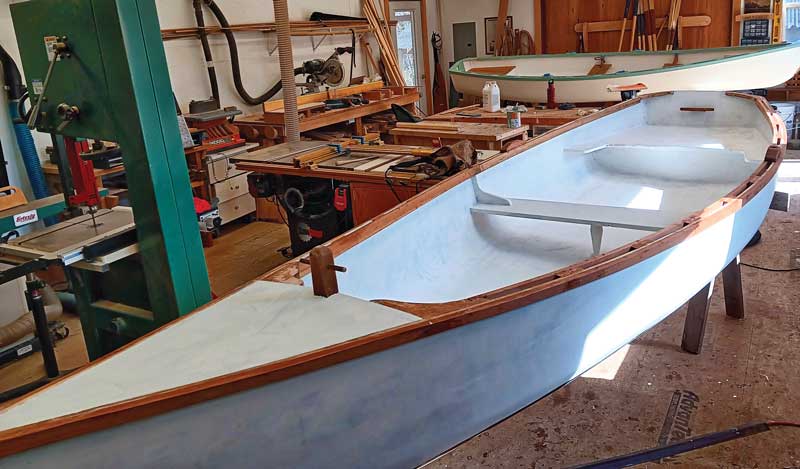
So, I fired up the woodstove, and we began building his new, almost completed design, a round-chine rowboat: the Wyman 13.
The boat was to be cedar stripped, using wood that David cut from his lot some 50 years ago. The hull would then be covered by fiberglass inside and out. It was a fun project that we tweaked into its final shape as we built it.
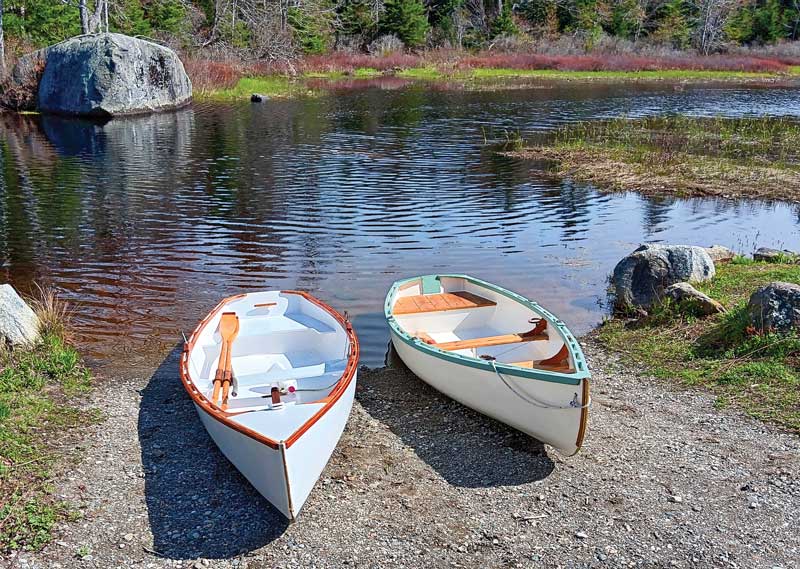
When launched, the now named WyBoat floated nicely on its lines and was a pleasure to row. She came in at 90 pounds, a bit heavier than David had planned, mostly due to my choice of using Dynel on the exterior, which required more epoxy to fair.
Maine winters spent in a warm shop creating a boat are pretty easy to take, so the next winter we built another Wyman 13, this one for the designer himself. Now that we had a better idea of what we were doing, the construction went much smoother, and the boat came in 10 pounds lighter. David was very pleased and christened his skiff the Helen.
The Wyman 13s, being easy to load and launch, are our go-to boats when the urge calls to head out for a row.
Gone Boating
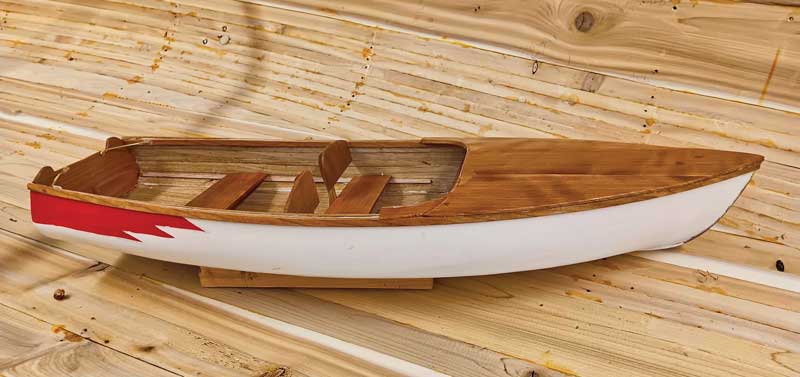
Having both enjoyed collaborating on these projects, for the winter of 2025-26 we started building a facsimile of a 14-foot Penn Yan Swift to be powered by an electric outboard.
I did a basic sketch based on photos readily found on the internet, and David did his design magic. I made a model to get a feel for what the boat could look like in 3D, while David developed its table of offsets. Our PennYan knock-off will be strip-built using local white cedar, glassed inside and out, with a cherry deck, seats and trim.
Sometime this summer if you happen to look out upon Blue Hill Bay, you just might see Susan, the dogs, and me quietly and comfortably cruising around the bay at 5 to 6 knots in a classic runabout that looks right out of the 1950s—just like its builder. That’s the plan.
Then come next winter, who knows, David and I might just be looking forward to starting another project, but what boat to build this time? Deciding is part of the planning fun. There will be wood by the stove and white paint readily at hand to create lofting boards for a spiderweb of new lines.
✮
Steve Brookman is a retired pilot who lives in Blue Hill, Maine, with his wife and dogs. Besides building boats, he likes to use them.