

Here in New England, most of us water people have two seasons. There’s summer, when we can use our boats, and the rest of the year, when we can’t.
Personally, I like summer best.
Still, there are ways to mess with boats in that other season. There are trips to plan, repairs to ponder, new gear to purchase. And there are boatyards. I like walking around boatyards, and boatsheds, too, where the better off are able to store their boats and have them worked on.
Mucking around boatyards, you get to look at the all sorts of different-shaped hulls, both sail and power. You can check out the fairness of topsides, see the many ways rudders are attached or trimtabs are designed. Though nowadays most boats that are left outside get covered, you can still see how spars are rigged or what sort of electronic domes and arrays people have packed on their masts or cabin roofs.
This past January, a business trip to Portland was made all the better by a visit to a still-expanding yard. Nestled well inside the city’s natural harbor is Portland Yacht Services, run by Phin Sprague and his crew. He’s a well-known figure to anyone who ever used to attend the much-missed Maine Boat Builders Show, held in an old Portland locomotive factory, the site of Sprague’s previous boatyard.
Encumbered by city regulations and unable to expand, Sprague closed the old shop, and after protracted legal wrangling with the city and other entities, he secured a long-term lease on waterfront land last used by the railroads. PYS’s first structure, Building A, went up in 2012. Several more quickly followed, with buildings H and I coming online just this year. It was projected that it would take perhaps three years to fully utilize these latter two, Sprague said, but on our visit they were already mostly packed with vessels in for repairs.
All of the buildings are big and red, and most have massive overhead doors that can accommodate the yard’s 350-ton Travelift. Sprague said they are able to service boats up to about 150 feet.
On the morning we pulled in, a Portland ferry had just emerged from one shed, opening up space indoors so other boats could be brought in for repairs.
In the vast bay adjacent to the yard’s office, Sprague’s own boat, the 65-foot, John Alden-designed Lion’s Welp, sat in a corner by the kitchen. The strip-planked, cold-molded schooner had sailed the family to Bermuda and back last summer, and was now being prepped for the season ahead. Nearby, the aluminum, Sparkman and Stephens-designed Palawan awaited a new engine. Other boats—fishing boats, sailboats, launches, you name it—were in line for refits, paint, or an array of other repairs.
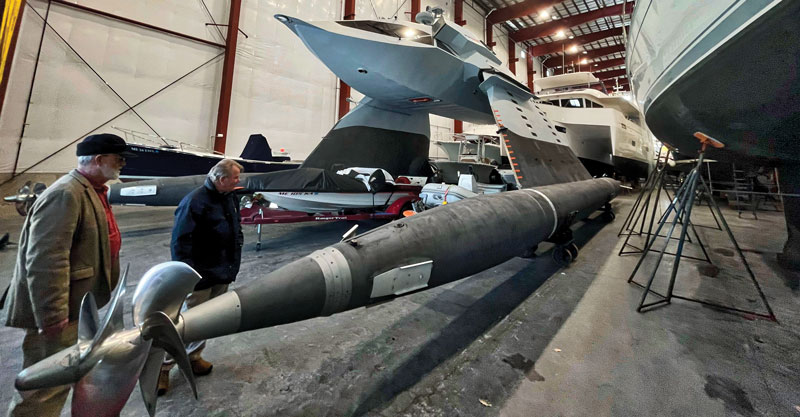
Over the next couple of hours, we visited a machine shop, a wood shop, paint bays, a rigging loft, and still more sheds packed with boats. Here, we spotted a Pearson Ensign, there a Portland fire boat. There were bass-fishing boats, an employee’s snowmobile in for fine tuning, outboard engines, pontoon boats. In one bay near the water, we found a massive prototype of an autonomous craft designed to be used as a gun platform to protect a naval fleet. What in heck was that doing there? Right behind it was a French power trimaran in for structural repairs.
What a show! Not as good as sailing up Muscle Ridge Channel on a July afternoon, but for the middle of January? Not bad.
✮