

All images of paintings are courtesy of the Museum of Fine Arts, Boston
Looking through the late art historian John Wilmerding’s ground-breaking study American Marine Painting (1987) recently, I took time to study the way artists treat the sea. The range is remarkable, from, say, the calm of a Fitz Henry Lane harbor scene to the explosive turmoil of a John Marin downeast coastal view.
In some seascapes, the waves are perfectly ordered, like the sets surfers dream of; in others, they are chaotic. Artists employ every shade of blue, gray, and green, plus yellow and orange tones to match the sunlight, with no two palettes quite the same.
Wilmerding pays special attention to Winslow Homer (1836-1910) who lived by the sea for much of his life—and sought it out when, for example, he lived in the English fishing village of Cullercoats or traveled to the Caribbean in the winter. Homer revealed the energy of the ocean, in oils and, most fittingly, watercolor, turning his skills in both mediums to representing realms of water in a brilliant manner.
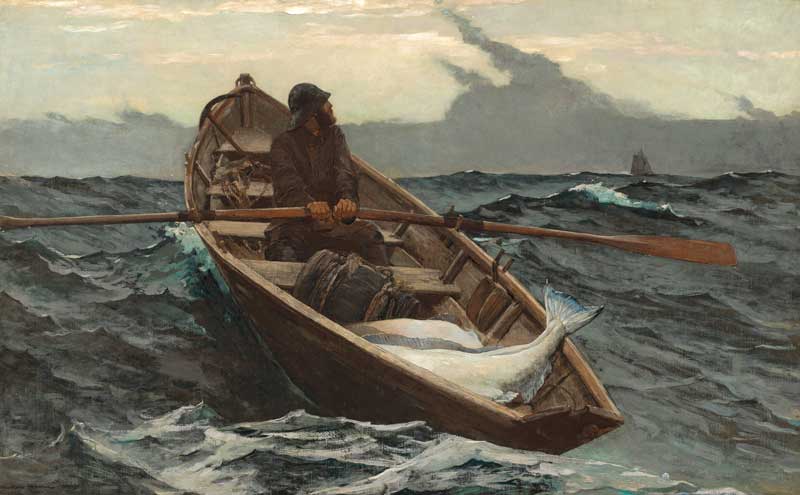
A recent show at the Boston Museum of Fine Arts, “Of Light and Air: Winslow Homer in Watercolor,” provided the occasion to study his particular genius at rendering water. One might begin with one of his greatest paintings, The Fog Warning, painted in 1885 while living at Prouts Neck on the Maine coast near Scarborough. Pulling hard at the oars, the fisherman seems to climb a mountain of gray-green waves that move every which way.
The unruly ocean might be conspiring with the bank of fog that threatens to come between the man in the dory and the mother ship in the distance. The scene brings to mind this description from the opening of Stephen Crane’s celebrated short story “The Open Boat.” It reads, “These waves were of the hue of slate, save for the tops, which were of foaming white, and all of the men knew the colors of the sea. The horizon narrowed and widened, and dipped and rose, and at all times its edge was jagged with waves that seemed thrust up in points like rocks.”
By contrast, in Homer’s Two Boys Rowing, 1880, the sea is an uneven plain of pale watercolor washes. The youngsters, who have stowed their sail and now steer and row with oars, seem to float above the water, the reflection of their boat’s underside resembling a Rorschach test.
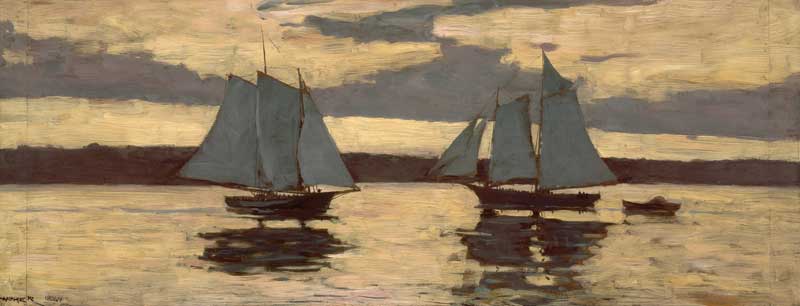
Homer’s several sojourns in Gloucester, Massachusetts, in the 1870s and ’80s led to a number of memorable seascapes. In Gloucester Mackerel Fleet at Sunset, 1884, one of two paintings made to decorate the cabin paneling of his brother Charles’s sailboat, two schooners stand out against a glowing sunset, the sky lighting up the water.
Homer developed into a notable marine artist while in Gloucester. Boats made a great impression on him. Catboats, dories, schooners—he loved their lines, their tilting shapes, their sails catching sunlight or forming shadows on the surface of the sea.
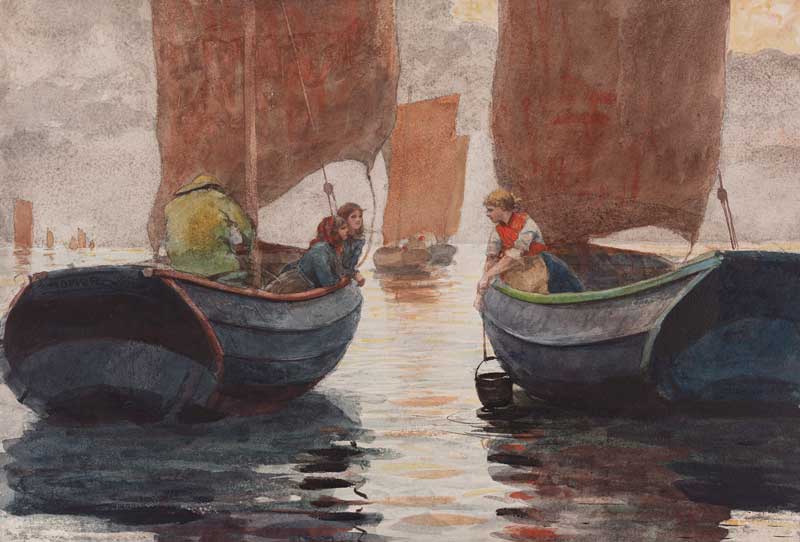
In 1881, Homer traveled to England, to the aforementioned Cullercoats near Tynemouth on the North Sea. Here, too, the boats caught his eye. In the watercolor An Afterglow, 1881, women converse between twin cobles, the distinctive high-bowed flat-bottomed boats that resemble Dutch clogs. The title is most fitting: the soft sunset light gives the scene a certain radiance.
Upon his return from England, Homer renewed his acquaintance with the sea, this time along Maine’s ironbound coast. In the mid-1870s, his family had begun establishing an enclave on Prouts Neck. There the painter would live and work year-round, except for vacation trips, from 1883 onward. And there he would become one of the great painters of the sea.
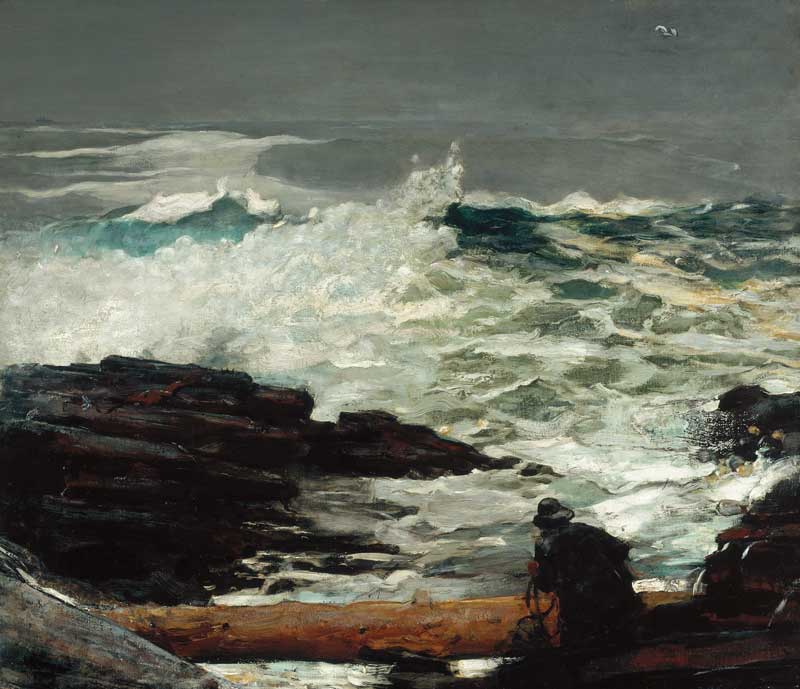
Homer never lost his fascination for different ocean motifs, especially surging waves. Considered his final canvas, Driftwood, 1909, shows a man in the act of salvaging a timber from a furious ocean. According to art historian Philip Beam, the artist was aware that this was to be his last canvas. “[Homer] took his palette, deliberately messed it up, and hung it with his maulstick on the wall of his studio”—his way, writes Beam, “of saying ‘finis.’”
A number of painters followed in Homer’s footsteps. One thinks of George Bellows, Rockwell Kent, Marsden Hartley, and N. C. Wyeth. The last-named artist paid him the ultimate compliment: Homer, he said, “painted the sea for the first time in history as it really looked.”
Inland Waters
In the introduction to his Making Watercolor Behave (1932), painter Eliot O’Hara (1890-1969) outlined the benefits of using the medium. “Speed of getting an effect, quickness of drying, light weight, cleanness, and permanence make this medium an ideal one for either the amateur or the professional on a vacation or a voyage.”
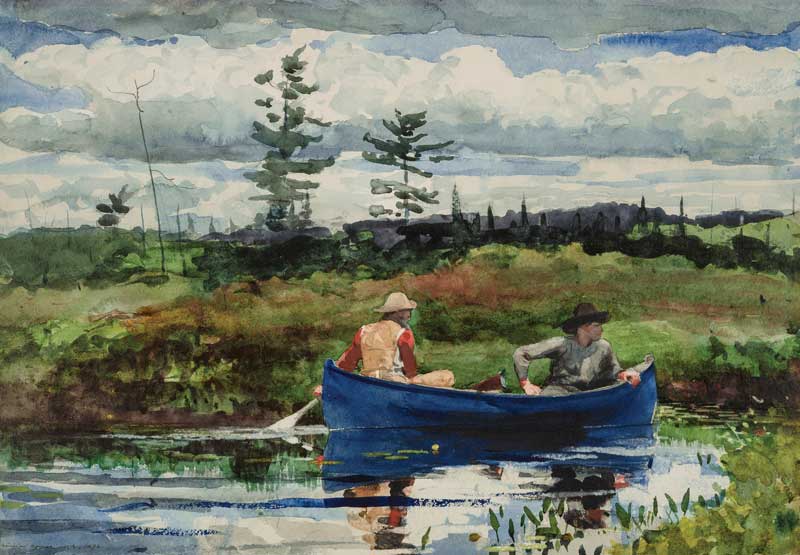
Homer knew how to make watercolor do his bidding. In one of his most admired paintings, The Blue Boat, 1892, two Adirondack guides make their way by canoe through a marsh. Water reflects sky and boat, bringing blue into an otherwise predominantly green environment. The artist knew he had hit one out of the park: a hidden pencil inscription reads, “This will do the business.”
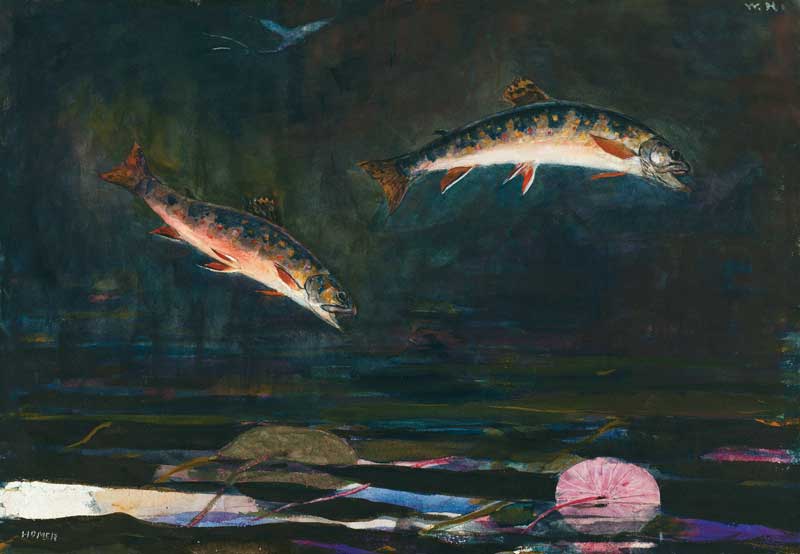
The painting is one of the Boston MFA’s most treasured works of art, appearing on all manner of merch. In one of the museum’s Facebook ads, the boat appears to move across the water. The same ad animates the two brookies in one of Homer’s extraordinary watercolors of fish, Leaping Trout, 1889. In the foreground, lily pads bend to the flow of the river, represented by abstract strips of color.
An avid angler and a not-so-ardent hunter, Homer joined the North Woods Club, in Minerva, New York, in 1888. The watercolors he painted during subsequent visits are among the most formally and technically beautiful and explicitly expressive watercolors he ever made. As art historian Lloyd Goodrich wrote: “[Homer] saw nature less like a poet than a woodsman. He did not try to express his own emotions about her, but to create a living image of her.”
An important part of that “living image” of nature was the water. Homer brought all of his prowess as a painter to rendering this fluid, scintillating element. More than a century after his death, his ways with water continue to amaze.
✮
Carl Little is the author of Winslow Homer and the Sea and Winslow Homer: His Art, His Light, His Landscape. He writes from Mount Desert Island.
Where to See Homer’s Watercolors Next:
“Of Light and Air: Winslow Homer in Watercolor” travels to the Museum of Fine Arts, in Houston, Texas, June 13 - September 19, 2026.