

As with boats, function is the primary factor when it comes to designing a dwelling, but beauty is also important. Add the right touch here and there, and a workboat can become a yacht, just as a house can become the home that reflects the taste of its owner.
As a young man I worked for Dick Carter, a renowned racing sailboat designer, whose loft was located in a tall wartime concrete lookout tower in Nahant, Massachusetts. Carter employed a cadre of aspiring draftsmen, and his designs won such events as the Fastnet Race, the One Ton Cup, and many other European offshore racing championships. Fast across the waves, Carter’s boats were uncomplex in form—so simple that they bordered on appearing plain. Besides his one-off high-end race boats, Carter’s team created a more mainstream production boat, the Carter 33, that closely followed two design tenets: form follows function and less is more. The 33s were built in a yard in Laviron, Greece, using lightweight, often inexpensive materials and finish surfaces that could be misinterpreted as “budget.” Exported to America, the diesel-powered auxiliary racer/cruisers sold for just under $30,000.
Carter was shrewd enough to appreciate the pitfalls of marketing a bargain-priced 33-footer to avid racers looking for a winning ride. But he often spoke of the “Tiffany Items” that were added to the basic hull, deck, and rig to boost the perception of the boat’s true value. Carter 33s were fit out with Goiot winches and deck hardware of stylish shape and brushed aluminum patina. The ultimate “Tiffany Item” was a half model on the main bulkhead of each new boat, painted in the exact same color as the topsides. He made the point that just a few highlights of precious appearance were an effective counterpoint to Carter Offshore’s surprisingly affordable offerings.
Carter 33s sold like hotcakes and they won races. And, I’ll never be able to overlook the value of those Tiffany Items. Tiffany, after all, is seen as a luxury brand that’s up there with Mercedes Benz and The Ritz. The company’s goods, packaged in its trademark blue felt-lined boxes, are emblematic of top quality at any price. Add a Tiffany Item to your house, and well, you get the idea.
Here in Maine, there’s no end to the people creating Tiffany Items for boats, homes, and you name it. Here are just two who have caught my attention.
Windows on Elegance
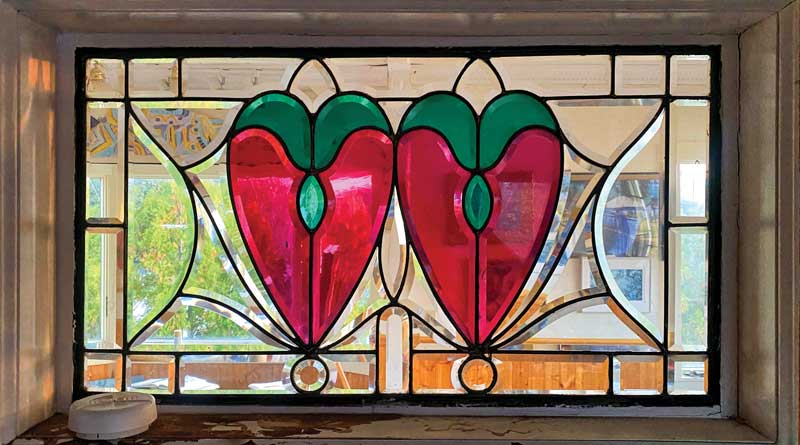
There’s no denying the beauty of stained glass. In dark, cavernous cathedrals and humble country churches, such windows proclaim, “Let there be light.” During the Victorian Era, non-ecclesiastic stained-glass windows became a delightful embellishment in the parlors of the manses along fashionable boulevards. Due to obvious value, even if fine homes were moved or demolished, those fine windows were often rescued and resold.
I spent my honeymoon at Three Stanley Avenue, an Inn in Kingfield, Maine. My bride and I dined at the fine restaurant next door, where chef Dan Davis seated us in his breakfast dining room. That place was a feast of morning light, made the more dazzling by virtue of my bride, plus a dozen incredibly beautiful stained-glass windows. I’d only recently bought my first house in a fishing village on Mount Desert Island. At $17,000, it wasn’t much, but the moment I saw Davis’s collection of colorful windows, I dreamed of warming the innards of our house with a kaleidoscope of rays from stained-glass panes.
At the time I imagined I might have to go to Europe to find such portals, but Davis said au contraire—he bought his in nearby Canaan, Maine. You can bet that we stopped by Soll’s Antiques on our way home to the coast. Meeting Alan and Candi Soll more than 40 years ago was the beginning of a long and treasured friendship.
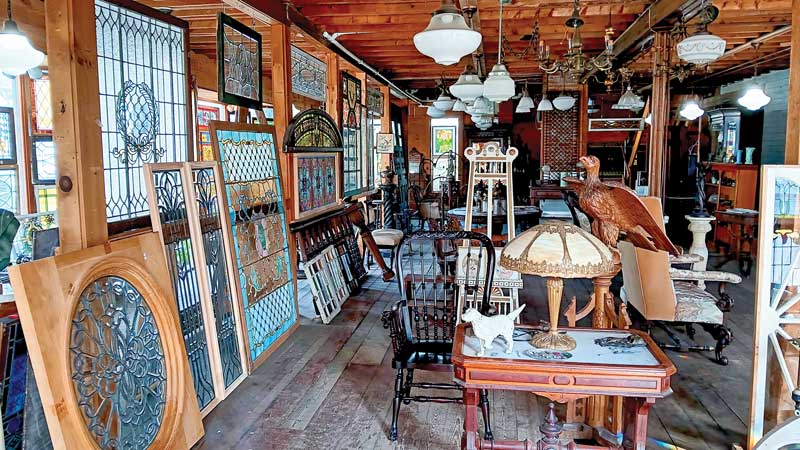
At their shop I was immediately shocked by the prices: Even at my boatyard pay, they were unexpectedly affordable! At the time, our house needed its asbestos shingles gone, a foundation, and a septic system, so it was 25 years later before I actually began my Soll’s Antiques window addiction, But stained-glass windows? We had to have them.
Alan Soll is an expert on American stained-glass art, and he maintains that this country owes nothing to Europe in terms of quality. In many cases Americans tried experiments in glass formulas, pigments, molding, and shaping during the 18th and 19th centuries that were cutting edge. In Soll’s opinion, modern American stained glass doesn’t match the beauty of the late 1800s, which is all Soll’s Antiques sells. His son Isaiah, who’s currently running the business contends that “what’s coming out of China doesn’t come close.”
I bought my first window from Soll’s for a new paint studio addition more than 20 years ago. Later I added a cut-glass transom in the shape of a heart to my daughter’s room. By then I’d made occasional pilgrimages to the Canaan shop, often bringing other appreciators into the fold.

I adore the impact of fine-art glass. My house may still lack what some would consider to be necessities, but I gladly forgo them for the eight Soll’s Antique stained-glass windows—squeezed into the family budget—that we enjoy. And I hope never to leave my quirky home with its views right down on the town dock in Bass Harbor.
Row, Row, Row Your Art
One day while talking to Lynn Cottrell, who I call Mother Hen of her family’s business, Cottrell Boatbuilding in Searsport, she mentioned that their rowboats had occasionally been chosen for some unusual purposes.
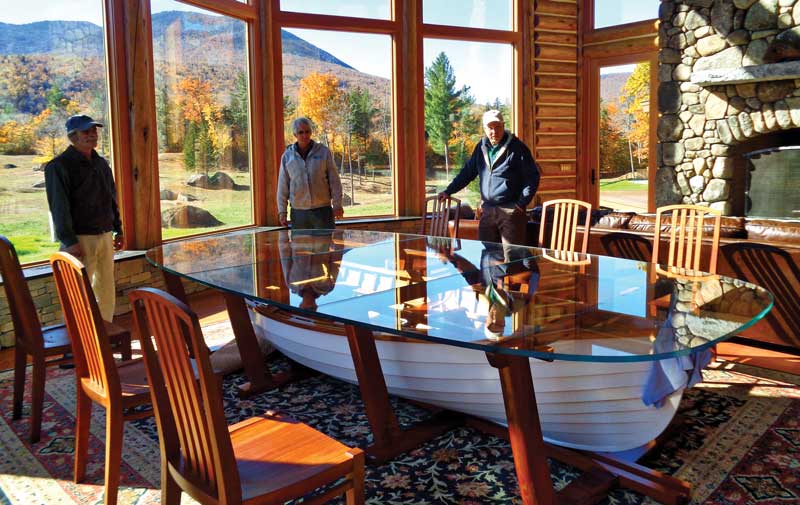
In February, 2014, for instance, a caller came on the phone and told Cottrell, “I’m David Leach, a custom furniture builder down here in Southern Maine. I have an unusual request. I have a client who wants a dining room table built, and we want a beautiful rowboat beneath it.”
When her husband, Dale, came in from the shop, dusted with mahogany, his initial response was, “You gotta be kidding me!”
She reminded him that orders were a bit slow and said, “Hey, it’s a job. It’s a boat. They’re going to use it.”
Cottrell said the buyers had told Leach that they would still use the boat for its intended purpose, rowing, so Dale agreed to take on the job.
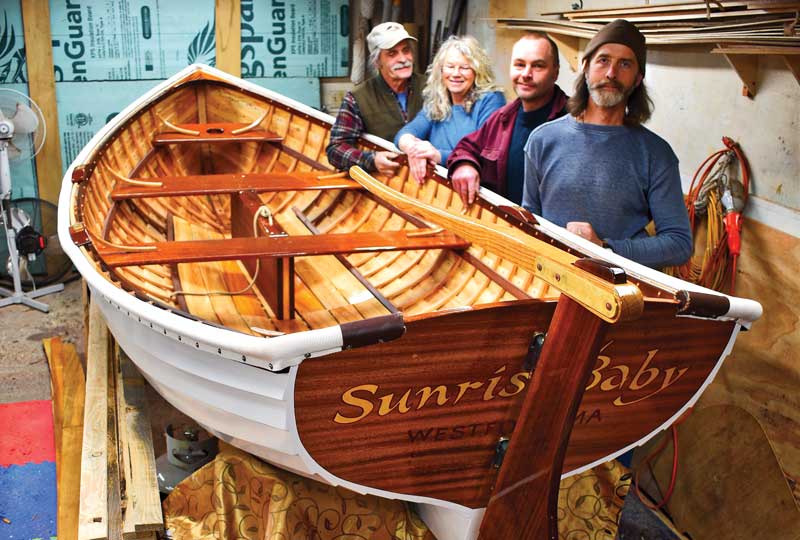
Cottrell said it turned out that the owner, a man, whose beautiful house was in Wolfeboro, New Hampshire, had been a contender in world rowing championships. He wanted not only an exquisite looking boat, but one that would row exquisitely. Leach built the table with a support rail underneath, by which the boat could easily be slid out and carried down to the lake.
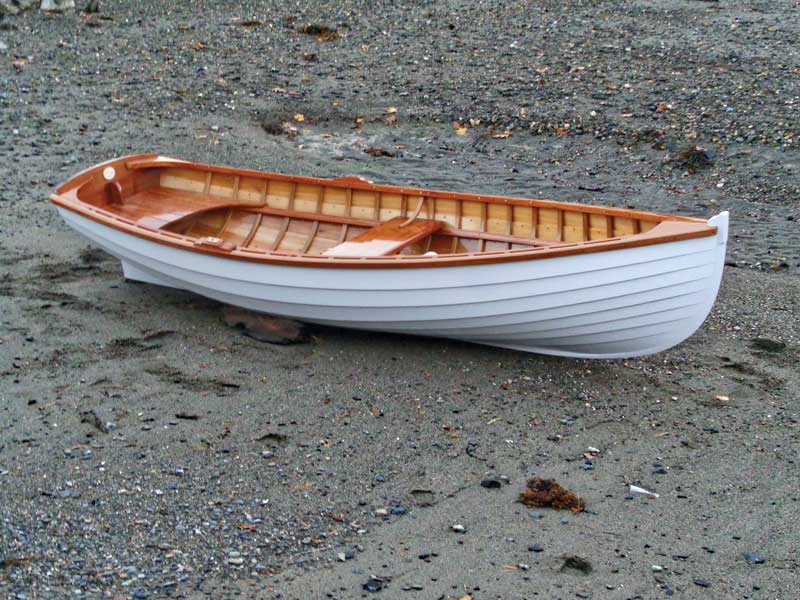
There’s no denying that a Cottrell 10-foot Whitehall skiff can be a Tiffany Item when it is the centerpiece of an entire house. Cottrell said the price of the rowboat seemed reasonable, considering, “The glass on the tabletop ended up costing more than the boat.”
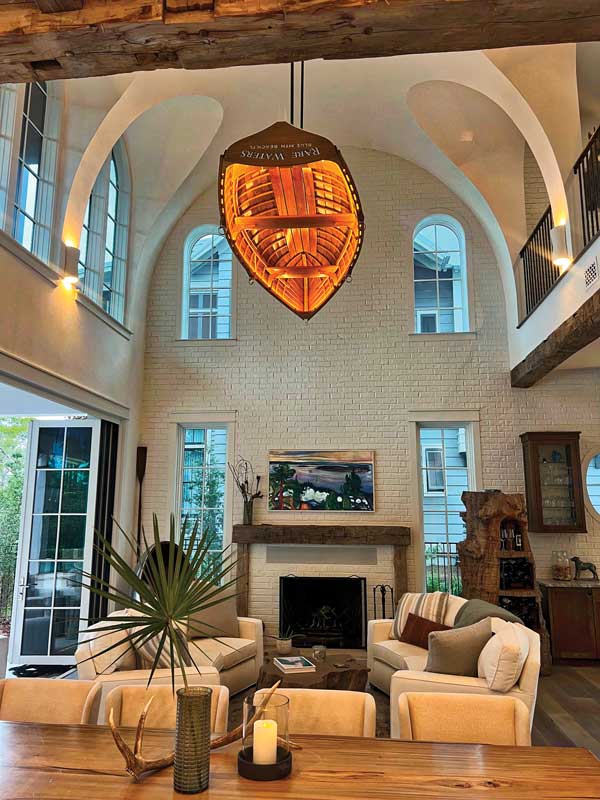
Another time the phone rang and it was a contractor named Rusty Barron. Cottrell recalled, “Mr. Barron said he was building a large new home in Florida, and that he wanted to know if we would build a 10-foot Whitehall to use as a lampshade.” (How Tiffany is that?)
The unusual order came at a good time, since Dale Cottrell had both his sons and a daughter-in-law working, and needed more jobs. Lynn recalled saying, “Well we built a boat as a table so I don’t see any reason we can’t build one as a chandelier!”
Soon the owner of the Florida house emailed a photo out of a magazine of another boat, not so pretty, used for much the same purpose. Then the homeowners got involved and Cottrell said, “They were the nicest people in the world.” They said that before the chandelier was installed, they felt it imperative the Whitehall they named Rare Waters be enjoyed in its natural element.
“They came to Camden and we delivered it,” Cottrell said. “Immediately the two of them set off and rowed out to Butter Island. Then they trailered the boat down the whole East Coast, all the way to Florida. Along the way, Rare Waters was rowed in dozens of harbors and lakes.”
The owners, experienced rowers, judging by their pull some distance across Penobscot Bay to Butter Island and back, kept the Cottrells informed all the way, eventually reporting, “It was rowed in the Atlantic, the Gulf, and in one of the rarest ‘dune lakes’ in the world.”
The boat then became their home’s crowning fixture, suspended at the third-story level in their open-ceiling great room. The house sits adjacent to Blue Mountain Beach, on one of the few natural dune lakes of the Florida panhandle. The boat was carefully suspended aloft and the woman who owns the house told Cottrell, “It was hung by a strap so as to be unchanged, with no holes drilled for that or for wiring of the lighting.”
In January, 2024, Cottrell got another call from Florida, this time it was a woman from D. Garret Construction, who said they were remodeling the Marco Island Yacht Club. She ordered a 12-foot Penobscot Wherry, to be installed inverted in a ceiling alcove. She gave detailed instructions followed up by a purchase order, all in a very corporate and officious manner.
Dale Cottrell and his son, Ben, did most of the work on this boat, and six weeks into it, another call came in, again from the sunshine State. This caller introduced himself, Cottrell said, and began by saying, “I have a very unusual request…”
The caller turned out to be the Marco Island Yacht Club’s commodore, and he was unaware the Penobscot Wherry had already been ordered and was being built.
The call came at an opportune time, though, because, Cottrell said they were about to prime the boat’s interior mahogany planking a cream color, per the work order. Instead, the club opted for a varnish job, inside and out, with the name Friendships Formed on the transom.
Cottrell said the boat, which she believes was never rowed, now decorates the club’s main entryway.
And yet another customer, this time from Missouri, called to order a 10-foot Whitehall “lampshade,” Cottrell said. This boat, built from mahogany, was varnished inside and out and its wale strake was painted Salty Dog blue. Ben Cottrell did most of the work on this beauty.
Tiffany Items. Boat designer Dick Carter was right. An object of function and design such as a humble home, an upscale mansion, or a yacht club, can be significantly enhanced by some conspicuous accessory that is superb in its own right.
✮
Boat designer and Luders 16 sailor Art Paine lives in a home full of stained glass windows that overlooks the Bass Harbor docks in Bernard, Maine.