

Photos by Letitia Baldwin

All it took was a gust of breeze for a clamdigger, a lobsterman hauling traps, and a woodsman sawing logs to spring into action. In the same puff, a woman bent over a washtub started scrubbing and a farmer was repeatedly kicked in the butt by a horse, right there in a Main Street yard, in downtown Milbridge, Maine.
Those were just some of the whirligigs that were furiously spinning on David Schoolcraft’s lawn, which skirts Route 1 in this coastal town 30 miles east of Ellsworth. In addition to his display of hand-built toys, the 83-year-old craftsman also refurbished the intricate wrap-around porch and countless other Victorian-style elements that adorn his white clapboard home.
Originally from Syracuse, New York, Schoolcraft has worked with his hands all his life. For decades, he did largely finish carpentry for a residential and commercial renovation company before retiring in 2015. During those years, he became proficient in electrical work, machining, and plumbing and heating too.
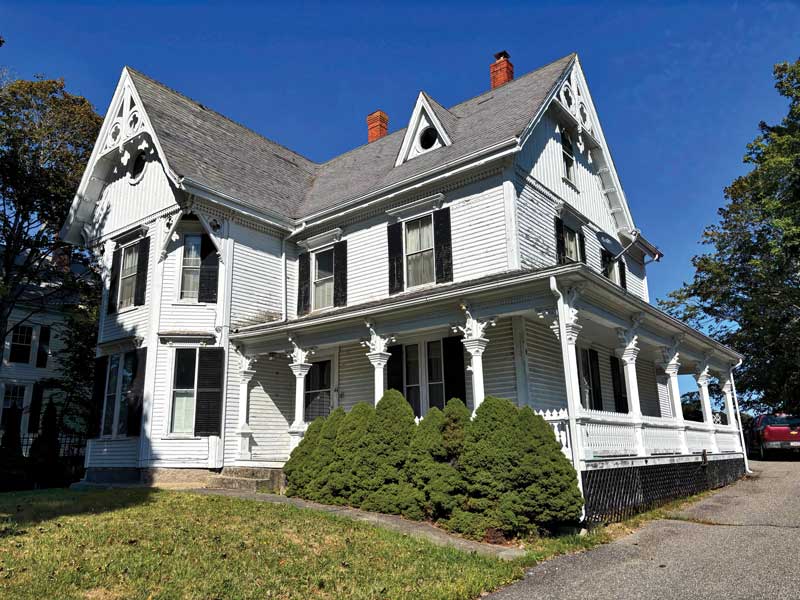
All Schoolcraft’s skills came into play after he and his late wife, Judy, acquired the house built by the 19th century shipbuilder and sea captain Gilbert M. Leighton. The couple moved to Milbridge in 2016.
Uninhabited for many years, the neglected Victorian’s restoration consumed much of his time. But when Judy died several years later, he cast about for an additional pursuit to keep his mind and hands busy during long Maine winters.
“You know, we ought to build whirligigs,” he recalls friend and real estate agent Alfred DiMarco telling him. It was DiMarco who had sold the Schoolcrafts the house, and he had noted a late Birch Harbor gentleman had once made and sold many of the fanciful ornaments, lamenting, “You hardly ever see them anymore.”
Whirligigs—the name springs from the Middle English word whirlegigg, meaning spinning top—have made people smile and chuckle since the 15th century. The light-hearted creations became commonplace by the 19th century.
“Whirligigs, 3-dimensional, wind-driven articulated toys, have been created by artists, self-taught and otherwise, for more than 200 years in this country,” authors Jacqueline Atkins and Robert Bishop wrote in their 1995 book, Folk Art in American Life. “These small, animated statues or structures were created strictly for amusement, for, unlike weathervanes, they do no more than signal that the wind is blowing or not blowing. They also allow a great deal of scope for creative expression.”
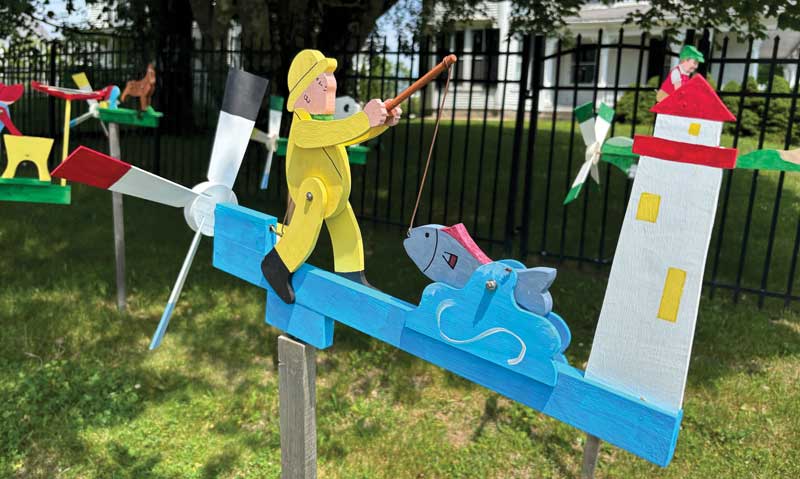
Whether the observer is a dog walker or a mother pushing a baby buggy, whirligigs have a universal charm. They celebrate everyday tasks and activities that people can relate to worldwide.
That spirit—elevating the ordinary—inspired a Scottish folk band to call itself Whirligig. Whirligigs figure in Scottish writer Andrew James Grieg’s 2020 crime novel, Whirligig, in which the killer leaves intricate, clockwork contraptions fashioned from bone and wood at every crime scene. The lawn ornaments even sparked the fastest swimming, semi-aquatic insect’s common name: Whirligig beetles swim in frenzied circles on the water’s surface.

An Engineer at Heart
Throughout his career, Schoolcraft said, he has enjoyed figuring out how things work and how to fix them when they break. And his whirligigs? They are created to capture the humor—the light moments—in people’s daily lives.
“I wanted it to be something that I could build entirely in my shop,” Schoolcraft said, referring to the whirligigs, after welcoming a visitor into his historic house, built in the 1880s. He also likes that whirligigs harken back to a time “when you didn’t go online and buy it, you built it.”
Like other Victorian-style homes gracing Milbridge, Schoolcraft’s abounds in architectural details, from its porthole-inspired dormer windows to the porch’s L-shaped railing supported by 120 wooden balusters. After moving in, Schoolcraft meticulously replicated each one on his bandsaw.
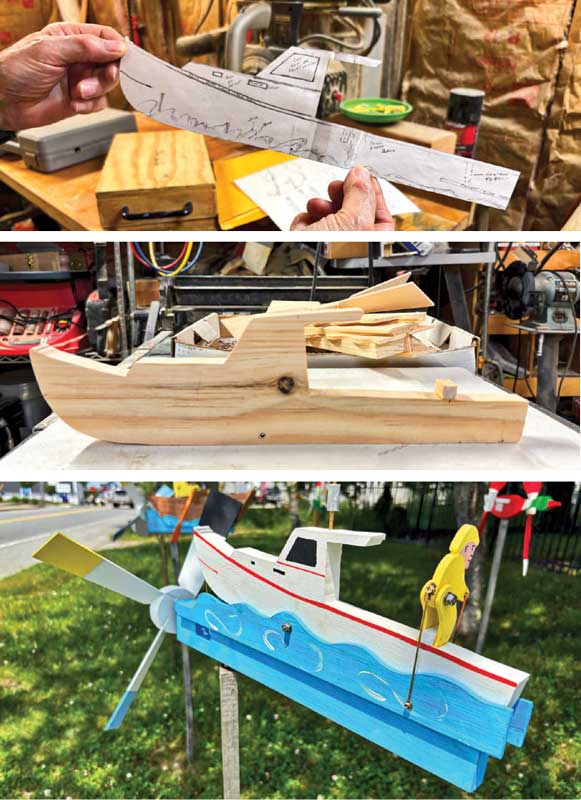
During a visit to his small, well-equipped workshop, which occupies the house’s former carriage house, Schoolcraft extracted an 1/8th-inch brass brazing rod from his supply of metal hardware. He showed how it could be fashioned to serve as a whirligig’s crankshaft, concealed inside a shallow, pinewood box. On one end, the crank is fastened to the hub of a propeller fitted with birch plywood blades to catch the wind.
“You have to have an approximate 45-degree angle to cut them accurately and space them evenly,” he explained of the prop blades.
Depending on the whirligig’s weight, and the amount of wind power needed to turn it, the hub usually has from four to as many as eight blades fixed into slots. The wind sets the blades spinning and activates, say, the fisherman hauling a lobster trap, which is attached by a 1/16th-inch brass rod to the crank.
Each whirligig Schoolcraft builds gets primed with latex and finished with acrylic paint.
Leaving the workshop, Schoolcraft led the way through his kitchen. He pointed out the built-in cabinet that features deep bins for holding potatoes, squash, and other root vegetables. He refinished the chestnut countertop.
In the front parlor, Schoolcraft settled into an armchair. His placid marmalade cat, Sam, occupied half the sofa nearby. He noted the house was once owned by the late Dr. Laurence Betteridge, who saw patients in what is now the adjoining dining room. The physician also was a ventriloquist, and entertained patients with his papier-mâché assistant.
Never having made whirligigs before, Schoolcraft said he first built some popular models from plans purchased online. Before long, he was modifying those and producing his own designs, such as the clammer, fighting roosters, fisherman rowing a dory, and man cranking a Model T Ford.
“There’s quite a lot that goes into each one,” the master woodworker said, crediting DiMarco for helping him get the lines of the downeast boats right. “It takes some trial and error until I get it working good,” he said of the mechanical parts.
In the summer of 2021, to test their appeal, Schoolcraft displayed a dozen or so whirligigs on his front lawn with a for-sale sign. Locals and motorists snapped them up. Growing demand spurred him to make multiple sets of parts for those most sought after, such as the lobsterman hauling a trap. He sold more than 20 of that model this past year.
Despite his success, Milbridge’s whirligig maker has no plans to expand or peddle his creations online. Replenishing his stock over the winter suits him at his stage in life. Making money was never his primary motive.
“What really gives me pleasure are the people who come back and say how much they enjoy it,” he said. Like the woman who bought six for her husband who teaches industrial arts in Jonesport. “He said they were very well built.”
✮
Letitia Baldwin is a freelance writer who lives in the downeast towns of Gouldsboro and Cranberry Isles. She previously worked as the arts & leisure editor at the Ellsworth American and style editor at the Bangor Daily News.
To Find the Whirligigs:
From April 15 through October, David Schoolcraft’s whirligigs may be purchased at 44 Main St., Milbridge. To contact him, call 315-391-0753.
America’s Granddaddy of the Whirligigs
Photos courtesy Vollis Simpson Whirligig Park and Museum
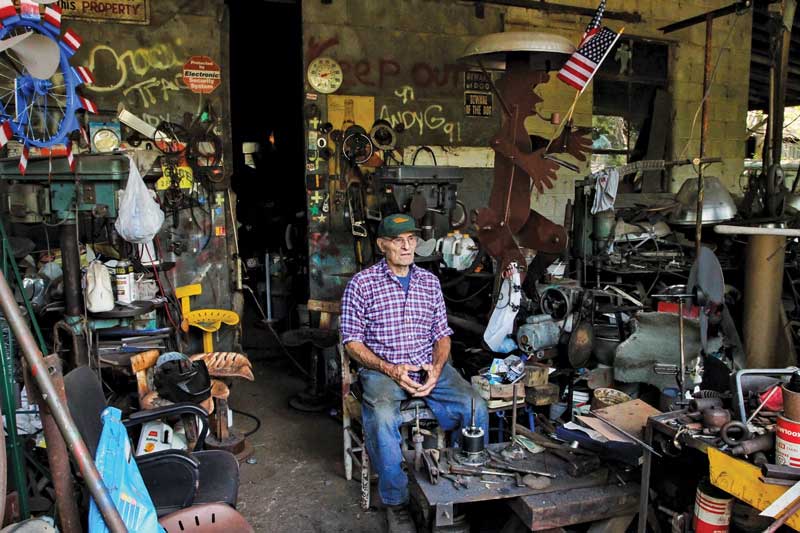
In the United States, Vollis Simpson is the best-known maker of whirligigs. One of 12 children, Simpson grew up in North Carolina’s tobacco-farming community of Lucama. Leaving school in the 11th grade, he served in the U.S. Army Air Corps during World War II. While stationed on the South Pacific island of Saipan, he built a windmill from a junked B-29 bomber’s parts to power a washing machine to launder the airmen’s clothes.
Returning home to his family’s tobacco farm, Simpson and two brothers started a machine shop where they repaired and fabricated parts for farm vehicles and equipment. Their other side gig was moving houses and barns. They often used salvaged I-beams, pipes, rods, and other scrap at hand to rig and transport the structures.
Upon retiring in 1985, Simpson allowed himself some fun. His metalworking became a form of play. Plumbing his own junk piles, he applied his cutting torch to make a piloted rocket ship, a man smoking a pipe, a cowboy strumming a guitar, a team of mules driving a covered wagon, and other curiosities from metal sheets and other discards. He mounted them atop poles in a roadside pasture on his farm. Calling them “windmills,” he made mechanisms to power them from spare parts. As high as 60 feet, the moving, neon-painted contraptions were visible at night.

Not only did the machinist’s giant whirligigs draw locals, they became a tourist attraction and won national acclaim as art. His tallest work, “Life, Liberty, and the Pursuit of Happiness,” was commissioned by Baltimore’s American Visionary Art Museum as a centerpiece before the museum’s 2018 opening. The 6,000-pound structure features an angel, a duck, an airplane, and a unicycler—all of which move in unison.
Before his death at 94 in 2013, Simpson saw the first of his 30 kinetic sculptures restored and erected in the two-acre Vollis Simpson Whirligig Park in the small, nearby city of Wilson. —Letitia Baldwin