

All photos courtesy Sarah LeWine, Paul Tarantino
The most famous dory adventure in New England—so far—occurred in January 1883, when Howard Blackburn, fishing in a dory on the Grand Bank, became separated from the Gloucester schooner, Grace L. Fears. With his dorymate dead, Blackburn rowed for five days to Newfoundland, losing all his fingers and most of his toes to frostbite.
A much more tolerable adventure occurred this past summer, when two more Gloucester dorymates, Sarah LeWine, 59, and Jim Tarantino, 64, set out to row from their home harbor of Gloucester across the Gulf of Maine to Lunenburg, Nova Scotia.
“I was in the Dory Racing Club in Gloucester,” LeWine said. “I had been rowing for a couple of years out to the breakwater with my first dorymate, a woman, and I always wanted to go farther. I started to imagine a trip up the coast of Maine, but I couldn’t think of anyone who’d also want to do that. And then when Jimmy and I became mixed-double race partners and started practicing, we went out to the breakwater, and I said, ‘What I really want to do is row up the coast of Maine.’ He told me he’d been planning to row up the coast and over to Nova Scotia, and asked if I wanted to go. I have so much respect for Jimmy, I said, Yeah!”
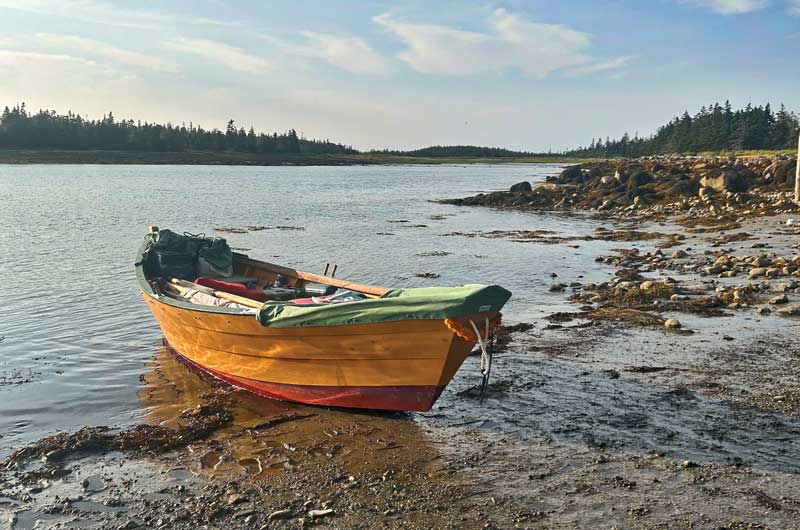
Tarantino bought the dory, a little over 20 feet long with a 51⁄2-foot beam, built at the Big Boat Shed in Lunenburg. “When I went up to get it, it looked too heavy,” Tarantino said. “But it’s a work boat, that’s what you need.”
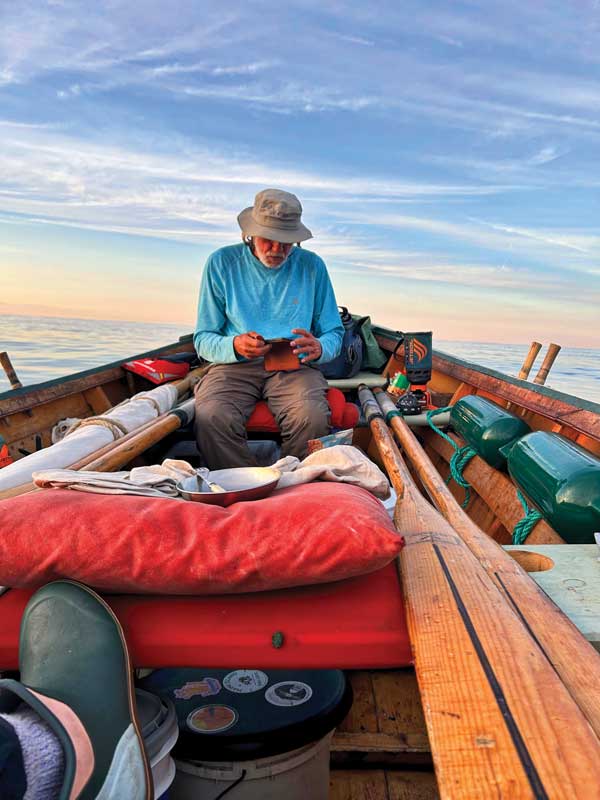
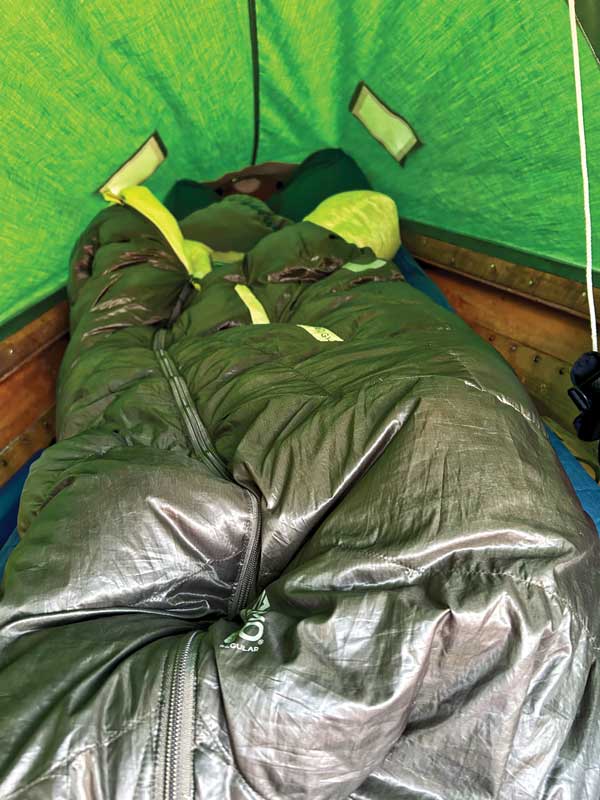
Tarantino named the boat Heart o’ Gloucester, and the two began planning. They loaded the dory with food, water, and Tarantino’s Jet Boil cooker. For safety, they had survival suits, life jackets, and an EPIRB. They set up sleeping spots in the bottom of the dory—Tarantino in the bow, and LeWine in the stern. “We just rolled our sleeping pads out on top of all our stuff,” Tarantino said, adding that he had a tent custom made to fit over the dory. “Best $3,000 we spent.”
They left Gloucester on July 26, pulling for Maine. A friend gave LeWine a garland of marigolds that she hung from the dory’s distinctive tombstone transom. “We followed the coast, rowing about 4 or 5 miles offshore,” said LeWine. “Stopping in harbors along the way.”
LeWine and Tarantino found they were better off sleeping in their boat than on shore. They had to row with the tides, and that meant odd hours for departure. But they gratefully accepted offerings of fresh food and getting their laundry done. “And we liked living and sleeping on the boat, and staying right with it,” LeWine said.
“People were so good to us,” she added. “When we were off Mount Desert Rock, a lobsterman pulled up alongside, his boat was the Lucky Strike. I’ll never forget the expression on his face when he asked where we were rowing from. He cracked up with a kind of disbelief when we said, Gloucester! He sped off and came back a few minutes later with a couple of lobsters, laughing with delight when he offered them to us, but we couldn’t take them. We had no way to cook them.”
Those were the comparatively easy summer days for LeWine and Tarantino. “Though rowing six to 12 hours a day is never easy,” LeWine said. For 11 days, the duo leapfrogged along the coast of Maine, as the passage across to Nova Scotia still lay ahead of them. “We left for the crossing from Frenchboro on August 6,” LeWine recalled. “Jimmy thought we could make it in 48 hours. But it was more like three and a half days.”
They rowed 18 hours a day, sometimes more. Often, one would row while the other slept. As the people of Maine had been generous, so were the Weather Gods out in the Gulf of Maine. Although LeWine and Tarantino experienced contrary winds and choppy seas at times, there were no storms, as such. “What surprised me was how alone we were,” LeWine said. “I thought there would be more boats. But it was just us. At night it felt kind of scary, and mystical in a way. We were a speck out there, but we belonged.”
At one point, rowing in choppy waves, trying to hold a course by keeping in line with a star, LeWine got seasick. For Tarantino, the long hours of rowing took their toll. He found himself so tired that he started hallucinating. “I thought I was with someone else,” he recalled. “I was calling her the wrong name.”
With light comes sight, and LeWine remembers the big swells rolling in. “You see this big mountain of water coming at you,” she said. “It looks threatening, but in a dory, you’re OK. You just ride up one side and down the other.”
Rowing on the open ocean is a far cry from rowing on a placid lake and poses unique challenges. “I’m not the best at holding a course,” LeWine admitted. “But Jimmy is, that’s why he wins so many races.” Holding course on the open ocean involves balancing the power you put into each stroke and finding the water as the boat is lifted and dropped. It’s not unusual to miss and pull as much air as water, though for experienced rowers like LeWine and Tarantino it’s not common.
The big seas altered the currents somewhat, and Tarantino, who was doing the navigating, noticed that they were going deeper into the Gulf of Maine, toward the powerful tides of the Bay of Fundy. But unlike Blackburn rowing blind for Newfoundland, LeWine and Tarantino had GPS, and a satellite connection through Tarantino’s Garmin InReach. “We also used an app called Marine Ways,” LeWine said.
Finding themselves off course, things got a little snappy between the two, as can happen after a few weeks together in a small boat. “I just wanted to know where we were and what was the plan,” LeWine said.
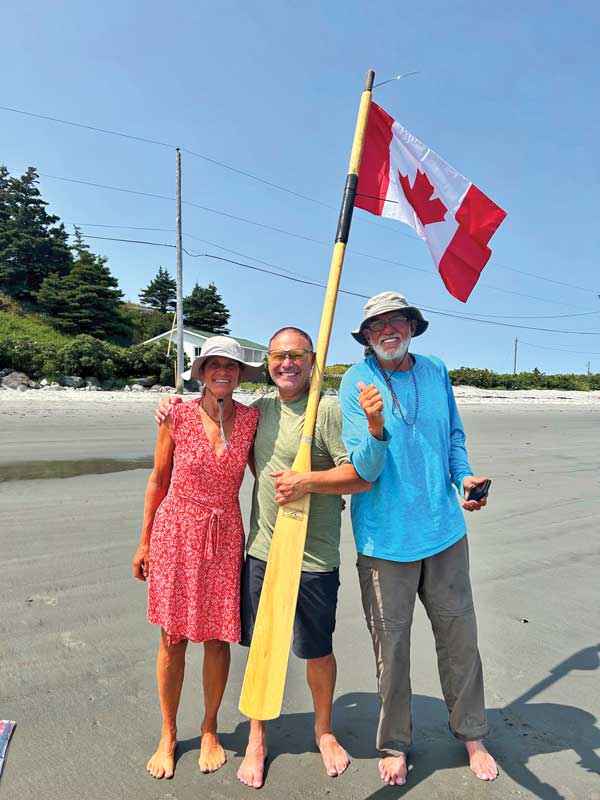
“I just wanted her to trust me,” countered Tarantino, who was trying to figure out the best way to deal with the easterly set. “We were being pushed east, so finally we just decided to row that way,” he said. “We ended up farther into the Gulf of Maine than we planned. We landed at Cape Forchu, Nova Scotia, on August 10.”
They still had to fight the Fundy tides to get down around the tip of Nova Scotia and row another 100 or so miles up to Lunenburg. After more than 300 miles, things got rough on the home stretch.
LeWine and Tarantino rowed with the ebb tides until they got around to the eastern shore. “Then we were off the coast about 4 miles, and the wind and waves got big, really big, and close together,” LeWine recalled. “We were going down one, looking up at the next. I didn’t think we were going to make it. I thought this was it.”
“I didn’t think anything,” Tarantino said. “I just kept rowing.”
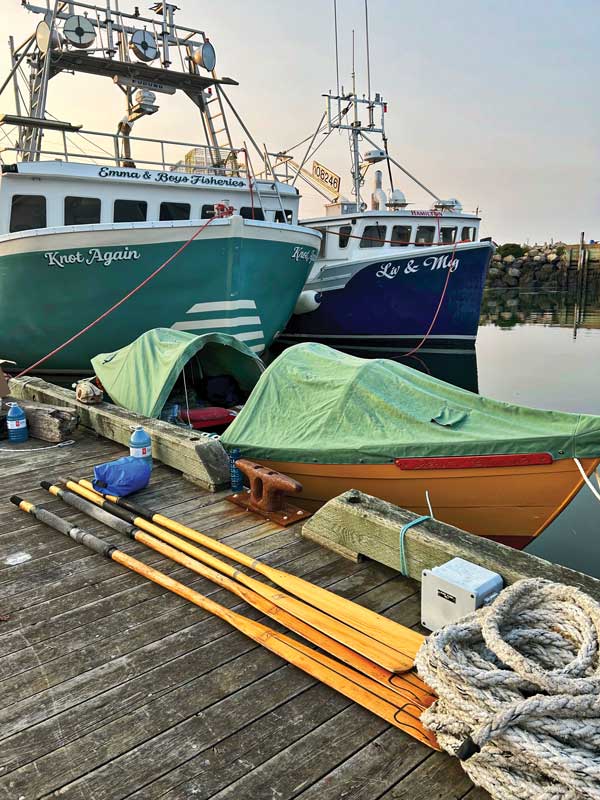
They made it through the worst day of the journey and into Little Harbour. “We waited for the weather to pass, then kept rowing the next few days and pulled into Lunenburg on August 19,” LeWine said, noting that the marigolds on the transom made it all the way.
“We had an incredible welcome to Lunenburg, with what seemed like an armada of dories that came out to greet us,” she said. “Andy Rhodenizer, who built the boat, rowed out too, and so many others jumped in their boats to join our arrival. I’ll never forget that, and all of the people gathered on the docks cheering us in, the crew of the Bluenose sounding its horn, too! It wasn’t just about us; it was a moment of joy for all.”
LeWine and Tarantino stayed in town for the 74th International Dory Races between Gloucester and Lunenburg, and on August 24th left Lunenburg and drove all the way home to Gloucester, where they continue to give talks about the adventure.
✮
Paul Molyneaux lives in East Machias and has written about commercial fishing in the New York Times and other publications.