

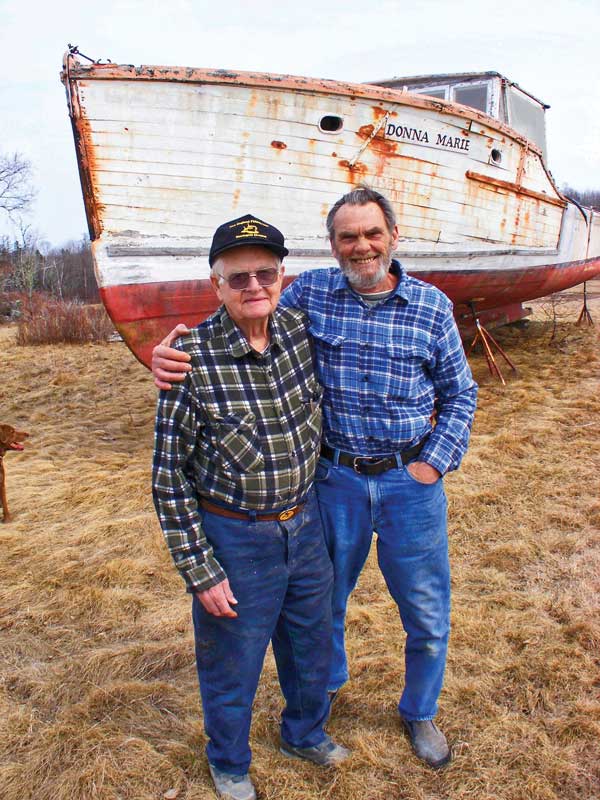
Lord knows there’s no shortage of landlocked old wooden lobsterboats viewable from your vehicle when driving in downeast Maine—you’d be hard-pressed not to see one if you’re anywhere near the coast.
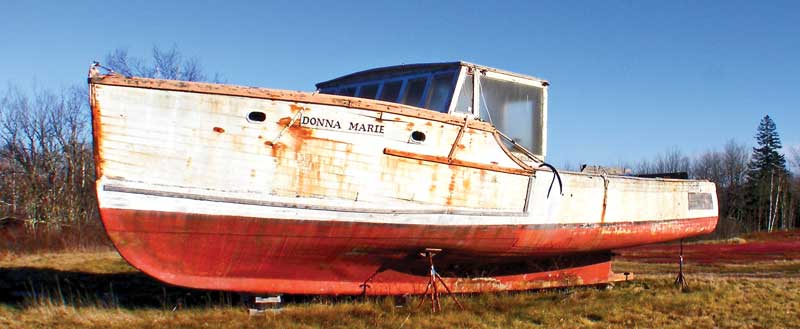
But there’s one old wooden classic sitting in a field alongside Route 187 as you head to Jonesport after turning off Route 1 in Columbia Falls. The boat’s backstory is a unique one. And even though it’s been years since her keel touched salt water, she’s probably had more ocean under her (and over her, for that matter) than most boats of her vintage.
Her name is the Donna Marie. Look at her with one set of eyes and she’s just an old 45-foot wooden boat with flaking paint, her fastenings bleeding rust from stem to stern. But through a different set of eyes, knowing that back in the 1970s she was offshore lobstering on the southern side of Georges Bank alongside her sistership, the Ann Marie, and, well, she’s something to be admired.
The phrase “They don’t make ‘em like that anymore” applies to both the Donna Marie and the men who fished back then.
“It was time.”
Any discussion of the early days of offshore lobstering in New England will likely lead to a debate over who was the first to do this or that; who went the farthest; who fished the deepest; who caught the most; dragging vs. trap fishing; wire vs. rope. Who was the boldest?
With apologies to, and much respect for, all who blazed the way for others to follow, I can tell you that when it comes to offshore lobstermen from the state of Maine, Benny Beal was a pioneer.
Benny was already a recognized highliner amongst the Jonesport-Beals inshore fleet (which included fishing the tide-wracked Grand Manan Channel—no picnic itself) in the late 1960s when he began thinking about heading farther offshore with homemade traps and a homemade boat—the aforementioned 45-foot wooden Ann Marie.
Years later, I asked Benny what inspired him to take that gamble, basically going on some stories he’d heard, a paper chart, a compass, and guts.
“I was delivering boats my father, Elihu, built to New York and around,” Benny told me, in his slow, measured downeast drawl. “We took one to Montauk, New York, and I got talking with some of the fishermen. They told me about dragging lobsters on that sand bottom down there…and they were getting them way off outside on the Continental Shelf, too. I guess I…” Benny paused at that point. It was almost as if he’d never really thought about why he’d done what he had. “I don’t know, dear,” he finished, “I guess I just figured it was time to go out there myself.”
It was during the building of Benny’s 45-foot by 15-foot Ann Marie, designed by his grandfather, Riley Beal, that a fisherman from Marblehead, Massachusetts, named Manny Porter showed up to take a look at her. Manny talked with Benny about what he was planning on doing with the 45-footer, and where he was headed with his first load of lobster gear.
The two men took a liking to each other early on, and a deal was struck: As soon as the Ann Marie was launched, Elihu would begin work on another 45-footer for Manny.
That boat was the Donna Marie.
The Porter Brothers
“I’ve been there and back / Just to see how far it was.” Those lyrics from the old Ronnie Lane song “Debris” nicely sum up of the life of Tommy Porter, one of Manny’s brothers.
Tommy left Marblehead for the first time when he was 14. His mother sent him to the store for tuna fish; he returned a few weeks later, having been to California and back, and handed her the can of tuna.
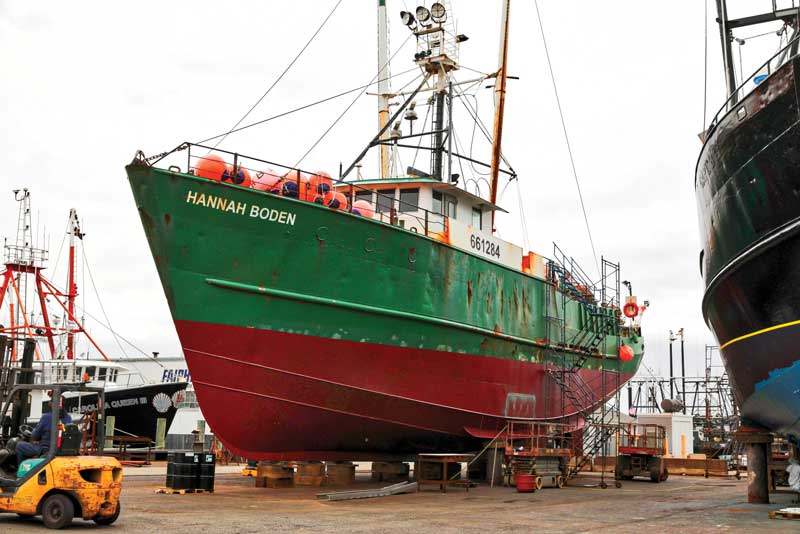
In his lifetime on the water, Tommy has fished the Atlantic from one end to the other—from the Grand Banks down to South America. The list of boats he’s skippered and worked aboard is a long one, including the Hannah Boden and the ill-fated Andrea Gail for the late Bob Brown. But if you were to ask him about his favorite boats from over the years, the Donna Marie would be high on the list.
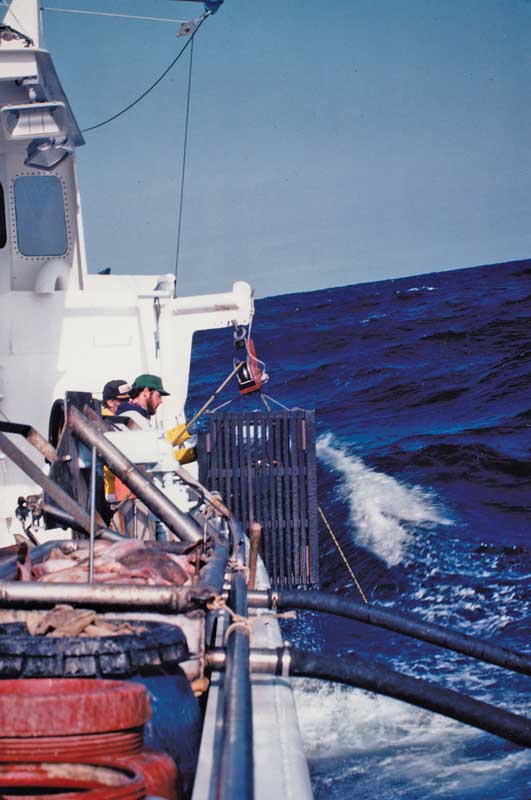
When Tommy got out of the service in the spring of 1971, Manny was tub trawling with the newly-launched Donna Marie. Soon after that they were headed off to the southern side of Georges Bank with lobster gear to fish in company with Benny Beal.
Tommy was with Manny for the trip the Donna Marie shouldn’t have survived, along with their younger brother, Billy, and Tom Cogswell.
“She was a great sea boat,” Tommy remembered, “but that was a horrible night: a gale of wind, snowing, and cold. We were taking an awful beating, but that boat was solid. And then a sea hit us that blew the windows out and just about ripped the house off her.
“I was on the engine box cover and that sea washed me right through the half-inch plywood door in the side of the wheelhouse onto the wash rail—still in my sleeping bag. You can probably still see my fingernail marks where I was trying to keep from going overboard. The engine box cover washed off, and the deck was flooded rail to rail. The scuppers were plugged with bait that had gotten washed around and the main engine died.
“She was going down.
“I’d just made some plywood covers for the lobster tank a couple days before we left, plus I’d bought a 20-foot length of 3-inch hose with a quick-release for the Lister diesel pump we used for the lobsters.
“Like I said, the main engine had stopped, but that Lister was still thumping away; I got that new 3-inch hose down into the bilge and started pumping her out. We managed to get the main engine started back up just before the batteries went under. Don’t ask me how…we should have all died, right then and there.
“And the plywood covers I’d made? There’s my brother, Billy, up on the bow with a rope around him in the middle of the night—blowing about 80. She’d roll down and you’d hear him up there, trying to nail the covers over the blown-out windows on one side: bang bang bang! And then she’d roll the other way, and he’s trying not to wash overboard while I’m hanging onto the rope.
“The stovepipe was gone and the stove was flooded. No heat; no life raft; no survival suits. Nothing. But we kept her afloat and started heading for home. The rest of that night, it was three of us at a time in a wet sleeping bag, trying to stay warm, with the fourth man on the wheel, taking half-hour shifts,” Tommy recalled.
“It was bad. When we got close to Cape Cod, I ended up shooting flares at a dragger off the GRS buoy because we had no lights. I mean, everything was gone—the front windows; the side windows—gone. We got into Harwich Port and I grabbed a handful of dirt. I said, ‘Manny, you see this?’ And I ate the dirt. I says, ‘I ain’t ever going out there again.’ But…I did.”
Recollections in a Jonesport Field
Of the three Porter brothers who rode that storm out aboard the Donna Marie, Tommy is the only one still with us today. Manny and Billy both passed away in 2021, within a few months of each other.
Benny Beal died in 2022, having spent the majority of his 90 years on or around the ocean.
A few years before Benny passed, I was able to arrange a reunion between him, Tommy Porter, and the Donna Marie in that field alongside Route 187.
Manny Porter eventually sold the Donna Marie, replacing her with a 55-foot Bruno & Stillman. (“The Donna was twice the sea boat,” said Tommy.) A few years later, Benny tracked her down, wanting to bring her back to Maine to rig for scallop dragging.
Once back home, the Donna Marie was kept busy as part of Benny’s fleet of workboats. Then, one of the skippers who’d fished her for Benny ended up buying her and working her for a number of years, but eventually she was hauled out on the bank and trucked to the field where she rests today.
As we approached the old girl, it was easy to see how heavy her planking was: In several places on the hull, the inch-and-a-quarter mahogany had pulled away from the timbers.
“That mahogany’s still solid,” said Tommy, knocking on the 45-footer’s hull with a gnarled fist. “Damn,” he noted, “this is one heavy boat.”
Benny recalled, “When we had her hauled out on the railway in Jonesport, we had to build a special cradle for her.”
As we rounded the corner of the stern, Tommy turned to Benny with a grin.
“Wasn’t there some story about a bunch of bananas they had to put on the skids to slide the boat down when they launched her?” he asked.
“Yep,” said Benny, nodding. “There’s nothing as slippery as bananas when you’re launching a boat.”
Tommy started to laugh. “And by the time they went to launch the boat, your father had eaten all the bananas, right?”
“Could’ve been ...” said Benny, with a smile.
He pointed at the Donna’s stern. “You see how she has a nice, flat bottom across here? It doesn’t appear that way when you look at her from up forward, does it?”
“No,” said Tommy. “You eye her up from the bow and she looks pretty round—that’s what made her so easy going into it. But she does flatten off back here…it kinda surprises you.”
The Good Days, the Bad Days
Benny told us when he first went off to Georges Bank with 4-foot wooden lobster traps he’d built himself, they didn’t get the big fishing haul. “Maybe 20 pounds to a trap,” he recalled. “Then I took gear out over the edge, where the canyons fall off. That was much better than inside on the flatter bottom. That’s where we found some lobsters. We had these trawl tubs that would hold 100 pounds, rounded up. We hauled up the end trap that was half full of bricks and filled one of those tubs with lobsters. The next one that come up, we filled one of those tubs and put another 30 pounds on deck—130 pounds out of a single-bedroom trap!”
Once the Donna Marie joined the Ann Marie, the two boats fished in company, sharing the fishing bottom and keeping the gear tended. It was pretty work for a while, but then it was over.
Tommy remembered hearing Benny’s call to Manny over the shortwave radio. “We were at the dock, loading on traps and getting ready to leave to run back off. Benny came on the radio and said, ‘Don’t bother coming, they’ve cleaned us out.’”
Benny nodded, recalling how a fleet of foreign trawlers took over the most productive lobster bottom they’d found, destroying hundreds of brand-new
lobster traps Benny had built over the previous winter.
“The fall before, we’d been fishing out in 135 fathoms or so on those edges, but I brought three 10-trap trawls in and set them on a 50-fathom piece just outside of Little Georges. The last trip we made before winter set in, we hauled them to see what there was.
“Man, oh, man,” Benny recalled, “They were just as full as you could’ve stuffed ’em—and the biggest kind of lobsters. Over the winter, Manny and I figured between the two boats we were gonna stock one hell of a charge of money. We built up a big gang of brand-new traps to set out there.
“Well…it didn’t work out that way,” said Benny, shaking his head. “In the spring, we set all that new gear out and we were running off to haul for the first time. I was laying down and one of the boys woke me up. They were seeing all kinds of boats up ahead on the 50-mile radar.
“Back then we didn’t have all the automatic stuff—you had to pick up a master and a slave on the Loran. I got that set up and took a distance on the radar,” Benny said. “They were right in the middle of our lobster gear. Big Russian draggers.
“We ended up with 23 traps left out of the hundreds of new ones we’d built and just set out, and a few endlines. Everything had been towed up and destroyed by those draggers,” Benny told us.
“And there was nothing you could do about it?” I asked.
“Oh, we took them to court, and we eventually beat them,” said Benny. “But the lawyers took it all. The only thing I got out of it was a photostatic copy of a Russian check—and I don’t even have that anymore.”
We began to walk back across the field to the car.
“Those were the days, Benny,” said Tommy.
He turned to look back at the Donna Marie.
“And that was one hell of a boat.”
✮
Brian Robbins’s past lives include years as an offshore lobsterman and editor for Commercial Fisheries News.