

Rent a classic
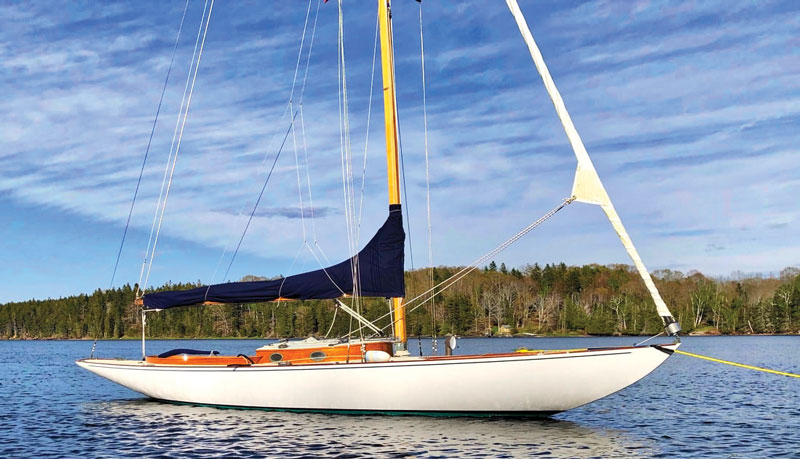
Seeking to build community and make classic sailboats more widely available, the folks at Buck’s Harbor Marina have started a new initiative called the Maine Classic Boat Collective
The marina now owns a small fleet of classic daysailers that it plans to rent to the public, starting this summer. In addition, people can become members of the collective to get reduced rental fees, among other benefits, said marina general manager Tom Hollyday.
“The goal is to provide community access to classic, traditional boats,” he said. “If people can’t sail and use these boats and they are stuffed away in someone’s shed, why would anyone buy them 20 or 30 years from now, if they had never experienced something like that.”
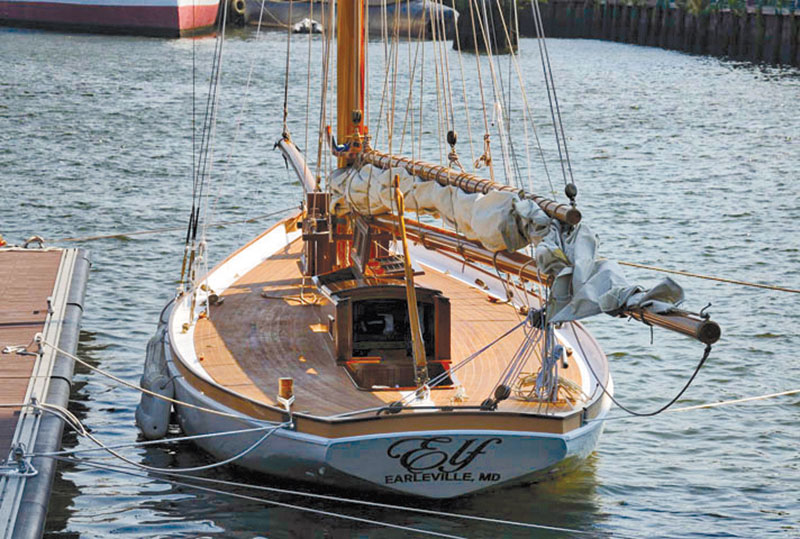
Since part-time Brooksville resident Andrew MacArthur bought the marina in 2024, he has made improvements to the facilities, including building a new dock system, installing new fuel tanks and new mooring balls, and upgrading outdoor showers. The marina already has a range of powerboats for rent. The collective is the next step, Hollyday said, adding that MacArthur is a “wooden boat fanatic.”
The classic fleet will include a cold-molded Herreshoff 12½; a fiberglass Herreshoff Marlin and a fiberglass Golden Era Petrel; a Pearson Ensign; a cold-molded, modified Dark Harbor 20; a 1925 John Alden Triangle; a 1951 Stuart full-keel knockabout; and a 1927 Herreshoff S Class. In addition, plans call for making an 1888 gaff-rig cutter available for charter.
All the boats have small electric motors, and will have iPads on board for navigation.
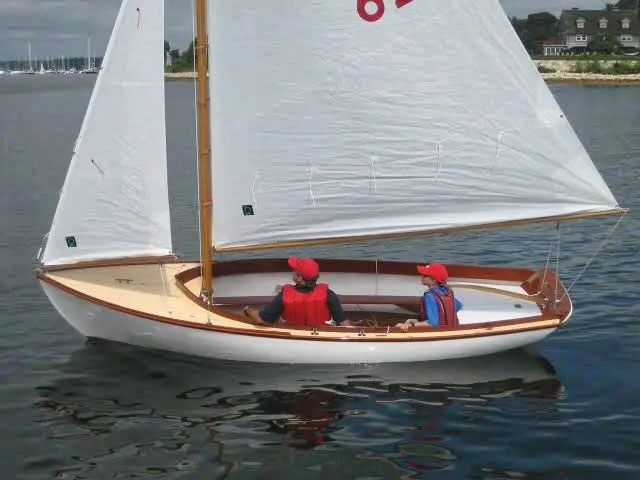
Some of these boats are currently in Brooksville, stored at Seal Harbor Boatyard. Others are being worked on at Artisan Boatworks in Rockport, as well as Atlantic Boat and Hylan & Brown in Brooklin. The Hylan & Brown shop is also restoring and adding an electric motor to a 1908 Fay and Bowen torpedo launch, which the marina will use as a launch, Hollyday said.
Would-be yachters can fill out a form and be approved to rent the smaller boats for day sails. Renting the larger boats will require learning how to sail them with a marina employee. Rental rates will range from $150 to $250 a day. Hollyday also plans to reach out to area yacht clubs, making boats available to their members for charter.
The general manager, who most recently captained the pilot cutter Hesper along the coast, said long term plans call for making the collective a formal nonprofit.
For information, contact Buck’s Harbor Marina at info@bucksharbor.com.
Shrimp fishery remains closed
In news that actually won’t be news to most people, regulators have voted to extend the long-term shutdown of the New England shrimp fishery. Maine fishermen used to catch millions of pounds of small pink shrimp in the winter, but the fishery has been under a fishing moratorium since 2014. Rising temperatures have created an inhospitable environment for the shrimp, and their population is too low to fish sustainably, scientists have said. According to a report by the Associated Press, an arm of the Atlantic States Marine Fisheries Commission voted this winter to shut down the fishery for at least another three years. The decision came after some shrimp harvesters last year participated in a sampling and data collection program. The fishermen, who battled some rough weather, caught only 70 shrimp totaling less than 3 pounds, according to the AP.
Ferry plans
Almost a year after the low bid to build a replacement for the Islesboro Ferry came in $7 million over budget, the Maine Department of Transportation has come up with a new design that it says will likely cut $20 million off that previous $41.5 million bid.
MaineDOT had hoped to replace the aging Margaret Chase Smith ferry with a longer, double-ended, electrically propelled boat. During a December public meeting in Islesboro, MaineDOT officials said significant savings could be realized by instead using a hybrid-assist propulsion system, according to a report in the Midcoast Villager.
Electric or hybrid propulsion is a requirement of the $28 million federal grant that MaineDOT secured to fund 80 percent of the new ferry, according to reports.
Another cost saving involved abandoning the idea of a double-ended hull, and reducing the length of the ferry, resulting in savings both in boat construction and berth modifications.
The proposed new boat will have seating for 100 in the cabin and 62 outside, and room for 18 cars and three large trucks, the Villager reported.
MaineDOT stopped accepting comments in early January.
More parking
In other ferry news, down the coast in Rockland, the Maine Department of Transportation announced plans to expand parking at the ferry terminal by adding an open-air deck over the city’s existing parking area. The upper deck will have 211 spaces. The ground level will have 210 spaces, according to a story in the Midcoast Villager.
The project, estimated to cost between $10 million and $12 million, will require special federal funding. No specific construction date is listed but work is expected to be done within two years, according to the report.
Life jackets required
Youngsters, age 11, who think they have aged out of the state law requiring them to wear life jackets are in for a reality check. As of January, 2026, children 12 or younger, including boat operators, must wear a United States Coast Guard-approved personal flotation device while on any watercraft that is underway and being used for recreational purposes, according to Maine Department of Inland Fisheries and Wildlife, in a news release.
The change increases the required age from 10 or younger, and is intended to improve youth safety on Maine’s waters. The updated age requirement now aligns with federal law.
Exceptions include if the child is below decks in an enclosed cabin, or if the watercraft has a Coast Guard certificate of inspection.
Really, though, it’s a good idea for everyone, no matter how old, to wear some kind of PFD. “Maine Department of Inland Fisheries and Wildlife encourages everyone aboard a watercraft to always wear a life jacket,” the department said in its release.
Over the bar
Virginia Oliver, who gained fame in recent years as Maine’s centenarian lobster lady, has died. She was 105.
Oliver became famous when family friend Wayne Gray made a short film about her in 2019. “She’s a local legend,” Gray told the Portland Press Herald. “She’d get calls from all over the world. She’d say, ‘what’s all the fuss about?’ But then she’d laugh and answer their questions. She liked to talk about lobstering. She liked being out on the water. She liked being her own boss.”
Oliver began lobstering with her older brother when she was 8. Later in life she worked with her husband on his lobster-fishing boat, and when he died in 2006, she joined her son Max on his fishing boat. Oliver fished regularly with Max until she was 102. Gray told the Press Herald that she had not fished much in the last three years, but continued to renew her commercial fishing license just in case.
“Virginia Oliver leaves behind a remarkable legacy of tireless passion for fishing that will serve as an inspiration to generations of Maine lobster harvesters,” said Carl Wilson, commissioner of Maine’s Department of Marine Resources.
Boatyard sandbox
Not all boatyard projects involve boats. A recent social media post by Brooklin Boat Yard touted the yard’s work to replace a treasured sandbox at the local Blue Hill Consolidated School that was built in the shape of a wooden boat.
The yard partnered with Hewes and Co., which provided a skiff kit that BBY interns built.
Wharf rebuilding
After a massive fire in late December on Custom House Wharf in Portland destroyed several businesses and damaged fishing boats and infrastructure, the owners have said they plan to rebuild, according to various news reports.
The heat of the blaze and the water used to suppress it damaged fishing gear stored on the wharf. Boats tied up to the wharf were also damaged and one boat sank, according to news reports.
A fund set up by the Maine Coast Fishermen’s Association to collect donations for fishermen had raised more than $72,000 by early January.
Fishermen’s Association Executive Director Ben Martens told Maine Public Broadcasting that his group will work with fishermen to decide how best to distribute the aid after the financial losses have been calculated.
Custom House Wharf co-owner Steve Goodrich told Maine Public that about 20 percent of the wharf was damaged, including the Sea Bags factory store, Nanuq Kayaks, Maritime Antiques, and a workshop space where he believed the fire originated, caused perhaps by something electrical. Fire officials have said they do not suspect foul play.
“I think for the most part, we’ll restore the buildings substantially to what they were before, but with more modern and up-to-date safety components,” he told Maine Public.
DoryWoman adds sauna to offerings
Go for a row, then take a sauna? Sounds good to us. Nicolle Littrell of DoryWoman Rowing in Belfast used a $10,000 grant from Women’s Net, a national organization that supports female business owners and entrepreneurs, to purchase a mobile wood-fired sauna to enhance her business during the winter.
Littrell has named her sauna business Salty Witch Sauna, according to a story in the Midcoast Villager. She named the sauna itself Mélusine, after the double-tailed mermaid from European folklore.
The sauna is located on leased space at 15 Front St., Belfast, behind the Bayview Point Event Center.
Sauna sessions will be available both as part of rowing packages and as standalone appointments, continuing until mid-May.
Customers wishing to enhance their sauna or rowing experience with a cold plunge may do so at their own risk, as this option is independent of any package offered by Littrell. A small beach nearby provides water access.

Winter wonders
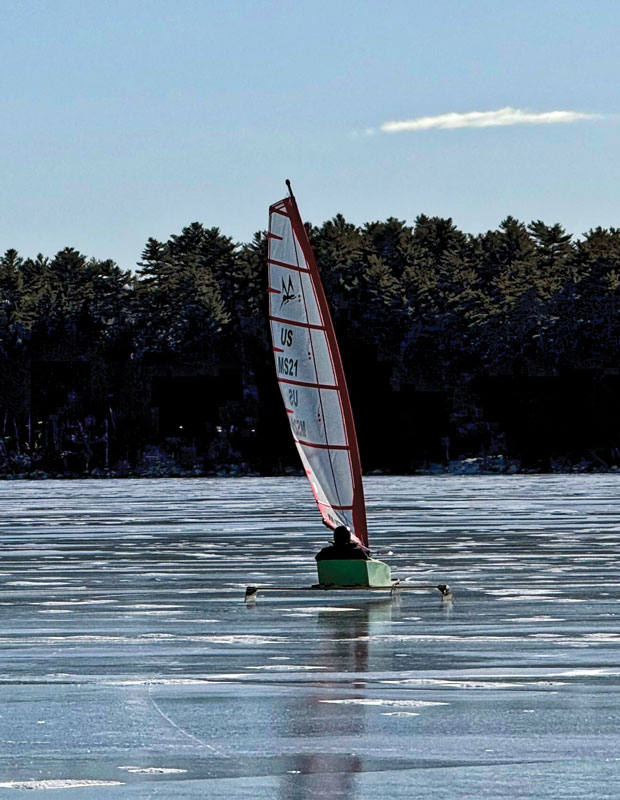
The weather in Maine this winter has been topsy-turvy, with record snow storms and cold. But not everyone sat by the wood stove waiting for spring. The snow drew skiers, while glorious ice on lakes and ponds drew dozens of wild-ice skaters and iceboat sailors.
Late in January, when snow had covered most coastal lakes, some coastal Mainers were treated to the rare spectacle of snow rollers. This occurs when light, moist snow falls on ice or hardened snow, and is rolled across the surface by high winds. The result is hundreds of round snow blobs with hollow centers.
Stephen Baron, a forecaster at the National Weather Service’s Gray office, said the office received a report of snow rollers from a correspondent in Durham around the same time they showed up on Knox County’s Megunticook Lake and a handful of other midcoast lakes.
“You need to have fairly precise conditions for them to occur,” Baron said of the rollers. “You need snow to be moist so it will stick, and temperatures right around freezing or a little above. You need a hard layer underneath and wind blowing so that as the snow slides it rolls into a ball.”
Federal money for Maine
We received a slew of press releases in January from U.S. Sen. Susan Collins’s office announcing new federal funds earmarked for various Maine/New England projects and institutions.
They include:
- $4.53 million to remediate algae blooms in North Pond and Unity Pond. Of that, $2.35 million is allocated for the 7 Lakes Alliance in Somerset and Kennebec counties, and $2 million will go to the Friends of Lake Winnecook for work in Unity Pond.
- $30 million for the Atlantic States Marine Fisheries Commission for right whale related research and monitoring. Language is also included directing the National Oceanic and Atmospheric Administration to work with Canada to develop risk reduction measures.
- $2 million for Gulf of Maine and Georges Bank American lobster research through Maine Sea Grant. The four-year award will support collaborative research to address complex challenges facing the American lobster fishery. The initiative will also synthesize research findings so they are accessible and actionable for fishermen, policymakers, and the public, and support place-based technical assistance within the Gulf of Maine, Georges Bank, and the Southern New England region.
Trail work
Seeking to help communities better prepare trails for storms, protect against erosion, and increase accessibility, the state recently awarded $7.5 million to 44 projects through the first round of the Maine Trails Program, according to a news release. The funding for the projects, which are spread throughout the state, comes from a $30 million bond passed in November 2024.
The funding can be used to buy land to build new trails as well as to make upgrades or repairs.
Adam Fisher, the trails planner who oversees the Maine Trails Program, said one of its goals is to see communities build “sustainable trails” that can weather climate change. Severe storms, like those that hit the state two winters ago, can cause significant damage to trails, he noted.
Four of the projects that received funding in this round will focus at least in part on rebuilding or improving eroded sections of non-motorized trails managed by the Maine Appalachian Trail Club, the Falmouth Land Trust, and Cumberland Chebeague Island Land Trust, as well as motorized trails managed by the East Branch Sno-Rovers and ATV Club and Kokadjo Roach Riders Snowmobile Club.
As this round of awardees gets to work, planning is already underway for the next application window. One focus is ensuring that the funding continues to be accessible, said Bronya Lechtman, the grassroots outreach manager at the Natural Resources Council of Maine, which worked alongside the Maine Trails Coalition and other organizations to advocate for the trail bond.
Eternal snack
There’s been a lot of tough news in the world these past few months, so here is something fun: The world’s oldest known Twinkie turned 50 this year.
Yup, a Twinkie: yellow and spongy, with a sweet filling—the kind of snack your mother might not have let you eat when you were young. This ancient example of a food item has been preserved at George Stevens Academy since 1976.
According to a recent news article in the Bangor Daily News, the preservation saga began when students in Roger Bennatti’s chemistry class wondered how long one of the snack cakes might last. Bennatti bought a package at a local store, ate one and set the other aside. The Twinkie stayed propped on a board in his classroom until he retired in 2004. Then, one of his students, who later went on to teach at the school, took custody of the relic. Her father built a display case for it and there it has stayed—desiccated, dusty, missing parts, but otherwise intact, according to the BDN. There are no signs of mold or rot.
Along the way, the Twinkie has put the school into the limelight and likely had a hand in the cake’s reputation as a food that could survive the apocalypse.
A Twinkie’s shelf life is about three and a half weeks, and it technically had just one preservative, sorbic acid, on its ingredient list, according to Steve Ettlinger, an expert quoted by the BDN. Other processed ingredients replace butter, milk and eggs, meaning there’s less in it that can spoil.
The Twinkie lives in the school’s offices now, making appearances by special request, though staff are careful not to expose it to direct sunlight for too long.
And in case you are wondering, Bennatti told the BDN that he had no desire to taste the 50-year-old cake.
✮
Atlantic Challenge’s camaraderie
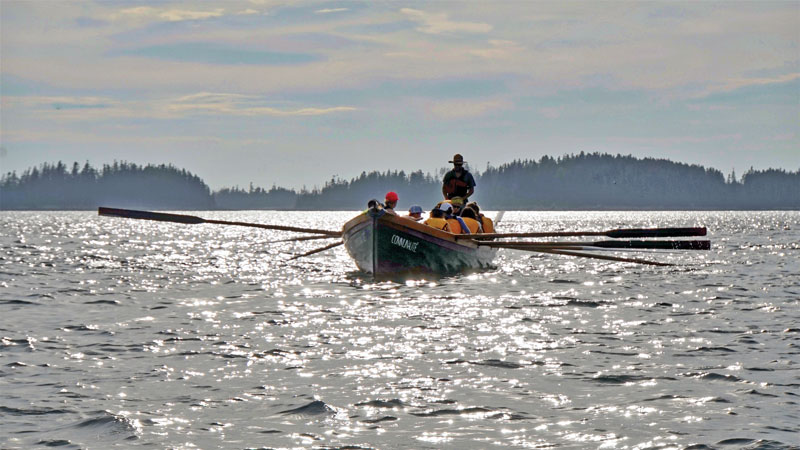
Every summer a pair of unusual craft emerge from boathouses on Penobscot Bay, crew up, and present a rare sight: three-masted Bantry Bay gigs, each with 10 rowers, sailing and practicing seamanship skills.
They are part of Atlantic Challenge USA, originally begun by American Lance Lee and Frenchman Bernard Cadrolet in New York Harbor in 1986. Lee started the Apprenticeshop in Rockport, Maine, where the first two 38-foot gigs were built.
Lee’s idea was that rowing and sailing together would ”nurture understanding, ties, and friendship, internationally. This is achieved through learning swift and competent handling of the gigs; to engage in high hurdles, not low ones. Atlantic’s goal is to build citizens.”
Thanks to the positive experiences of the sailors and the passion of Lee and Cadrolet, some 16 countries have built pairs of gigs and fielded crews to compete in the biennial Atlantic Challenge International Contest of Seamanship. Typically, 12 crews participate in this weeklong gathering and friendly competition which showcases seamanship skills in a series of rowing, sailing, docking, knot-tying, and navigation events. Belfast, Maine, was the site of the competition in 2024; the next will be held in 2026, in Roskilde, Denmark.
Until recently the American boats were based out of a tiny cove on Greens Island, near Vinalhaven. Taking advantage of full moon tides, the arriving crews would pull the boats out of the remote—some would say hidden—boathouse, settle into tents and a few very rustic cabins, get up early, and put their arms to the oars.
Instead of oarlocks the boats have slots in the sides that create a distinctive ‘klock’ as the heavy oars move in unison back and forth. We are fortunate to have a cabin on Hurricane Sound, where the crews train, and we hear the distinctive sound, echoing across the bay when the boats are almost out of sight.
The sailors, mostly under 30, pay a fee for the two-week training session. But it is way more than rowing and sailing—it’s the camaraderie of teams working together on the water, often singing in cadences, calling and answering back and forth between the boats, sometimes with a fiddler or a bagpiper aboard.
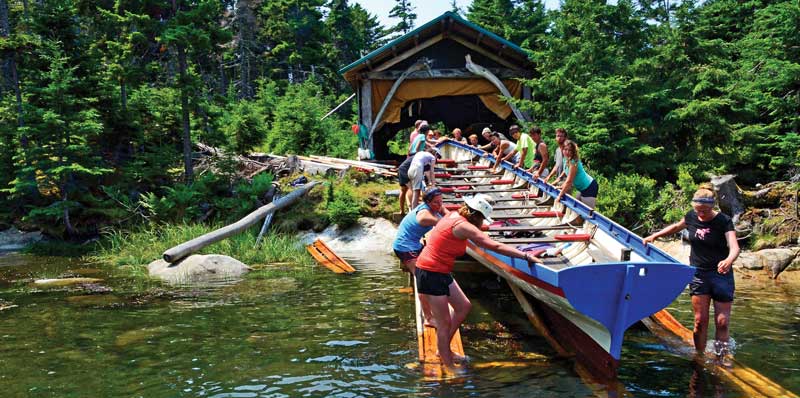
The Hurricane Sound area around Greens Island is a perfect place for such activities: surrounded by islands, often separated by narrow channels offering challenging maneuvering and sailing. I often kayak along the Greens Island shore, and would occasionally see the gigs unused on a fine day. That’s when I realized there was another dimension to the program beyond rowing and sailing: just hanging out with new friends in that exquisite land and seascape. In 2025 the program was expanded to include a three-day Vinalhaven circumnavigation.
With hopes of expanding the program further, director Arista Holden announced a fund drive to build another gig at Lowell’s Boat Shop in Amesbury, Massachusetts. The Westover Foundation offered to match the first $50,000 of donations.
The plan is to truck down one of the existing gigs in early summer to join the new one, and for the two boats to row and sail up to Belfast. Consider applying for a spot on the crews for the trip back up to Maine! To donate to the new gig or to apply to row and sail with Atlantic Challenge go to atlanticchallengeusa.org.
—Joe Upton