

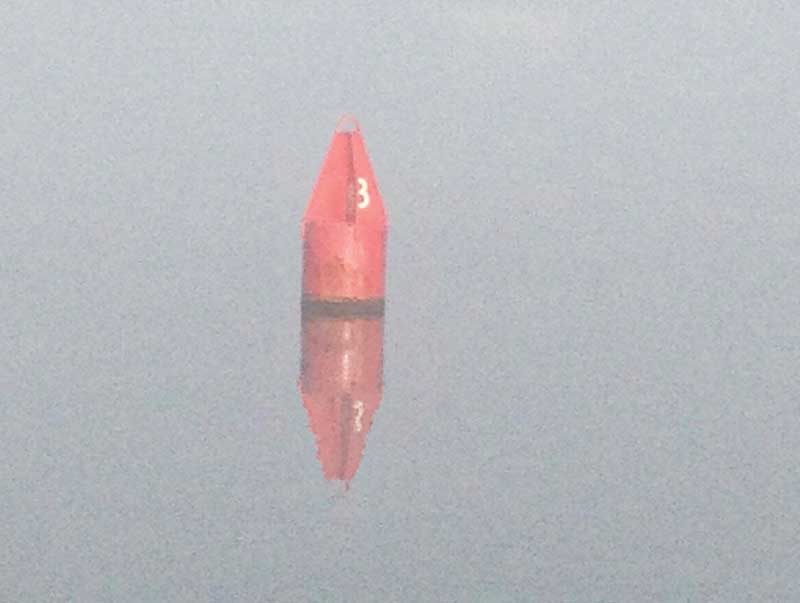
“Don’t take my buoy”
A controversial Coast Guard-proposed plan last spring to remove hundreds of aids to navigation along the New England coast prompted some 3,000 comments, mostly in opposition, before the June 13 deadline. The overwhelming response was well in excess of the number of comments the agency usually receives for its proposals, according to Coast Guard Petty officer Rajesh Harrilal, a public affairs specialist with the agency’s Northeast District. He told MBH&H at press time that staff are reviewing all the comments and will incorporate them into a revised proposal.
“They are going through all the comments, making notes, and comparing them. When that is done we will put out another press release with a new proposal with changes based on the first public comment period, and then there will be another comment period,” he said. “The timeline might be late summer or early fall….There were so many comments I’m not sure when exactly it will be.”
The original proposal called for removing roughly 350 buoys across the northeast between New York and the Maine border with Canada—close to 6 percent of federal maintained buoys in the region. The Coast Guard characterized the plan as a shift toward more modern navigation systems, such as GPS and electronic cartography, and contended that the buoys slated for removal are nonessential. But mariners, both recreational and commercial, argued that physical markers serve as a backup when GPS fails or digital screens are hard to read. They also are valuable for those operating small boats, and who might not have access to GPS.
Based on his conversation with the Coast Guard’s waterways chief, Harrilal said many of the comments expressed general support for keeping buoys, others were from fishermen with detailed information on how they use particular buoys, while still others came from people who said they had been using particular buoys for navigation for years and did not want to see them go.
“Some of the comments were just like ‘Don’t take my buoy,’” he said.
The Coast Guard issued an interactive map with its original proposal that many boaters found difficult to use. Harrilal said he had heard that feedback and was hoping that in the next round boaters might find it easier to see which buoys were being proposed for change.
No more floating camps
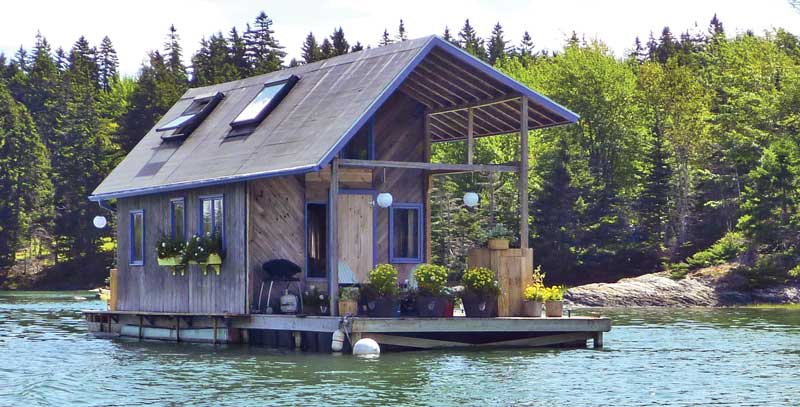
While Maine has many wonderful land-based camping spots, a recent trend toward floating camps has resulted in a new law banning them in state waters. The law applies to non-water-dependent floating structures in both salt and fresh water. House boats as defined by the law are permitted if they are operable as watercraft with propulsion, navigation lights, steering, and such.
The issue has been a topic of debate for several years, according to Stacey Keefer, executive director of the Maine Marine Trades Association.
Municipal officials and harbormasters have been frustrated with a lack of ways to regulate them as the number of homemade floating structures has grown steadily over the years. No one state agency has had jurisdiction.
Issues include the risk of pollution, access to fire and other public services, inability to be moved in the event of bad weather, and complaints from waterfront property owners whose views are affected.
Keefer gave an example of a floating camp moored in East Machias that fell apart, resulting in debris that the owner never removed, and forcing the town to step in.
“This all stemmed from problems like that,” she said of the new law.
Owners of structures already in place as of Jan. 1, 2025 can apply for exemptions if they meet certain criteria, according to the law.
Revolutionary war find?
A team of archeologist has uncovered what they believe is a British schooner named the Margaretta that was captured by the Americans in a naval battle off Machias, according to a story in the Bangor Daily News.
“There’s no evidence against it, and some strong evidence for it,” archaeologist Arthur Spiess told the newspaper. He is co-author of a report about the shipwreck for the Maine Historic Preservation Commission and the Natural Resources Conservation Service. The wreck was found in Jonesport’s Sawyers Cove.
The schooner was involved in what many consider to be the first naval battle of the Revolution, just weeks after the fighting at Concord and Lexington. On June 2, 1775, three ships sailed into Machias Bay—among them the British schooner HMS Margaretta, according to the BDN story. Residents of Machias attacked the British and ended up capturing the schooner, which they hid along the coast.
Before releasing the report to the public, the research team is waiting to learn whether the U.S. Naval History and Heritage Command will assert a legal claim.
Electric news
At least two projects to build and outfit workboats powered by electric motors made the news recently.
First came a story in Mainebiz about a collaboration between Chad Strater, co-founder of the Boat Yard LLC in Yarmouth, a marine construction, logistics and vessel electrification services company; and Nick Planson of Shred Electric, a New Gloucester firm that partners with manufacturers and marine and farm businesses to electrify equipment. They developed an electric-powered prototype workboat which they tested with over 150 hours of hauling freight, towing vessels and delivering materials to islands over the past winter.
Strater told Mainebiz.,“We were out in every kind of weather. The boat performed flawlessly. With nearly 4,000 pounds of payload capacity and 18 feet of open deck space, it’s become a reliable workhorse in our daily operations.”
Funding for the prototype came from the United States Department of Agriculture’s National Institute of Food and Agriculture; the Maine Technology Institute; the Island Institute; and Coastal Enterprises Inc., through its Marine Green loan program.
With a 100-horsepower electric outboard made by Flux the vessel reaches up to 35 mph unloaded, with a cruising speed of 22 mph.
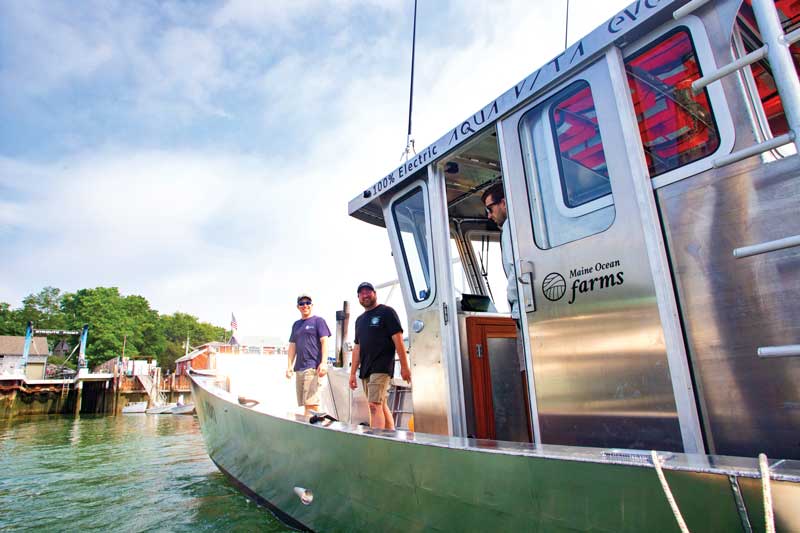
Then in July, the Portland Press Herald reported on the launch of a 28-foot electric workboat that will be used at Maine Ocean Farms, a Freeport-based oyster farm.
Fogg’s Boatworks in North Yarmouth produced the metal-hulled vessel, named Heron. Its dual 120-hp outboard motors, built by Aqua-Vita, are powered by a pair of below-deck batteries, which together hold about 126 kilowatt-hours worth of power. The boat can carry up to 4,000 pounds of gear and oysters, according to the news story. Fully loaded, the vessel can go 20 to 25 miles on a single charge, but that capacity will depend on factors like speed.
The Island Institute helped develop and fund the boat, and the project received most of its funding from the U.S. Department of Energy.
“This is an amazing project,” said the Institute’s senior community development officer Lia Morris. “It’s an opportunity to collect data and test the use of electric motors in aquaculture.”
420s at the A-Shop
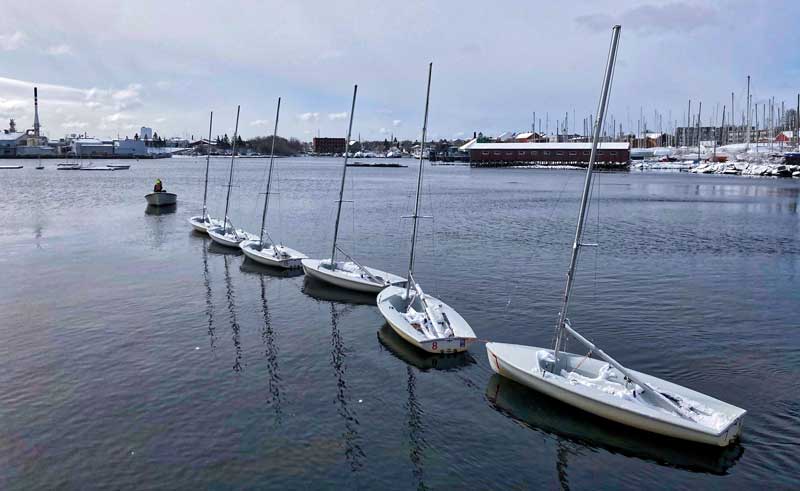
Sailors at the Apprenticeshop have benefitted from a fleet of almost new 420s that the organization acquired from Harvard University.
The Rockland-based nonprofit launched the boats on April 1 during a snowstorm, just in time to kick off the spring sailing season.
The A-shop is home to several varsity sailing teams including Oceanside High School, Camden Hills, Islesboro Central School, and the Rockland Community Sailing team (a combined team for students from other public and private schools and homeschoolers).
The boats are only 6 years old. They were used in 2024 to host the National College Championships, and came with sails purchased for that event, according to A-Shop Executive Director Bella Ferracci. The new-to-Maine boats are sensitive to wind and waves, responsive to weight, trim, and helm, and lighter, faster, and more maneuverable than the shop’s old boats, she said. They self-rescue from a capsize more quickly and easily. This impressive fleet will be used primarily for high school racing and the Apprenticeshop’s youth summer sailing programs, she added.
In addition to the varsity teams, sailing programs at The Apprenticeshop include: Adult & Family lessons for all skill levels; Free Friday Community Sailing every first and third Friday, June to September; and the Youth Summer Sailing Program and one-week sessions throughout the summer, open to ages 6-14.
Hurricane satellite shut down
The National Oceanic and Atmospheric Administration planned to cut off satellite data that helps forecasters track hurricanes by July 31, according to a report by the Associated Press. The data in question comes from three weather satellites that the agency operated jointly with the defense department.
The data gives key information that can’t be gleaned from conventional satellites, including three-dimensional details of a storm, what’s going on inside of it, and what it is doing in the overnight hours. The data was initially planned to be cut off on June 30 “to mitigate a significant cybersecurity risk,” NOAA’s announcement said. The agency later postponed that until July 31. Hurricane season usually runs June 1 to Nov. 30.
According to the AP story, the Navy said only that the “program no longer meets our information technology modernization requirements.”
NOAA, which has seen a large number of Department of Government Efficiency cuts, told the AP that the satellite program accounts for a “single dataset in a robust suite of hurricane forecasting and modeling tools” in the National Weather Service’s portfolio. But meteorologist and other scientists criticized the move.
Union of Concerned Scientists science fellow Marc Alessi told The Associated Press: “On the seasonal forecasting front, we would see the effects,” he said, “but also on the long-term climate change front, we now are losing an essential piece to monitoring global warming.”
Hinckley opens new boatshop
Hinckley Yachts has announced the opening of a new manufacturing facility in Topsham, Maine. The new 6,500-square-foot shop will house a dedicated team of 15 full-time craftsmen focused on building interiors for Hinckley’s iconic yachts, according to press release form the company.
The facility will be run in conjunction with Hinckley’s main yard in Trenton.
The location was chosen for its strong population demographics, established marine industry presence, and a deep pool of skilled labor, according to a press release from the company.
“As demand for our yachts continues to grow, it is essential that we maintain production that stays true to our heritage of craftsmanship and quality,” said Gavin McClintock, CEO of Hinckley Yachts. “This facility will not only help us meet current and future demand, but also provide meaningful opportunities for skilled artisans in the region to join a team committed to excellence.”
3D-printed affordable housing
You may recall a story in MBH&H about the University of Maine’s project to print small homes on its massive 3D printer (“Small and Efficient Dwellings,” July 2023). Now comes news that the Bangor nonprofit Penquis is eyeing a site in Brewer where it hopes to locate up to nine of the 3D printed houses created by the University of Maine’s Advanced Structures and Composites Center, according to the Bangor Daily News. If all goes well, the nonprofit hopes to begin siting the homes as early as the next building season.
He wants an island
President Trump has made headlines with his claim about annexing Canada, as well as his on-again-off-again tariff threats toward Maine’s northern neighbor. But behind the scenes his administration has been working on a smaller land grab.
According to a story in the Bangor Daily News, the administration is insisting that Machias Seal Island belongs to the United States even though Canada has long claimed the treeless 20-acre bit of land where it operates a lighthouse.
The island is about 12 miles southeast of Cutler in Maine, and roughly the same distance southwest of Grand Manan Island in New Brunswick, Canada, the newspaper reported.
Aside from the Canadian-staffed lighthouse, Machias Seal Island serves mainly as a bird sanctuary. But fishermen in both the U.S. and Canada are interested in the fishing rights around the island, especially for lobsters. Several Maine lobstermen have encouraged the administration in its efforts to claim the land, according to the BDN.
John Drouin, a longtime fisherman from Cutler, said he hopes Trump can help make progress in sorting out the boundary dispute. He said the rival claims have yet to spill over into violent altercations between U.S. and Canadian fishermen—despite media references to the dispute being a lobster “war”—but that there have been plenty of angry exchanges over boat radios between the two sides.
Elver catch down
When the fishing season for elver ended last spring, the total catch of the baby eels, know informally as glass eels, was one of the lowest in the past decade. But, according to a story in the Portland Press Herald, industry officials say the elver population is cyclical and that this year’s low totals do not suggest a long-term decline. The annual statewide catch limit for elvers is about 9,500 pounds, but this spring only 7,535 pounds were netted. And the average statewide price of $892 per pound that fishermen earned is the lowest such average they’ve been paid since 2014, when it was $874, according to the Portland newspaper.
Darrell Young, a longtime elver fisherman from Waltham and a top official with the Maine Elver Fishermen Association, told the newspaper that cold weather delayed the elver run, which spreads north along the East Coast as temperatures rise each spring. As for the relatively low price, Young said, harvests in east Asia this spring have been bigger than in recent years, reducing demand for eels from Maine.

Put a stamp on it
A compass rose drawn by an 11-year-old Portland native in 1794 has been made into a U.S. Postal stamp and is taking the then young woman’s art around the world.
Lucia Wadsworth (1783-1864), who was an aunt of poet Henry Wadsworth Longfellow, started writing in a geometry and geography schoolbook in 1794. That book was digitized as part of the Maine Historical Society’s Maine Memory Network, according to an account on the historical society’s web page.
The Postal Service found Wadsworth’s notebook on Osher Map Library’s website—MHS’s digitization partner for the notebook’s inclusion in Maine Memory Network—and inquired about the possibility of using the artwork in 2024. The stamp was issued last January.
After serving under General George Washington in the War for Independence, Lucia’s father, Peleg Wadsworth, settled on the outskirts of Portland, building a home, barn, outbuildings, and adjacent store on Back Street (now Congress Street). The fifth of 10 children born to Peleg and Elizabeth Bartlett Wadsworth, Lucia lived in the structure now known as the Wadsworth-Longfellow House for almost her entire life. She was a no-nonsense woman and stamps are practical necessities, MHS noted. In addition, she was a committed letter writer, making it fitting that her drawing is now floating all around the world on letters and greeting cards.
Downeast boat under construction
Newport Yacht Builders is finishing off a customized Mussel Ridge 46 designed for high-performance sportfishing and comfortable family cruising.
A press release from the Rhode Island-based builder notes that this is the yard’s third Mussel Ridge hull. Plans call for the work to be completed by April 2026. As with the previous Mussel Ridge hulls, the hull and deck of this 46-footer were molded at Hutchison Composites in Cushing, Maine. Structural components, systems, and fit and finish are taking place at Newport Yacht builders in Newport, Rhode Island.
“Our new Mussel Ridge 46 will carry forward proven fishing capabilities of our previous build, Disruptor, while incorporating additional comfort features,” said Ezra Smith, chief designer and partner at Newport Yacht Builders. “This boat is designed to excel at offshore sportfishing, but it will also be a family friendly cruiser, making it truly versatile.”
The new Mussel Ridge 46 will be equipped with the latest innovations in sportfishing technology, powered by a 1,150-hp Scania diesel, with a 20-kW generator for electrical power and charging. Mastervolt lithium batteries will reduce the weight of the boat’s battery bank by approximately 450 pounds, according to the news release.
Over the bar
The Mount Desert Island boating community lost a good friend with the death of Lee Wilbur in early June. Wilbur, 82, grew up in Southwest Harbor, and after a stint in the U.S. Army, received a degree from the University of Maine. He and his first wife, Heidi, started Lee S. Wilbur Co/Wilbur Yachts in 1972 and built more than 200 semi-custom yachts before selling the company in 2001 to his daughter, Ingrid, and her husband, John Kachmar. After retiring in 2003, he turned his talents to writing, with a regular column in Fishermen’s Voice and occasional articles for this magazine.
A letter from Northport
We have subscribed to your magazine for years. What a delight to open up the July/August issue and find our very own small town, Northport, featured there (Small Adventures)! The author did an excellent job of describing the many different faces of our town, from its rustic rolling hills with-a-view, down to the beautiful Temple Heights area and small seaside community of Bayside. One detail the article honed in on is how, alas, Northport has “no town center.” While presently this is sadly true, stay tuned! The citizens of Northport have just voted to move forward with a plan for a beautiful, brand new Town Office and Community Center, to be located just off Route 1 at the base of Beech Hill Road. The new Town Office plan will give Northporters a centralized location for community events, meetings, and voting, as well as sorely needed updates for our municipal offices and volunteer fire station.
I invite your readers to learn more online at northportmaine.org/new-town-office-community-center-fire-station-project/. The town has just begun an ambitious capital campaign to help fund this project and minimize the burden to local taxpayers, so any donations from folks with or without a personal connection to this lovely place are much appreciated! As the sign on Route 1 says, “Northport Welcomes You.” And we invite you to watch our town progress and grow through this new project. Thank you for the awesome article!
Brynna Ledyard & Paul Overgaag
Northport residents
✮