

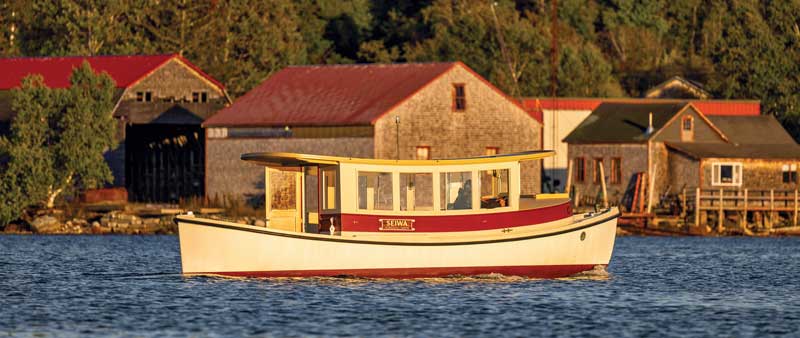
A recent refit by Hylan & Brown has given an old Navy boat new purpose while pushing the boundary of what’s new under the sun for cruising sailors.
The team at the Brooklin, Maine, yard turned a vintage, double-ended Navy whaleboat into a sleek cabin cruiser that’s fully powered by electric motors and solar panels. Named Seiwa, the vessel cruises at about 4 knots; and if the sun is shining, the solar panels in combination with the batteries enable the boat to cruise all day without plugging in to shoreside power.
“This is exciting for us because it’s proof of a concept that we hope to build upon: that you can go cruising in an electric boat, get where you are going, and not listen to an engine rumble all day,” boatbuilder Ellery Brown said. “We do a lot of boats for people who say they are done sailing. This is where sailors or retiring sailors are a good market. They are not used to going fast and they are interested in a new, peaceful, and less strenuous way of boating. This couldn’t be easier.”
The Navy had dozens of these 26-foot, open-cockpit fiberglass boats built in the 1950s and 1960s for use as transport to and from larger ships. The hulls are a rare case of a fiberglass production boat designed for efficiency at displacement speeds, according to Brown. “They do not have the means to get up on a plane. But they can putt-putt along efficiently under hull speed, which makes them a good candidate for electric propulsion,” he explained. “In our opinion, electric is a good option if you can forget about going fast and just want to cruise slowly.”
Seiwa’s refit was commissioned by a customer who already owned a classic wooden launch that had been refit for electric propulsion by Hylan & Brown in 2023. The design brief for the new project called for “something good to use for coastal cruising, to spend a night or two on, and cover some ground,” Brown said. The owner told the builders he was not concerned with speed for speed’s sake but wanted to be able to cruise to places like Isle au Haut, which is about 36 nautical miles from his home base in Sorrento. According to the owner, seiwa is a Japanese word that in a Buddhist context can mean “pure and serene harmony.”
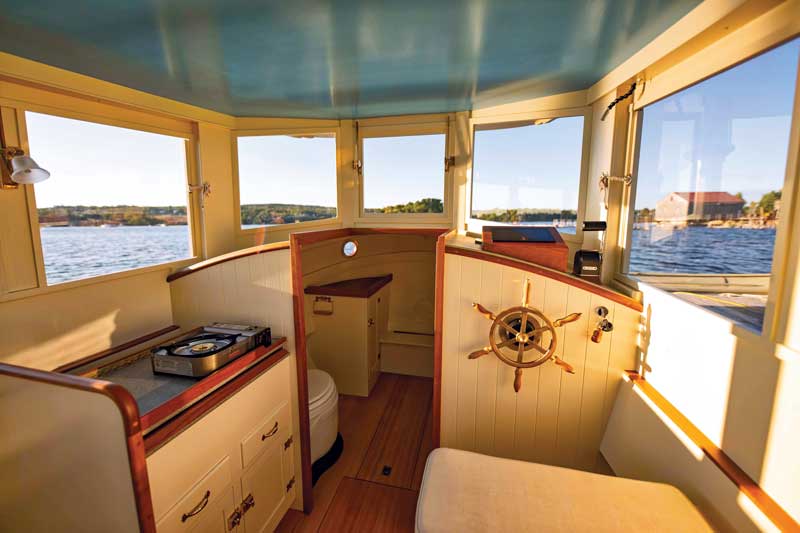
The team at Hylan & Brown gutted the whale boat down to its bare hull and built a whole new superstructure, including a hard-top cabin with spartan accommodations. Two settees extend into sleeping berths. Additional features include a black cherry table, doors, and trim, a tiny head, and a single-burner stovetop that folds up to reveal a sink underneath.
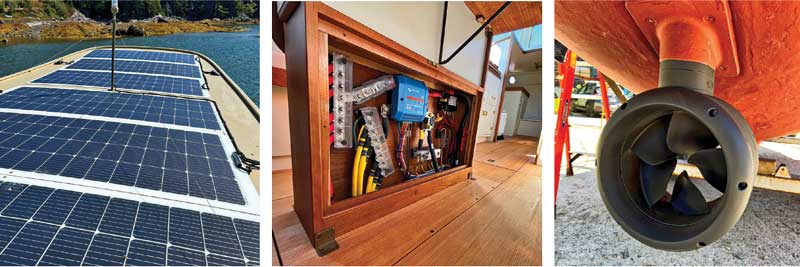
Power comes from a 60-kilowatt power bank consisting of 12 Victron 24-volt, 200-amp batteries stored under the settees. The motor is a 15-kilowatt, seal-less, completely waterproof pod drive built by Holland-based Rim Drive Technologies. It looks like a sort of nozzle or ducted propeller, but the blades of the propeller point in toward the center, with the rotor of the motor surrounding them, according to Ben Parson, the Hylan & Brown employee who helped design the system.
Rim Drive contends this design is the most efficient available on the market for low- and medium-speed operation, Parson said. An additional benefit is the lack of oil or seals. With water-lubricated ceramic bearings and only one moving part, these motors have very low maintenance requirements, he added.
At full throttle, running at about 6.5 knots, Seiwa can operate off the batteries for about four hours. “The better news is that when you slow down to, say, 4 knots, you can go for 16 hours, over 60 miles. You can go all day,” Brown said.
The batteries can be recharged dockside, but more importantly, they can be recharged on the go by six 200-watt solar panels mounted on the cabin top.
“The really neat thing is that if the sun is shining and you are cruising at somewhere around 3.5 knots you can go until the sun sets using little to no battery power,” Brown said. “In the electric power world that is called solar sailing; it’s loosely defined as travelling at a speed based on solar gain not on the battery bank…It’s sort of like sailing but instead of paying attention to the wind, you pay attention to the forecast and the sky because the distance you can go will depend on sun coverage.”
Launched in mid-September, Seiwa has been sea-trialed but her owner has not yet taken the vessel for a cruise. You could say they’re saving that up for a sunny day.
✮
“Seiwa” Specifications
LOA: 26' 6"
Beam: 8' 2"
Draft: 2' 4"
Displ.: 7,200 lbs.
Power: Rim Drive Technology
POD 15.0 (15 kW, 48V)
BUILDER: Hylan & Brown Brooklin, Maine dhylanboats.com
Polly Saltonstall is editor at large of MBHH.