

Photos courtesy J/Boats
Having captained sailboats for 50 years and shared family-wide enthusiasm for cruising under sail, not to mention reveling in one-design competition, and even designing and building sailboats, I am among the legion of sailors who are quietly heartbroken at the shrinking interest in wind-powered boats. We ask ourselves, “What’s it gonna take?”
One answer I’d put forward is a sailboat that is well-designed and constructed, delivered at an affordable price, and simple to sail by beginners while still putting a smile on an old salt’s face.
With that in mind, I’ve been hearing scuttlebutt about J/Boats’ newest launch, the J/7, for some time. And the moment I caught actual sight of this latest model, I believe I saw salvation in the flesh. I feel that if sailing as recreation and sport for the common lubber is to rise again, I’ve never seen a more compelling foundation for hope.
The reason the J/7 is revolutionary is that it addresses every factor that is limiting the use of sailboats. At a time when new-boat sales are reeling under the demise of affordability—and facing direct competition from old sailboats that are cheap to free—here is a fresh, efficient, and enjoyable lifestyle vessel that comes with a relatively affordable base price of right around $55 grand.
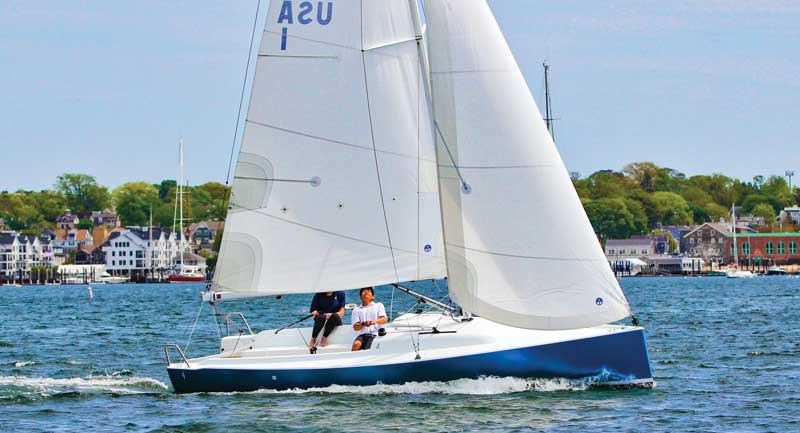
In order to pack the most speed into the least package, the J/7’s hull is square-ended. The bow is plumb and so is the transom. The result: The waterline is maxed. Such a design is commonplace now in performance sailboats. And even Yours Truly, a hidebound traditionalist, has come to see this style as attractive in a smaller boat. Screaming along at surprising speed with spray flying has come to look pretty to me. Especially more so in a boat that has a keel and lots of stability to the point that risk of a capsize is virtually absent.
Simply put, the J/7 encompasses everything that I, a lifelong sailor and mostly racer, strongly favor.
The J/7 was designed by Al Johnstone, who has taken over the J/Boats drawing board from his father, company founder and designer Rod Johnstone. For this boat, Al Johnstone has considered every factor that can make sailing easy and comfortable, as well as making ownership relatively inexpensive. He and his dad had been conspiring on this design for almost four years.
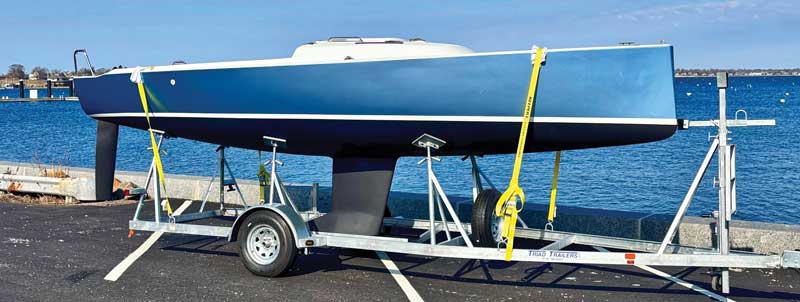
Although heavily ballasted to provide sound footing under sail and while on a mooring, the J/7 can also live in a backyard for free and be easily transported and launched. In terms of size and weight, it was designed to be trailerable, as they say, “behind the average SUV.” Unlike many comparable boats, the mast is deck-stepped, which makes it possible for the young and strong at least to step the spar by hand, without the delay and expense of a crane or gin pole. In consideration of dry-sailing, where boats are launched by a crane for the race and pulled immediately afterward, there is a single lifting point on the hull located at the center of gravity—so no slings are needed.
In many other ways, it’s clear that Al Johnstone coalesced reports from dealers, sailboat shows, and experienced racers in order to maximize efficiency. He and his dad placed special emphasis on the small gripes that may be constraining the vitality of the sport.
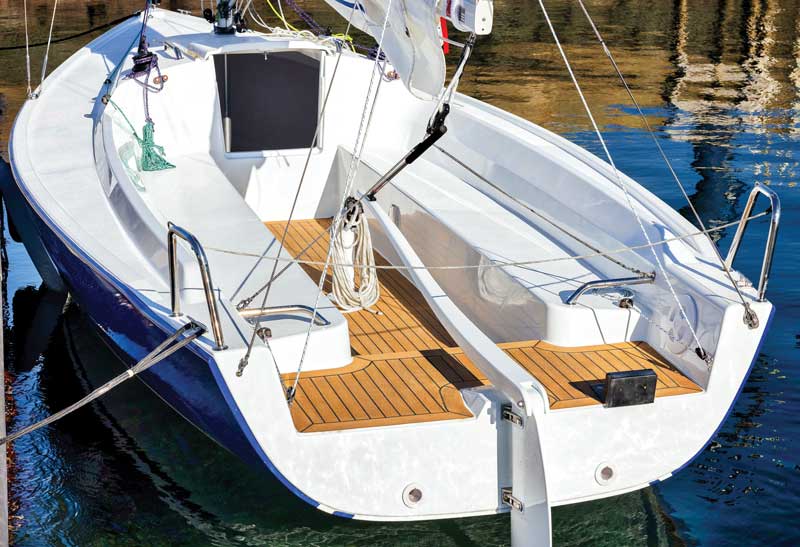
For example, there is just enough cabin on the boat to duck into in case of a cold rainsquall. Gear can be stowed there, and there’s even room for a portable head for contingencies. The interior, kept simple by design, also has a molded V-berth that can be cushioned if occasional naps aboard are so desired.
The cockpit, with a faux-teak sole, is large and has comfortable seating both inboard (with comfy slanted seatbacks) and out on the side decks. Both for performance and safety, this keelboat has been designed around exceptional stability, so crews won’t need to hike out nearly as much as in other “sport” daysailers. Those side decks I mentioned are nearly 9 feet long. This accommodates four or five adults. If racing’s your desire, you could shanghai a phalanx of brutes. I can only imagine how fast the boat would be with that moveable ballast when tacking into a stiff sou’wester.
For this review, I won’t be swooning about the sweet sweeping sheerline. That’s because the J/7’s sheer is fairly straight, ending at a low-slung open transom. The height of the stern provides a few advantages. It could be used as a “swim platform” of sorts, and with large stainless-steel rails mounted to either side, it would be a logical place for crew retrieval in an unlikely person-overboard scenario.
At its opposite end, a headsail set on a roller furler will be easy to set and douse, and it’s just overlapping cut will make it manageable to tack, even when the breeze kicks up.
The word “program” pops up frequently in J/Boat brochures. I interpret this as a reminder that the company has always promoted sailing through learn-to-sail and race programs, many under the aegis of J/World. This boat screams its suitability for sailing instruction. I have little doubt that the aforementioned tiny afterdeck, located behind helm and crew, was partly placed there for benefit of sailing teachers. It occurs to me and probably did to the Johnstones, that these economical, commodious, and exciting daysailers would be perfect on-the-water classrooms.
Indeed, for the good of our sport, every yacht club with a sailing program could use a boat such as this to replace their fleets of old, unevenly matched boats that are in constant need of maintenance. Upgrading via a group purchase could provide a keelboat class that suits both instruction and one-design racing.
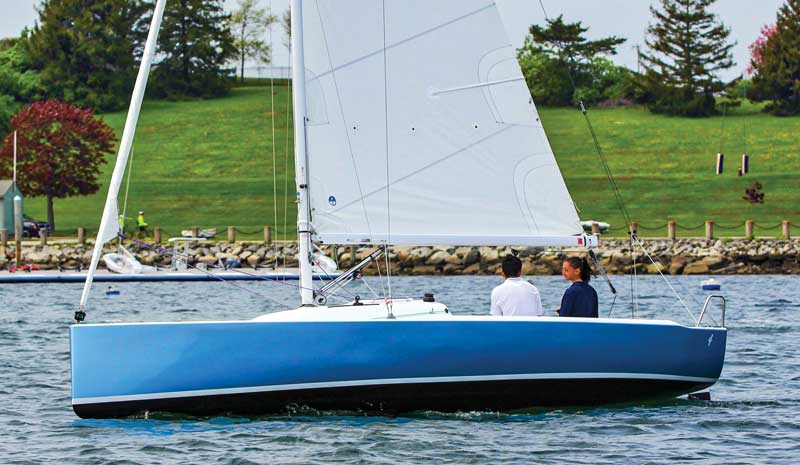
As for the J/7’s racing potential, I’ve designed, helmed, and been mainsheet-tactician on racing yachts my entire life, and this boat has everything I favor. Like most J/Boat designs, it’s fractionally rigged. That makes a backstay adjuster more useful for depowering. With a long boom and large ratio of main-to-jib area, it should sail extremely well under main alone. Roll the jib in tight and in a strong breeze, in a crowded harbor, you can still tack and jibe to maneuver at just a fraction below the speed you’d make under full sail—and with excellent forward visibility.
Unlike many sport one-designs, the J/7 mainsail has a single reef available. This can allow a sailing school an extra measure of time on the water, or a community sailing center to mandate reduced sail on a heavy weather day. The boat has a strong tubular boom vang that can flatten the sail or prop up the boom, eliminating the need for a topping lift.
Frequent readers know I have my opinions, and among them I favor a good-sized rudder, exactly vertical, and a long tiller. Check.
And, I have no great love for travelers, although in modern high-pointers it’s the best option to haul the boom amidships or de-power the main in a puff. This boat accomplishes that with a simple rope bridle.
I’d also note that the jib tracks, mounted on the cabin top, are very far inboard, which makes for a very close winded boat.
So, with the J/7 we see a long and fairly narrow hull, with a near 50 percent ballast/displacement ratio and a lead keel that has its mass located low. For comparison, the J/22 has a 700-pound keel that’s fat at the top and minimal at the base, while the J/7 has over a thousand pounds in its keel with a bulb at the bottom.
Performance? One day, a week before I wrote this review, father Rod Johnstone, age 88, and Jeff Johnstone, age 65, having decided to sail from Stonington, Connecticut, to Newport, Rhode Island, took off through Watch Hill Passage. It was open ocean until Castle Hill light, approaching Fort Adams in Newport. (Given age and experience, they elected to rig jacklines and clipped in.) This
23-foot boat sailed at between a low of 5 knots to frequent extended surf rides in the low teens—and made that trip in just over four hours. That may have exceeded what you could’ve accomplished in a car on a hot weekend if you hit summertime beach traffic on Route 138. Put plainly, the performance of this ocean-capable boat sounds scintillating!
One of the bright solutions for the future of sailing involves shared ownership or day-rate membership organizations that own a fleet of sailboats, plus a launch site and storage facilities, such as those found at Sail Newport in Rhode Island, Sail Maine in Portland, or the Community Sailing Center at Southwest Harbor. The J/7 would appear tailor-made for such operations. First off, there’s the boat’s price, which, as mentioned, starts right around $55,000. The boat’s simplicity, with proven Harken fittings, makes it relatively easy to maintain compared to more complex, tricked-out full-on racing designs.
As an aside, this boat’s design eliminates one thing that I believe turns many people off from sailing: It doesn’t have a spinnaker or a bowsprit that demands a quiver of light air headsails to be competitive. This saves an owner money and eliminates the need to search for skilled trimmers. However, optional spinnaker gear is available.
I am aging out of sailboat racing, despite having a gorgeous Luders 16, one of the prettiest boats ever conceived. Given my boat’s racing record, I might possibly trade even for a brand-new J/7, paint it my signature bright red, and keep the bottom white. I could experience what 15 knots feels like on Blue Hill Bay in reasonable comfort, with safety appropriate for an octogenarian.
The traditionalist in me is screaming no. But it’s tempting.
✮
Contributing editor Art Paine is a boat designer, artist, and writer who lives in Bernard, Maine.
J/7 Specifications
LOA: 23' 2"
LWL: 20' 10"
Beam: 8' 2"
Draft: 3' 10"
Displ.: 2,300 lbs.
Builder: J/Boats
Newport, RI
401-846-8410
Jboats.com