

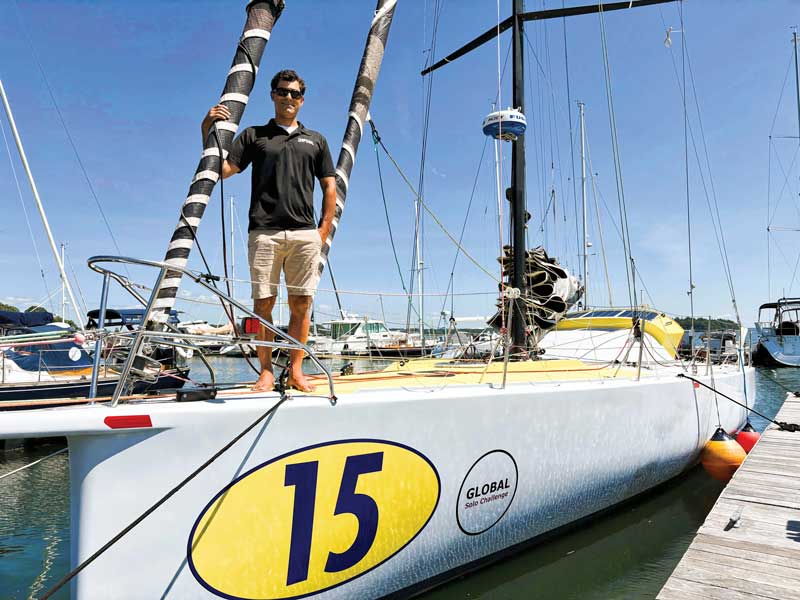
Ronnie Simpson has some unfinished business to take care of. While sailing in the inaugural Global Solo Challenge last year—a singlehanded, non-stop sprint around the planet—he was forced to drop out after encountering angry seas and losing the rig in the South Atlantic. He was in third place at the time and had sailed roughly 80 percent of the grueling 26,000-mile voyage. Scuttling his boat was a gut-wrenching, heartbreaking experience.
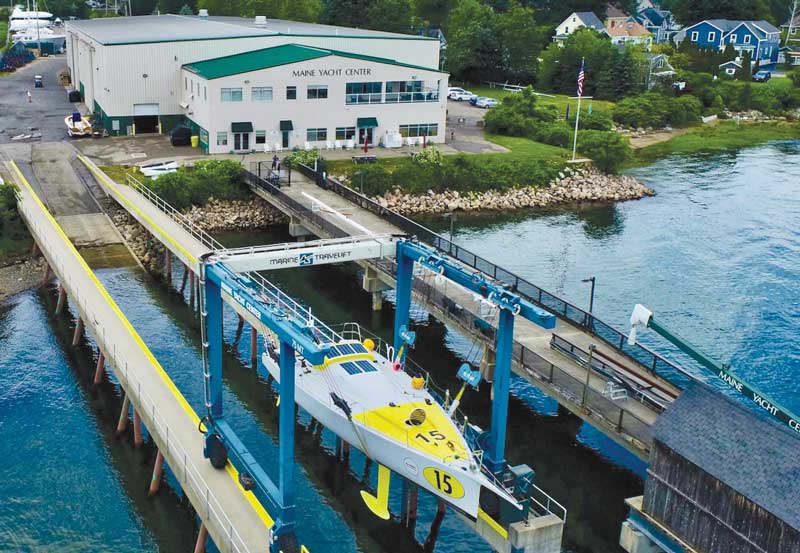
Now he’s back, getting ready for the next Global Solo Challenge, to take place in 2027-2028. He’s preparing his boat at Maine Yacht Center in Portland, raising money, and building a community in support of the long march ahead.
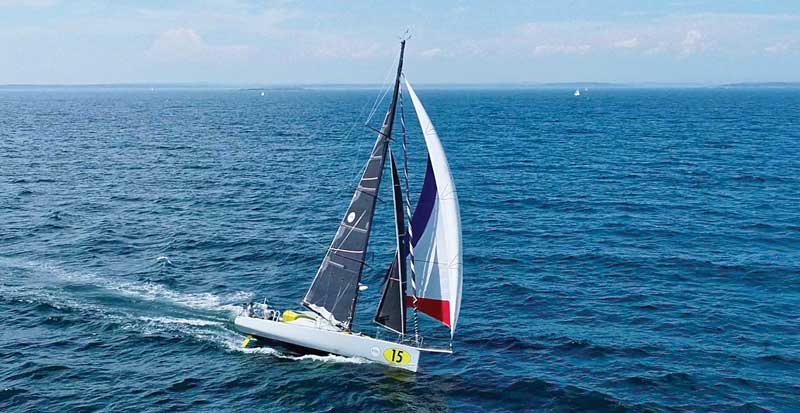
This time, he has every intention of finishing. Not only that, he has every intention of winning and becoming the first American to ever win a singlehanded, non-stop around-the-world-race, he said this summer aboard the Koloa Maoli, a Class 40 beauty that he purchased earlier this year. The boat is a first-generation Owen Clarke design that was built in 2006 and which completed the 2023-2024 Global Solo Challenge with a different skipper.
“It’s always been a goal of mine,” Simpson said, a beaming smile on his face. “I did the work last time, and I’m proud of what I could accomplish. I went through the pain and suffering, but I never got the payoff of finishing. It makes me all the more determined to do it this time.”
Brian Harris, general manager at Maine Yacht Center, can relate. He took a sabbatical from work to sail in and complete the 2022-2023 Globe 40 around-the-world race. That race is double-handed and includes stops along the way, but it would have been crushing to not finish, Harris said.
“I would’ve been heartbroken if we couldn’t finish. I would’ve needed a lifetime of therapy to get over it, probably,” he said. “I can certainly relate to Ronnie, who had a go of it and gave it his best effort with an old and tired boat on a shoestring budget and got the long way around the track but didn’t finish. So I can relate to that deep philosophical need to finish what you start.”
The Global Solo Challenge isn’t for the faint of heart. A non-stop race that follows the classic three-cape clipper ship route to the east, it begins in Vigo in northwestern Spain. Skippers sail down the west coast of Africa, around the Cape of Good Horn and continue through the Indian Ocean. They then pass south of Australia, around Cape Leeuwin, and across the Pacific before navigating past South America’s Cape Horn and entering the Atlantic for the final leg back to Vigo.
Boats leave on a staggered start depending on their size and speed, with the first boats leaving in August 2027 for the next race. Simpson expects to start in October, with the fastest boats leaving a month or so later. Of the 16 starters in the 2023 race, only seven completed the course—a testament to how tough it is to finish.
In that race, Simpson had rounded Cape Horn and was entering the final leg when he encountered what he calls “extremely unfortunate weather conditions” with upwind blow after upwind blow. Battling winds of 35 to 40 knots with waves and swells coming at him from all directions, his boat—the vintage Open 50 yacht Shipyard Brewing—launched off a wave and slammed down violently, bringing down the mast and forcing him to abandon the rest of the race.
While all of that was tough to endure, Simpson has been through worse. A native of Atlanta, Simpson joined the Marines after high school and deployed to Iraq. There, in 2004, he was severely injured by a rocket-propelled grenade that burned the front of his body, including his face, chest, and arms. Doctors had to remove half his lung, his eyes were severely burned, and he suffered concussive injuries. He was in a medically induced coma for 18 days while doctors treated him.
After serving out his enlistment, he found himself in San Antonio, Texas, where he bought a home, was selling motorcycles for a living, and was enrolled at a local college studying business. But he was unhappy and looking for something new when he had an epiphany: he wanted to sail!
He’d never sailed before, but the sea was calling his name.
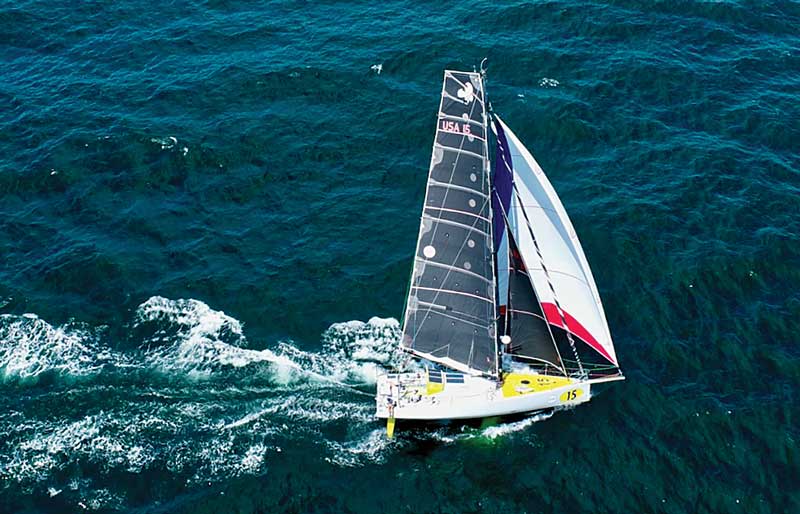
Simpson moved to San Diego and hooked onto any boat that would have him. “I kind of had a mid-life crisis, but at 23,” he said. He rigged boats, worked on charter boats, and delivered boats. All the while, he developed a bug for solo sailing.
Since then, he has sailed more than 175,000 nautical miles. He’s made more than 20 crossings from California to Hawaii and raced in Mexico and Australia. He’s done solo cruises in the South Pacific multiple times and crossed the Atlantic once, for the 2023 Global Solo Challenge.
For the 2027 race, he bought the Koloa Maoli from David Linger, an American skipper who sailed it in the 2023 race, finishing sixth in 175 days. Simpson hopes to finish his next attempt in 130 days or so.
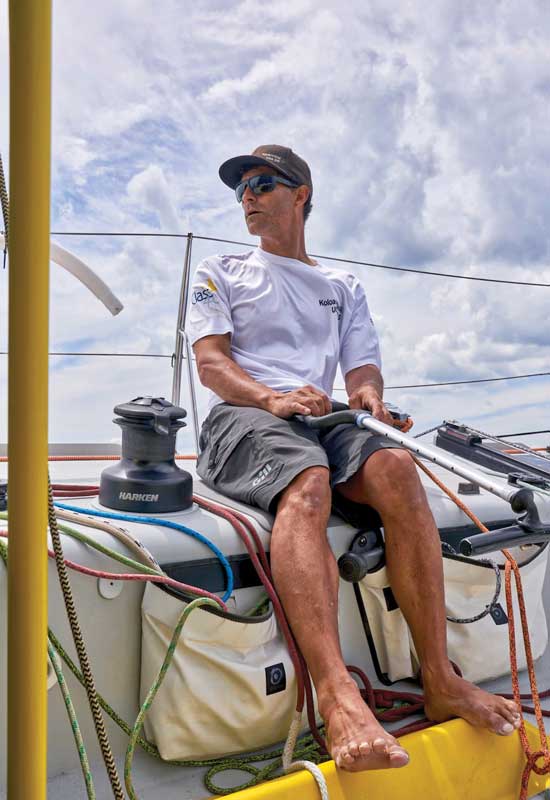
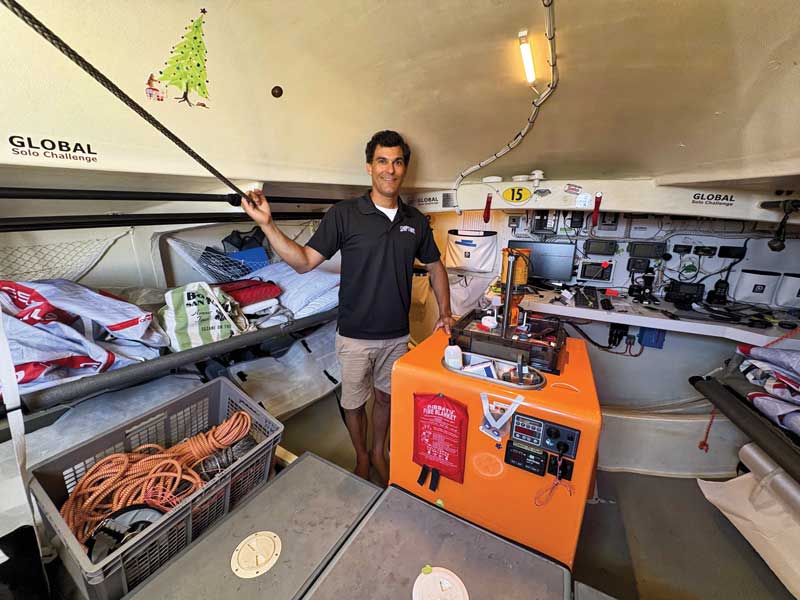
The boat is now based at Maine Yacht Center, where Simpson has been prepping it and taking it on sea trials for the next race. He’ll probably need a new keel fin and expects to upgrade the electronics and rigging.
He also needs to spread the word about the race ahead and attract sponsors. His goal is to raise about $1 million.
To build a community of support, he’s been attending multiple boat shows (Newport and Annapolis in September and October) and talking to yacht clubs. He also needs to do more sailing, including a 2,000-mile qualifier that’s required for the race.
Beyond the race itself, he hopes to inspire people to go sailing and set big goals. “Our key to success is to build a community to support this campaign,” Simpson said.
In the previous race, Simpson had an older boat, a limited budget, and a short amount of time to prepare. This time around, he’s got a better boat, more time, and the help of his partner, Marisa Veroneau, an experiential marketing professional who describes herself as Simpson’s “right-hand support.”
Veroneau’s helping Simpson with sponsorships, public relations, speaking engagements, and whatever else needs to be done. She’s captivated by the thought of Simpson sailing for months on end at sea, just he and Mother Nature.
“Ronnie’s story to me is about resilience and going for your dreams,” she said.
When Harris sailed in the Globe 40 race, his boat was called Amhas, an old Gaelic word that can mean “village idiot.” It was an appropriate name,
Harris said, because “you need to be touched in certain ways” to want to sail around the world.
“Ronnie’s a little bit of a zealot, but I think that’s what it takes,” he said. “And I mean that in a positive way.”
✮
Clarke Canfield is a longtime journalist and author who has written and edited for newspapers, magazines, and the Associated Press. He lives in South Portland.
Learn more about Ronnie Simpson, his boat, and the Global Solo Challenge: globalsolochallenge.com ronniesimpsonracing.com
Koloa Maoli Specifications
Sail number: USA 15
Boat design: Class 40, Owen Clarke Design
Year built: 2006
LOA: 40'
Displ.: 10,999 lbs.
Upwind sail area: 1,238 square feet
Downwind sail area: 2,368 square feet