

Photos courtesy Brooklin Boat Yard
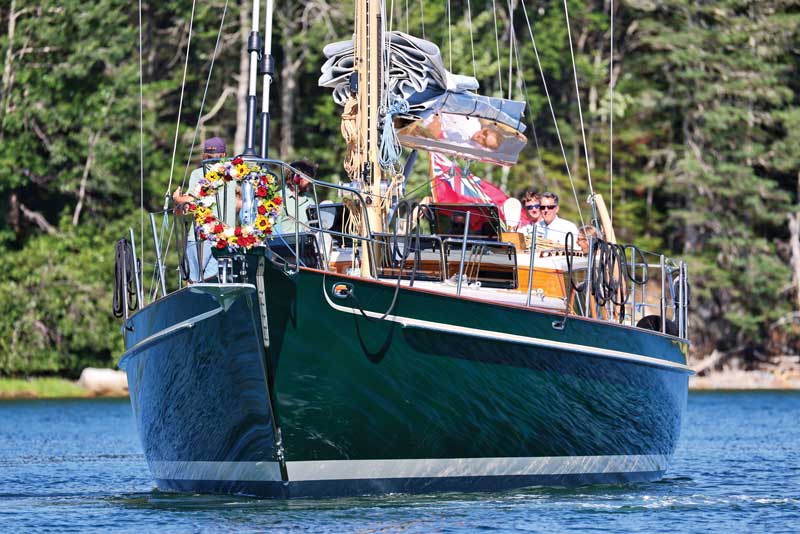
Philosophers have long said that patience is a virtue and that virtue is its own reward. Sometimes, though, the reward for patience is more tangible.
In July, Brooklin Boat Yard launched the spectacular 56-foot sloop Kiandra for a California-based customer who has serious voyaging plans for the yacht. Next summer, for a start, the coast of Maine. Then, in 2027, a transatlantic passage to Ireland. From there, it will be on to the Med for the summer. Next up would be an autumn crossing to the Caribbean, and then, once the winter season’s done there, a transit of the Panama Canal and up to Alaska. Then they’ll sail the boat to San Francisco, where they live.
And that’s only the beginning.
According to Kiandra’s designer, Mark Fitzgerald of Rockland, the yacht’s owner said that if he and his wife were enjoying the boat, and still married, they planned to sail to New Zealand before returning the boat to its home port in San Francisco.
“That’s like a five-year cruise. And he hopes next year is his last year working,” Fitzgerald said.
Talk about the long game. The building process for Kiandra, from initial bid to completion, took roughly three years, but construction was delayed for nearly two years after the project’s inception. BBY was the only boatbuilder the owner wanted for his boat, and the yard had a two-year backlog before it could begin construction. As a result, some five years elapsed from the project’s inception to the boat’s launching. During that time, and while waiting for construction to begin, Fitzgerald built a full-size plywood mockup of Kiandra, “from stem to transom,” in his Rockland boat shop.
“We put in the interior in plywood. We did the cockpit, the storage for the sailboards. Did the whole thing right here. We had the whole boat,” Fitzgerald said.
About those sailboards.
When the owner first came to Fitzgerald to design Kiandra he had a very specific idea of what he wanted.
“So,” Fitzgerald said, “he always dreamed, ever since he was young, of having an Alden. You know, a beautiful, long, 1950s, 1960s Alden.”
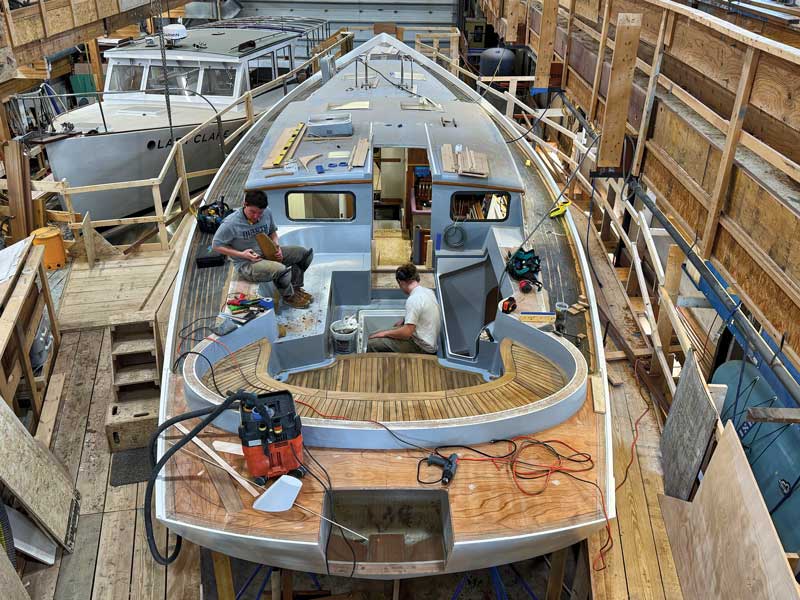
However—and there is always a however—in addition to working in the finance world, Kiandra’s owner is a professional scuba diver, and his son is a professional kite surfer. And he wanted to carry diving tanks, a compressor, two stand-up paddle boards, and two sailboards with him on the boat. The kicker was that he didn’t want to carry any of that gear on deck, where he would have to look at it while sailing. No surprise, those requirements had a significant impact on the boat’s design.
Fitzgerald solved the storage issue by turning the entire area under the cockpit into a huge “garage” for the boards and other water toys. It’s accessed by opening “this great big patch of the seat” in the cockpit and it extends some 3 feet into the boat’s interior.
“It’s huge,” Fitzgerald said. “And that’s also why the boat is so wide. We couldn’t do this in a narrow boat, so we just kept pushing it out.”
Kiandra is wide indeed. With an overall length of 56 feet and a waterline length of 42 feet 6 inches, the boat has a maximum beam of 15 feet 9 inches and a waterline beam of 14 feet. Drawing 6 feet 11 inches, the design displacement is 48,600 pounds. The 15,800-pound lead keel, featuring a thick bulb with what Fitzgerald described as “very thin” wings, was designed by Jim Taylor. The rudder has a conventional NACA 00 foil shape and is mounted on a carbon-fiber stock.
Another key element of the boat was definitely driven by the customer, who didn’t want to be confined to living accommodations below. “They wanted to be above deck, but they didn’t really want a pilothouse,” Fitzgerald said.
The result was the handsome deckhouse that the owners “can live in without going forward,” he said. “It’s got the galley. It’s got a head, and it’s got an aft cabin, so when the two of them (the owner and his wife) are out at sea, they can live in that deckhouse and they don’t have to get the forward part of the boat wet or dirty. It’s all self-contained in that one room.”
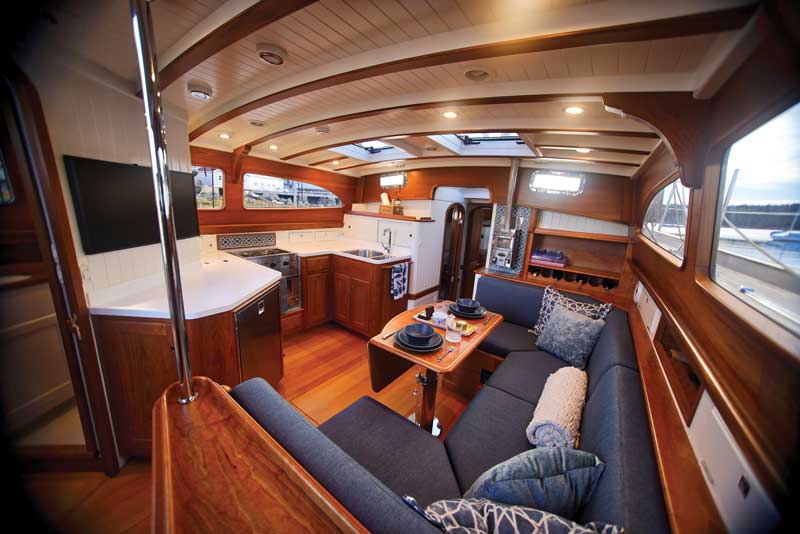
Below, forward of the deckhouse, there is a cabin to port with upper and lower berths and, to starboard, a second head compartment with a shower, and another double stateroom. All the way forward, in place of the more common V-berth, Kiandra has a fully equipped workshop that also houses a storage and cooling well for a scuba diving tank and the electrically powered air compressor for filling tanks.
The interior is, like the boat itself, traditional in design, and features details and millwork similar to yachts built in the mid 1900s. There is a lot of varnished Honduras mahogany millwork, with the overhead and most vertical surfaces painted white. A propane-fired stove accents the saloon and provides heat.
All those accommodations fit into a hull that Fitzgerald describes as being “Paine-esque,” a reference to yacht designer Chuck Paine, with whom Fitzgerald worked for many years. The structure is not too deep but offers substantial stability. The design for the hull is the product of a collaboration that included Fitzgerald, Paine and BBY chief designer Will Sturdy. Sturdy did the lofting for construction of the cold-molded hull—layers of Douglas fir, western red cedar and Sipo mahogany over laminated Douglas fir frames—and separate deck structure. Paine’s twin brother, Art (an MBH&H contributing editor), joined the project as “aesthetician,” helping to develop Kiandra’s “look.”
With a sail area of 1,411 square feet, Kiandra carries a full suite of North 3DL sails on a twin-spreader carbon-fiber mast built by the Moore Brothers Co. in Bristol, Rhode Island. The carbon-fiber boom has small “wings” to collect the in-boom, slab reefing mainsail. Furlers and winches, except for an electric mainsail winch, are all manual and supplied by Harken. Also manually controlled is the lifting mechanism for the folding steps concealed in the transom that give easy water access for scuba diving.
Kiandra is powered by a 110-hp Yanmar diesel with dual alternators. The engine drives a folding propeller, via an Aquadrive system that reduces transmission noise and vibration to the hull. A Side-Power bow thruster will assist with maneuvering. The boat is also equipped with a 6-kilowatt Northern Lights diesel generator and has tankage for 280 gallons of diesel fuel.
Unsurprisingly, the boat has a full heat-pump heating and air conditioning system, extensive navigational electronics, and a fully equipped galley with refrigeration. There is also a watermaker.
In early September, Kiandra was still at Brooklin Boat Yard, where craftsmen finished up the many final post-launch details that remained before the boat set out on her first extended cruise.
✮
“Kiandra” Specifications
LOA: 56'
LWL: 42' 6"
Beam: 15' 9"
Draft: 6' 11"
Disp: 47,500 lbs.
Engine: 110-hp Yanmar
BUILDER:
Brooklin Boat Yard
Brooklin, Maine
brooklinboatyard.com
Stephen Rappaport is a writer and editor, has lived in Maine for more than 35 years, and is a lifelong sailor.