

Photos courtesy of Lyman-Morse Workboats
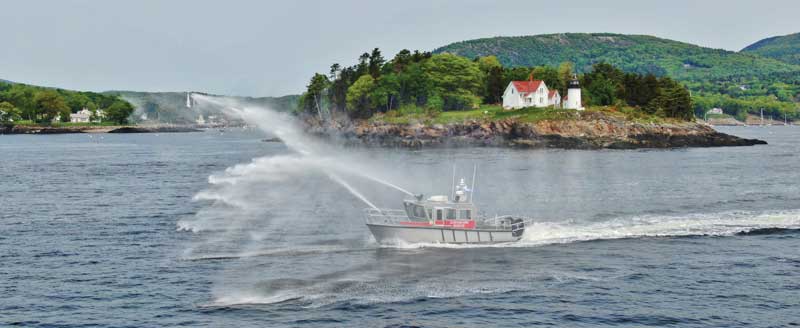
The top brass of a coastal Connecticut fire department didn’t know anything about Lyman-Morse Boatbuilding when they went looking for somebody to build a high-powered, high-tech fire boat. They do now.
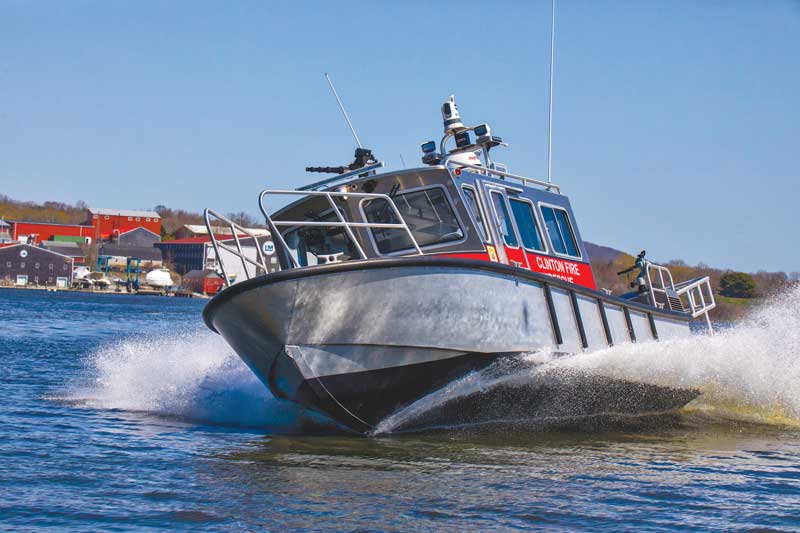
The fire department in Clinton, Connecticut, turned to Lyman-Morse for a 32-foot aluminum boat packed with speed, high-pressure water cannons, and the durability to withstand rough conditions in Long Island Sound. The boat has delivered on all its promises since the town took possession last June, said Michael Neff, deputy chief of the Clinton Volunteer Fire Department.
“We were looking for something that checked all the boxes—relatively fast for its size, the ability to pump significant amounts of water, and the ability to handle significant seas,” Neff said. “Lyman-Morse checked all the boxes.”

For Lyman-Morse, the vessel was the third—and by far the most complex—fire boat the company has manufactured. It also represented a step forward for Lyman-Morse Workboats, a division of the company that was formerly known as Lyman-Morse Fabrication, and which has churned out a variety of aluminum fire and police vessels, landing craft, water taxis, harbormaster boats, and other workboats since its launch in 2015.
Lyman-Morse had previously built two fire boats: a 28-foot landing craft vessel for Anderson County, South Carolina, and a 20-foot center-console V-hull patrol boat for Falmouth, Massachusetts.
But the new boat is not only larger, it is much more complex, with more features to meet the needs of the Clinton fire department. The vessel is the showcase of Lyman-Morse’s fire boats, said Jonathan Egan, manager of Lyman-Morse Workboats.
The boat is outfitted with high-capacity water pumps, water cannons, fire hoses, and foam suppression systems to battle fires in harbors, on boats, at marinas, and at remote shoreside locations. Below deck is a powerful V-8 inboard engine that drives the four water pumps, allowing Clinton firefighters to deliver water at up to 1,000 gallons a minute—much more than they could with their old boat.
Besides the rooftop water cannon, there are three other locations—one on the bow and two on the aft corners—where hoses can be attached to pump water to places that are beyond the reach of the water cannons.
Beyond that, the boat is heavy on electronics, Egan said. It has numerous chart plotters, remote display screens, an AIS 5000 automatic identification system, pump controls and a remote control for the water cannon on the roof.
It also has three joystick locations for its twin 350-hp Mercury outboards. Two joysticks are in the wheelhouse, one for the captain and one for the co-pilot. A third is located outside on the starboard gunwale, allowing the engines to be controlled from there if need be when rescuing somebody from the water or if nobody can be in the cabin.
“It’s one of the more advanced ones we’ve done, technologically,” Egan said. “There’s a lot of stuff on that boat.”
Clinton is a town of about 13,000 people, located halfway between New Haven and New London. The fire department has 60 to 70 volunteers. Besides its on-shore duties and obligations, the department also has responsibilities on the ocean, with the fire boat being its primary marine asset. The new boat replaces Clinton’s previous fire boat, a 27-foot Sea Arc built in 2003. It doesn’t have a traditional name at this point, but its call sign is Clinton Marine 9-2. It’s berthed at the Clinton Marina, next to the police boat.
Having a fire boat with high-pressure water pumps is especially important in Clinton because of Cedar Island, a small island with about 50 homes on it about a quarter of a mile from Clinton Harbor. With a limited water supply and restricted access, it’s critical to have a boat that can pump a lot of water if any of the homes there catches fire.
Clinton also has mutual aid agreements with neighboring municipalities on either side. It is also available to respond to distress calls from multiple towns to both the east and west, and also south into New York waters on the southern side of Long Island Sound.
“We’ll respond to any marine emergency in Long Island Sound in our jurisdiction,” Neff said.
Lyman-Morse, with operations in Thomaston and Camden, is well-known for the high-end sailing and motor yachts it has built since its founding in 1978.
Over the past decade, it has also built aluminum workboats for customers in the Northeast and as far away as Michigan and South Carolina. When Clinton put out a request for proposals, Lyman-Morse was among three companies that submitted bids.
After Lyman-Morse was awarded the contract, a team from the Clinton Volunteer Fire Department visited its 15,000-square-foot fabrication shop in Thomaston several times to see the construction in process. There, they talked with welders, electricians, designers, and other members of LM’s team to get a better understanding of the process and make changes along the way.
“You had that kind of hometown feel,” Neff said. “It wasn’t like a used car salesman, for a lack of a better term. You were involved and they made you feel like you were part of the process.”
Egan said the fireboat is another step forward in the evolution of Lyman-Morse Workboats. Since its founding, the division has built about 30 workboats and has been going “gangbusters” the last couple of years. Overall, Lyman-Morse has built about 170 vessels, he said.
“The workboats are selling really well,” Egan said. “We’re finding the East Coast seems to be waking up to aluminum. It’s interesting because there are scores and scores of aluminum boatbuilders on the West Coast, but not many on the East Coast. I think it’s fair to say we’re New England’s leading small workboat builder. We’re doing more than anybody else that I know of.”
Neff said he’s dealt with other aluminum boatbuilders in the past, but most of them have been in the South. “It’s awesome having a boatbuilder like Lyman-Morse that can build boats along the East Coast,” he said.
✮
Lyman-Morse Fire Boat Specifications
LOA: 32'
Beam: 10'
Draft: 2' 5"
Displ.: 9,265 lbs.
Power: 350-hp Mercury Outboards (2)
Hull material: Aluminum
BUILDER:
Lyman-Morse Workboats
Thomaston, Maine
www.lymanmorsefabrication.com
Clarke Canfield is a longtime journalist and author who has written and edited for newspapers, magazines, and the Associated Press. He lives in South Portland.