

Photos courtesy Rockport Marine.
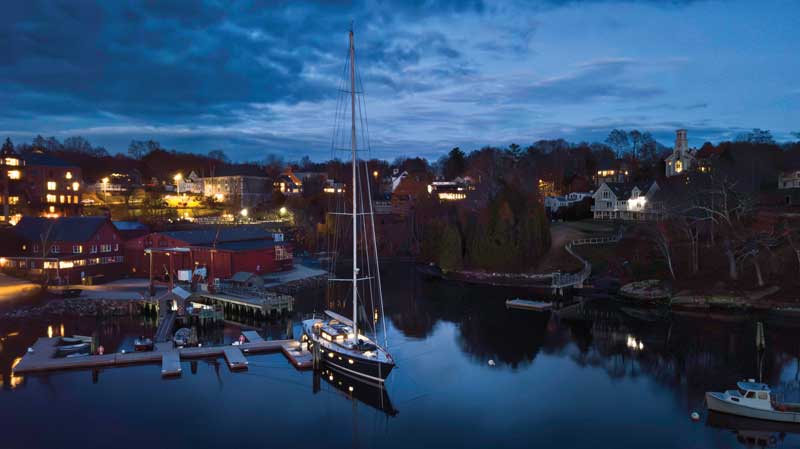
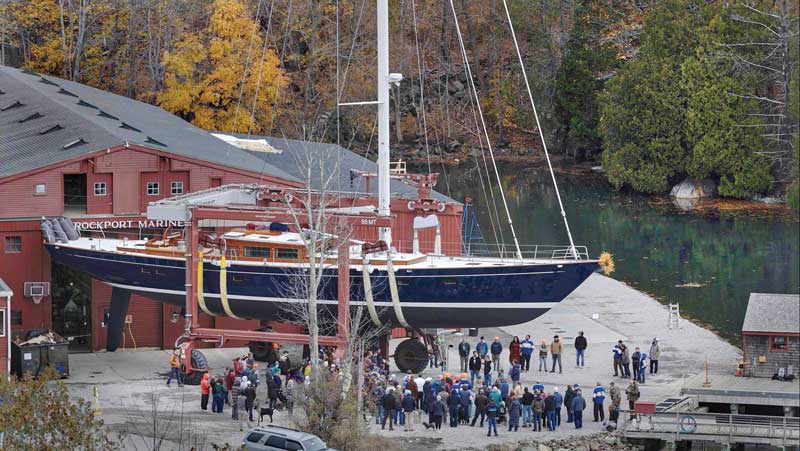
It’s not something you see every day here on Maine’s Midcoast. Strolling down the hill to Rockport Marine’s waterfront facility one Sunday morning in early November, I couldn’t help but notice the mast that towered above the yard’s rugged wood-clad buildings, providing the first inkling of the size of the sailboat suspended in slings and waiting to be launched.
For the past three years, Project Ouzel had been the talk of the area’s boatbuilding community, and rightly so. At 95 feet LOA, the superyacht tapped the skills of artisans and shops across the state and beyond, with all the parts and pieces coming together under the careful guidance of Sam Temple, third-generation boatbuilder and president of Rockport Marine.
Ouzel combines a classic sheer line, generous overhangs, and a low-profile deckhouse coupled with a performance rig, high-aspect rudder, and a modern bulb keel. The yacht blends traditional and contemporary in a modern interpretation of a classic pilothouse cutter.
“We started construction on this project almost three years ago,” Temple said. “It all began when the client approached Peter Wilson, president of yacht management company MCM Newport, and said, ‘I want to do this crazy thing.’” That crazy thing was to build a 95-foot sailboat to explore the world. The client, Temple added, was particularly interested in having a Maine-built boat.
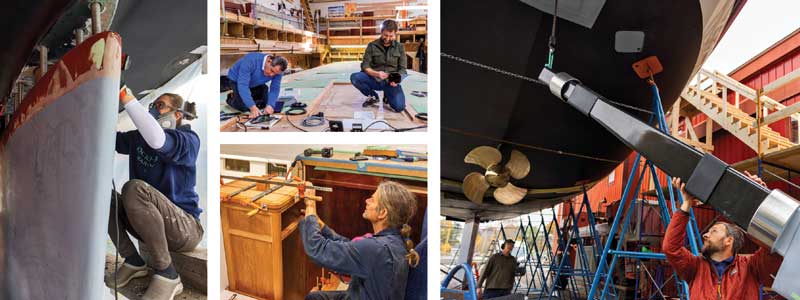
MCM’s Wilson put together the partner team, which began with Langan Design Partners and included Mark Whiteley Design for the interior. To bring Ouzel to life, the team turned to Maine’s Rockport Marine. With Langan Design already having built a sailing vessel at the yard, they were in a good position to vouch for the builder’s passion, know-how and craftsmanship. And, of course, the Midcoast location was a perfect fit for the owners’ brief that called for a New England-built vessel.
Tom Degrémont, partner at Langan Design, explained. “This couple had some serious sailing experience, an excellent eye for aesthetics, and a desire to build in New England. Not a request one turns down!”
Temple can’t divulge the names of the owners. “What I have been able to say is, they’re not interested in a yacht that sits in San Tropez or some of the more common yachty destinations. They’re interested in exploring the far reaches of the natural world.”
The boat won’t have a traditional home port, Temple explained. Like many large yachts of this caliber, the owners will set up an itinerary of destinations around the world, then join the boat in interesting places.
Ouzel’s hull is a true hybrid of traditional and modern materials—cold-molded wood construction using Douglas fir and western red cedar along with carbon fiber, E-glass, and foam cored bulkheads. It’s a technique, says Degrémont, that yields a strong shell while requiring less framing than a traditional plank-on-frame wooden yacht. Cold molding also happens to be a specialty of Rockport Marine.
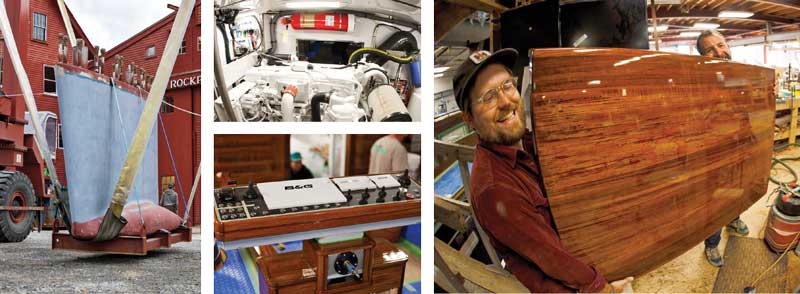
The yacht’s powerful sail plan carries 3,880 square feet of upwind sail area and 6,015 square feet downwind—each imposing significant forces on the structure. To handle these loads, the mid-section of the hull incorporates a lot of high-strength carbon fiber, reducing weight and maximizing internal volume. The result is a simple and functional layout that gives the interior a superyacht feel, yet keeps the classic elements of a traditional sailboat.
Temple said that one of the biggest challenges the team faced was tapping enough skilled labor. Rockport Marine already had a sizable workforce. Temple was able to hire another 10 craftsmen, increasing his employee count by 18 percent for the project. “Ensuring we had the necessary number of hours available in the timeline of the build was something to which I had to pay particular attention. On a daily basis, we averaged 20 to 25 people working on the boat,” Temple recounted.
“This is a large and complex project for Rockport,” Wilson added. “Assembling the correct team around them, including structural engineers; technical experts; and mechanical, electrical, mast, and rigging specialists was the key to success.”
“When you add all of the partner-contractors up, it’s probably two dozen, of which a dozen were what I would call primary.” Temple acknowledged the value that these top-of-their-game contractors brought to the project. “Irons Brothers made the keel in the UK, Marine Hydraulics Consultancy did the hydraulic systems, including writing the complicated software for the thrusters and various controls around the boat. The rig was provided by Hall Spars; Custom Composites Technologies built key structural components; Billings Diesel supplied the engine and generator; Hundested Propeller delivered the controllable pitch prop; and Kwant Controls developed shift and throttle components, which are actually a remarkably big piece of the yacht’s control systems,” Temple said.
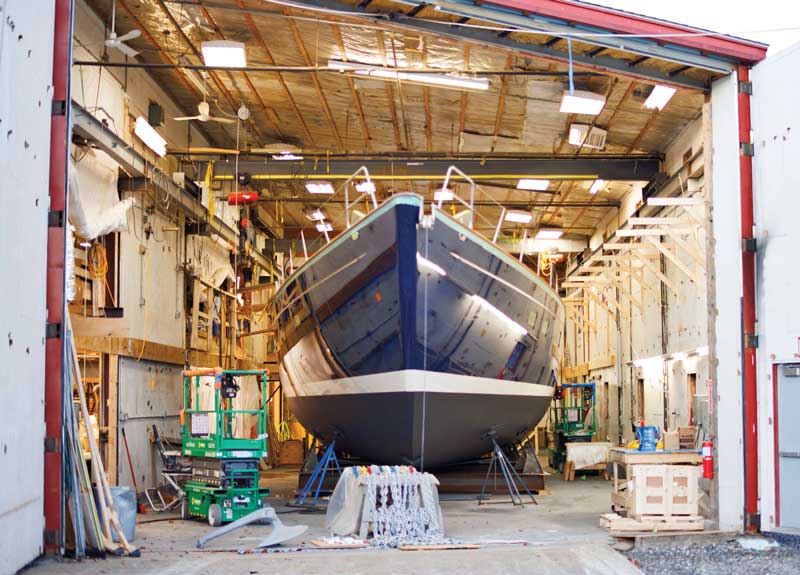
Finding the space to build a vessel of the size and scope of Ouzel was not without its challenges. With a displacement of 75 metric tons, Ouzel is at the upper end of the yard’s physical capacities when it comes to shop space, slip width, and Travelift capacity.
For example, to move the hull and deck in and out of the shop building, Temple had to construct a custom cradle for the boat. How do you fit a 21-foot-wide deck through a 17-foot-wide door? Temple laughed. “We cut a 5-foot slot adjacent to the door in the gable end of the shop!”
Despite the challenges involved with such an undertaking, Temple has no regrets. “You know, I really enjoyed working at this scale and I have explored other boat projects of this scale and larger. I’m interested in facility upgrades that will allow us to continue to work at this scale and maybe a little bigger.”
Project Ouzel also allowed Temple to take an innovative approach to labor efficiency. Three of his marine carpenters, Ben Diamond, David Kelly, and Seth Kramer, each became highly proficient at 3-D computer modeling. “This allowed them, working on specific components of the vessel, to make and modify their own design files, check their work, and have individual parts CNC cut.
“In practice, we proved that the cross-trained carpenters could plan and execute strategies for building complex parts, allowing them to tweak and adjust the layout of components. This was especially critical in areas such as the forepeak with its myriad systems and physical constraints,” Temple explained.
“Rather than having a number of people working in individual silos (plumbing, electrical, hydraulics, carpentry) in the forepeak—we have one individual focused on all of the potential problems and system conflicts with a deep understanding of the specific areas they are working on,” Temple said. The cross-trained carpenters can address issues during the 3-D modeling and mock-up process, rather than fixing issues that arise during the actual construction, delivering significantly greater manufacturing productivity.
The Ouzel project has shed a powerful light on New England’s marine artisans, Temple added. “When the client was choosing a builder, they were focused on Maine boatbuilding. The client has given us the opportunity for our unique industry to show the best it has to offer to the world. Maine and New England contain a confluence of talented marine tradespeople, allowing elements of large projects to be shared across multiple shops to great success.”
The Rockport Marine crew will be executing mechanical trials this fall and full sea trials in the spring. Temple believes Ouzel will complete sea trials and be ready for delivery to her eager owners well ahead of summer.
✮
Ouzel Specifications
LOA: 95'
Beam: 20' 6"
Draft: 12'
Displ.: 165,000 lbs.
Mast Height: 124'
Sail Area, Upwind: 3,880 sq. ft.
Sail Area, Downwind: 6,015 sq. ft.
Engine: Cummins ETA Tier 3-Compliant, 400-hp diesel
BUILDER:
Rockport Marine
Rockport, Maine
rockportmarine.com
Ted Hugger is a freelance writer living in Damariscotta. Come summer, he cruises out of Southport Island with his wife and a very spirited Cardigan Welsh corgi aboard their Grand Banks 42.