

Photographs by Duane Lowe
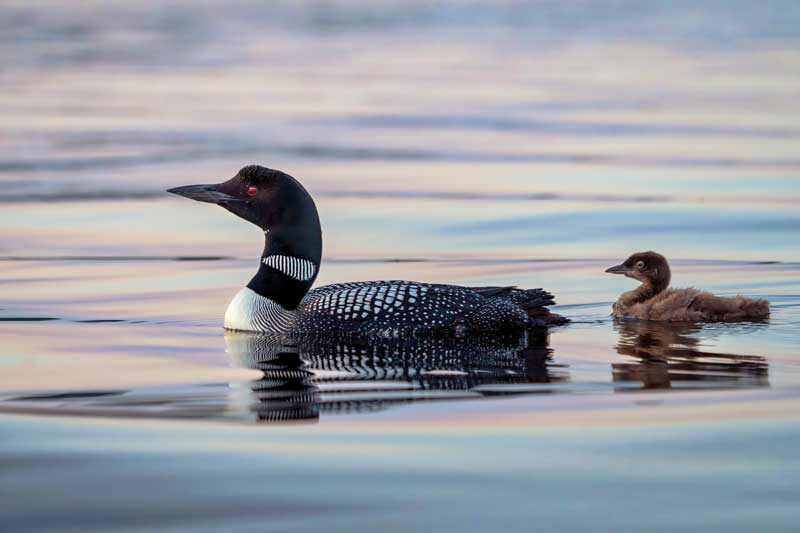
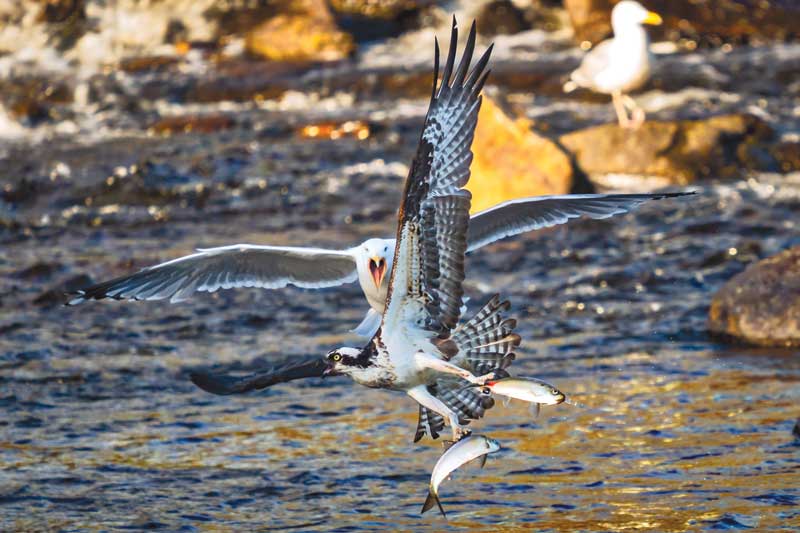
Waiting for just the right moment—say when a diving osprey hits the water or a loon slips a crawfish to her chick—is all in a day’s work for Duane Lowe, a Damariscotta-based nature photographer whose stunning moment-in-time action images have earned acclaim by collectors and photographers alike.
But he’ll be the first to tell you, it’s been a long journey.
Lowe’s photography has evolved from an inauspicious start in high school taking photographs for the yearbook with a borrowed camera. Years later, in 2005, he hired a professional photographer to provide images for his hospitality business’s new website with disappointing results. Armed with a Fuji point-and-shoot camera, Lowe ended up making all of the marketing shots he needed. But it wasn’t until 2012 when he was given a Canon Rebel digital camera that he really took on an intense interest in photographing wildlife at its wildest.
“I tried landscape photography, and I’m really terrible at it,” Lowe said. “If it’s sitting still, I can’t figure out how to shoot it. I went down to Ocean Point one day. I had all the ingredients. I had a lobsterboat. I had Adirondack chairs, flowers, sunshine, ocean. There was even an American flag in the frame. And I made 90 really boring images. No matter what I did, they were all boring. I’m more interested in trying to capture a moment that goes fleetingly by. You saw it, but you didn’t really see it because it happened too fast.” In short, stop-action photography.
Lowe cited participating in organized photography excursions under the tutelage of renowned nature photographers Mark Munch, Andy Williams, and Lisa LePoint as pivotal in the evolution of his art. The trips took him to the Drake Passage, Antarctica, the Ecuadorian cloud forest, and the Galápagos. Working closely with these experts under varied and challenging conditions elevated both his photographic skills and his self-confidence behind the lens.
He recalls feeling unqualified going into the trips. “It was fascinating to watch these fabulous image-makers work in such challenging environments. I was amazed by the amount of wildlife. It’s an absolute thrill to sit in a Zodiac with whales breaching around you. The icebergs were amazingly colorful when the light hit them just right. And the penguins were nesting when we were there—the noise and the smell of a penguin rookery is something you don’t forget,” Lowe said.
His travels to these exotic locations, rich with subject matter, left him with a trove of incredible images—and increasingly well-honed skills.
“I have no interest in what I call ‘bird-on-a-stick’ pictures, you know, a bird perched on a branch. I mean, they’re lovely. People like them and that’s fine. But what I found myself attracted to was capturing and freezing action,” Lowe explained.
Fish Ladder as Muse
Living on Damariscotta Lake, near the famous Damariscotta Mills fish ladder, provided Lowe with a ticket to break away from traditional nature photography.
“I was always complaining about the photographers hanging out on the bridge and slowing traffic down. So, one day, I walked down with my camera to see what all the hoopla was about,” Lowe recalled.
At that time, the fish ladder was being renovated, so there weren’t many alewives making the run. Because of that, hungry osprey were coming in close. Canon in hand, Lowe began shooting bird life around the fish ladder. “And that,” Lowe said, “is when I fell in love with bird photography.”
Capturing action photos of birds offered the technical challenge that Lowe was looking for and quickly became his preferred genre. “For me, it’s about capturing and bringing to life those unique moments in time that happen quickly.”
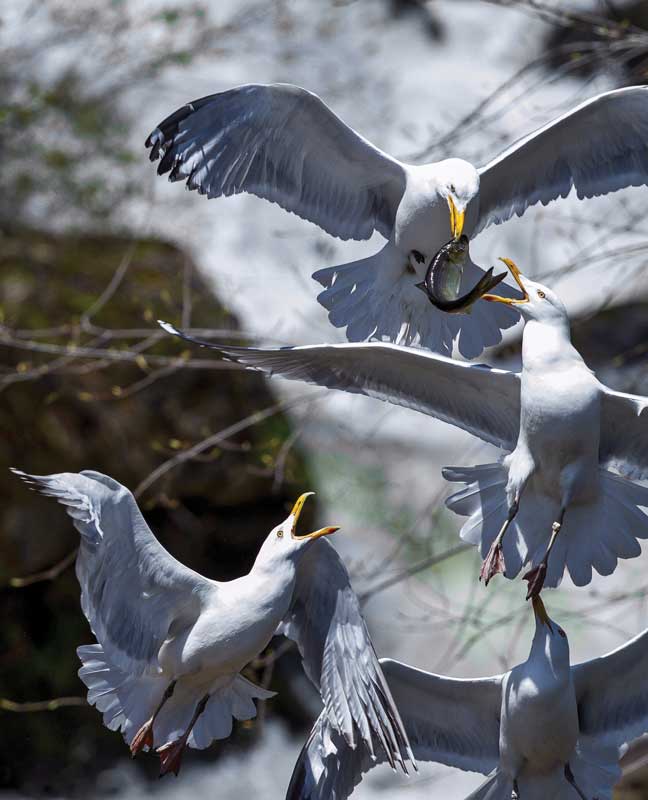
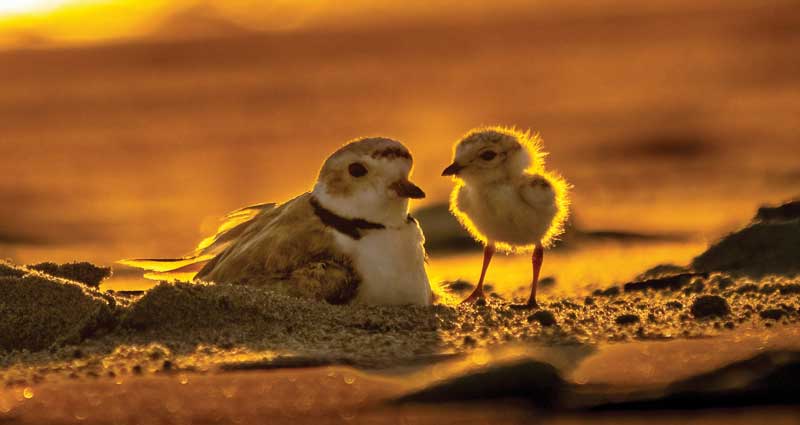
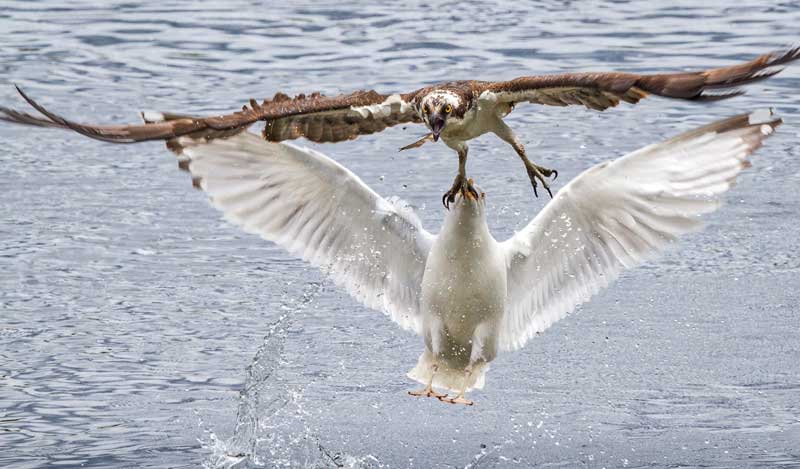
Lowe thrives on difficult-to-shoot images: an osprey diving at 50 mph just as it hits the water, gulls locked in aerial combat fighting over a single alewife, a mother loon feeding her chick a crayfish, a piping plover mid-flight and silhouetted against a fading sunset.
Lowe’s Canon Rebel was fitted with a Sigma 150-600mm zoom lens. He soon realized that he needed a faster lens for better low-light shooting. He sold his Sigma and purchased a 300mm 2.8 prime lens. “Of course, I then needed a new camera to go with a new lens,” Lowe said with a chuckle.
“And so, I sold all my Canon gear to switch to Sony. Today, I’m shooting with a mirrorless Sony A1, Sony’s flagship camera at the time I bought it.” His go-to lens is a Sony G Master FE 100-400mm super-telephoto zoom.
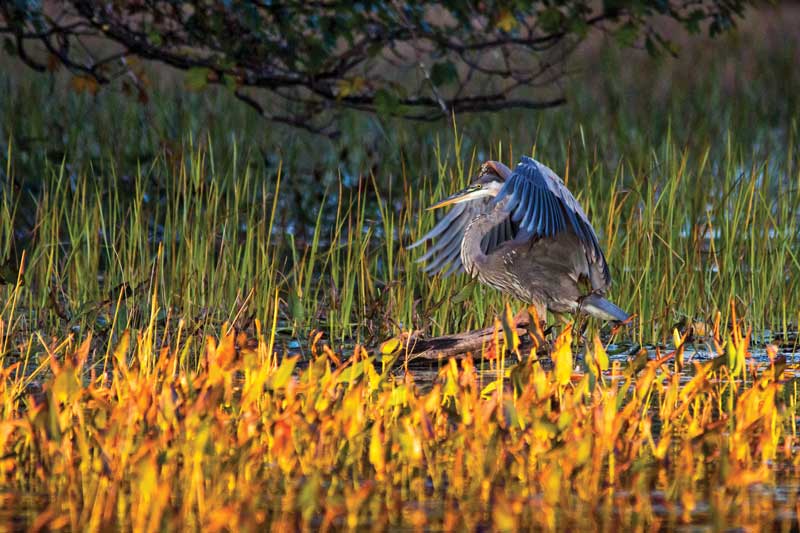
Lowe said that there are larger telephoto lenses that might help shooting subjects that are farther away. “The 100-400 doesn’t give me all the distance magnification I might like. I can’t bring things as close as I want, as a 600 would allow. But for me, it’s light and it’s quick. I want to be able to move quickly and shoot hand-held,” he said. “Because it’s a mirrorless shutter, there is no shutter black-out and I have a live view of what I’m going to make an image of at all times.”
The camera’s histogram (a graph of the tonal values of an image) displayed in his viewfinder allows him to monitor the camera settings and adjust them on the fly. The Sony lens features highly accurate image stabilization and the camera suffers less shutter vibration than a mirrored camera. The latter is critical when shooting in hand-held, low-light situations.
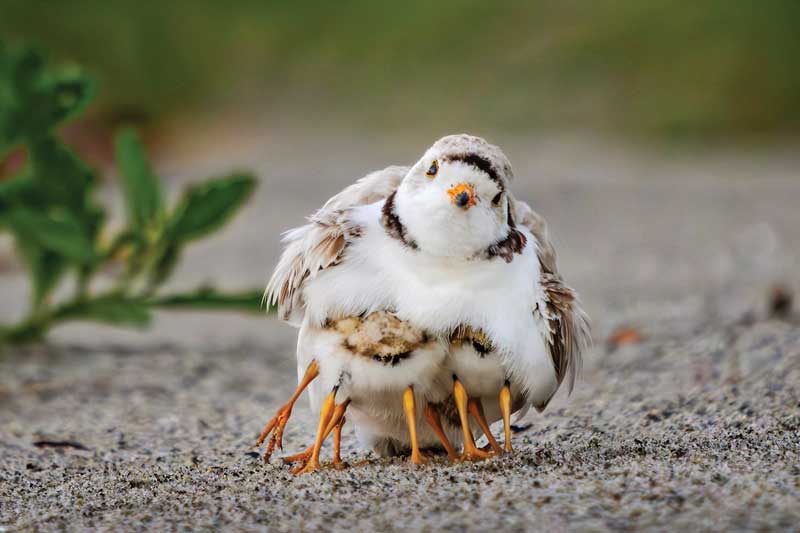
Take, for example, piping plovers. They are tiny little birds that weigh an ounce and a half when they’re fully grown and have a 4-inch wingspan. “People see them darting down a protected beach; I’ve had many people say, ‘We see them running around, but we don’t know what they really look like!’ I love to lie in the sand, camera at the ready, and wait for the birds to become comfortable with my presence. If I wait long enough, they ignore me, and I can capture unique, stop-action images,” he said.
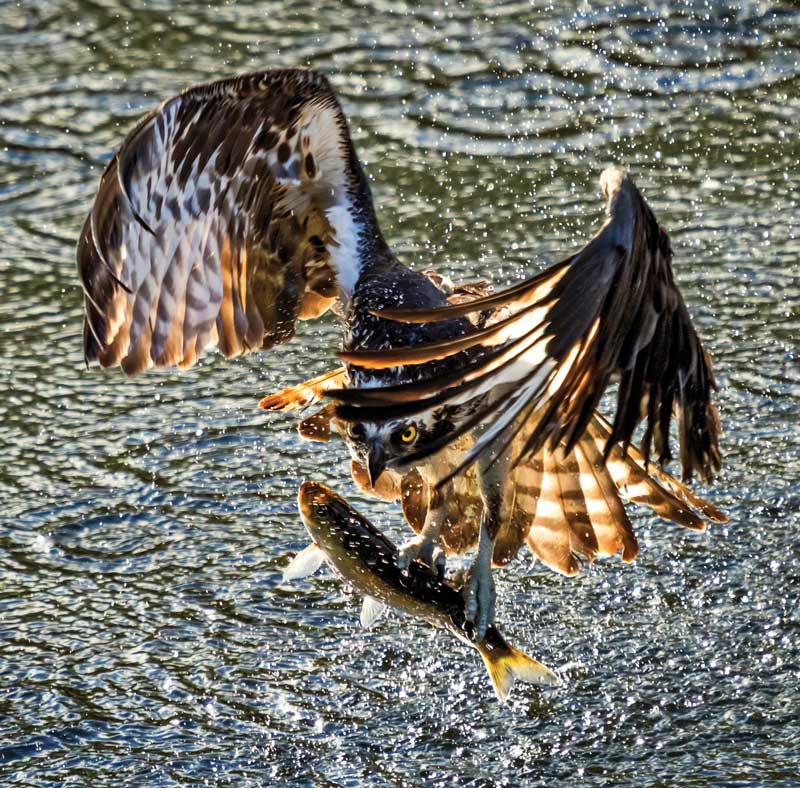
An Eye for Action
Lowe soon realized, however, it’s not the camera and it’s not the lens. “It’s about learning the art of identifying and capturing an image that’s unique. If I can catch piping plovers at sunset and they are front lit, I’ll have a nice image. But, if I’m shooting into the light at sunset and the plover is back-lit, I’m going to see great reflections on the water, and I can pick up details and highlights that make the difference between a good image and a spectacular image.”
Lowe said he takes advantage of the auto-ISO camera feature. ISO is a setting that adjusts the camera’s sensitivity and its ability to capture light. “With auto ISO, I can focus more on my shutter speed and image composition and let the camera worry about the ISO setting. Some of my better shots were made with an ISO of 12,800. I remember when shooting with film,” Lowe recalled, “that 400 was considered fast. Sony is fabulous for low-light images.
“If I’m shooting a subject that is really fast, like a piping plover or a least tern, I want to shoot with a shutter speed of 1/4000 of a second. For loons, I’m typically shooting at 1/1000 of a second or less,” he said.
Lowe recounted how he produced a four-image series of least terns, on 10-inch-by-15-inch metal prints that were commissioned by a client from Virginia for display in his home. “Least terns fly like lightning and are extremely difficult to photograph. The Sony A1 is capable of shooting 30 frames per second. As a result, the four images that make up this series were time-stamped within the very same second.” What you can’t see with the naked eye, Lowe captures digitally, separating each of those moments in time. “Each image tells a story on its own,” Lowe said. “But displaying the images together as a series makes for a powerful story of light and of nature.”
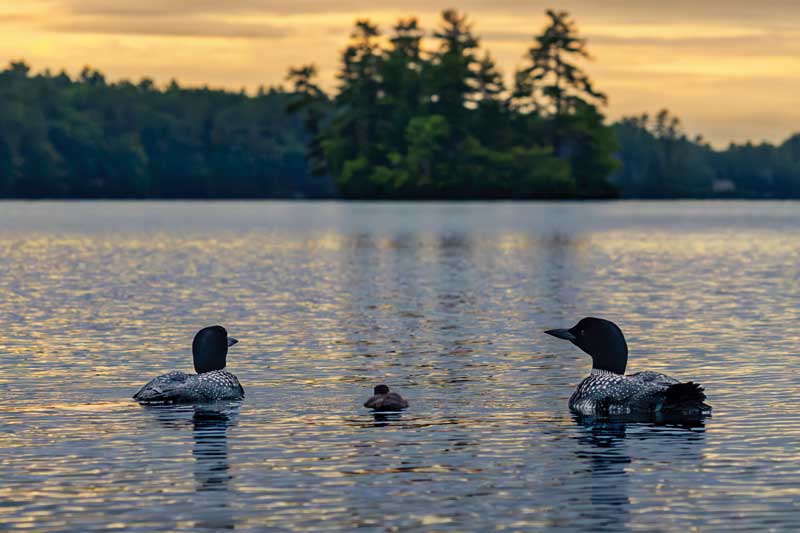
Summer of the Loons
From his home on Damariscotta Lake, Lowe spent many years photographing a pair of loons and their offspring. He would shoot from a neighbor’s dock, vantage points along the shoreline, or occasionally from a boat—but all with limited success. It wasn’t until he borrowed a neighbor’s kayak that he was able to join the loons in their world.
The kayak allowed him to shoot close to the water. “Doing so, I can get shots that are at an interesting angle. I learned to paddle backwards really fast. I learned to turn on a dime really fast,” Lowe explained. Spending months on the water, camera in hand, became fundamental in the evolution of his art.
Gaining confidence with the kayak, Lowe began what became his summer of 2025 ritual. Nearly every day of the week, he would take off in the kayak for three or four hours near dawn and then another three or four hours before sunset. He would seek out the loons in order to document the loon chick’s first summer on the lake. Lowe and his neighbors christened the young bird Baby Loon.
“The loons aren’t endangered, but they are protected,” Lowe noted. “It’s fascinating to watch how the mother and father raise their young. The parents are amazingly dedicated for 12 weeks or so. They have one purpose: to protect and feed that baby. Mom and dad both share the responsibility and take turns sitting with Baby Loon while the other goes off to feed.
“The loon parents have known me for more than 10 years. They’ve seen me shooting from the shoreline or from the kayak, so they really don’t see me as any type of a threat. When I’m sitting still in the kayak and they come by me, that’s a privilege and it’s a thrill,” he said.
“When Baby Loon was really young, I knew pretty much where the family was going to be on the lake. But as she aged, they started exploring the lake,” Lowe recalled. He began each day locating the family. Some days, Lowe would lose sight of them. “I know the coves where there’s lots of crawfish and things to eat, and where it’s a little safer from the bald eagles who are always up for a loon lunch.
“So, one night out on the lake,” Lowe recalled, “Baby Loon was scared by a fishing boat full of anglers. Her parents were quite far away; both were diving for dinner. Baby Loon looked at the boat coming towards her and she looked at me. Suddenly, she raced over to my kayak and sat there beside me until her parents returned. How close was she? I could have picked her up. She just sat beside me until the danger had passed. It’s important to stay out of their space. But it’s okay for them to come into your space. It happens occasionally, yes. And that’s sort of the gold standard when that happens,” Lowe said.
Reflecting on his summer’s work, Lowe said, “I make more conscious images now because I can see where I want to be in relationship to the light and see how my subject’s behavior is going to translate into an image that’s interesting.” He added, “One of my neighbors said, ‘you’ve always made good images, but this year you’re capturing emotions and storytelling.’”
Lowe said he cherishes his time behind the camera but loathes spending time on the computer processing the images to prepare for competition or printing. Processing these photos requires a great deal of skill because he’s shooting large, ultra-high-resolution RAW files containing uncompressed and unprocessed image data.
“I use Lightroom photo-editing software to do the basics,” Lowe said. “I will do rough edits of how I want the image to look in terms of cropping. I can lift shadows and make minor adjustments. But if it’s an image that’s print worthy—and I had a mentor years ago who told me it’s a rare image that is worthy of ink—I send the image to a processing expert to prepare the final files. I’ll sit in the kayak for hours waiting for something interesting to happen, but I’m not going to sit around trying to figure out what makes an image look the best on the computer screen.”
Lowe conceded that to get to where he is now, it has been a slow evolution requiring an innate passion for the subject matter and the process. And most importantly, the patience to persevere until you learn the birds’ habits.
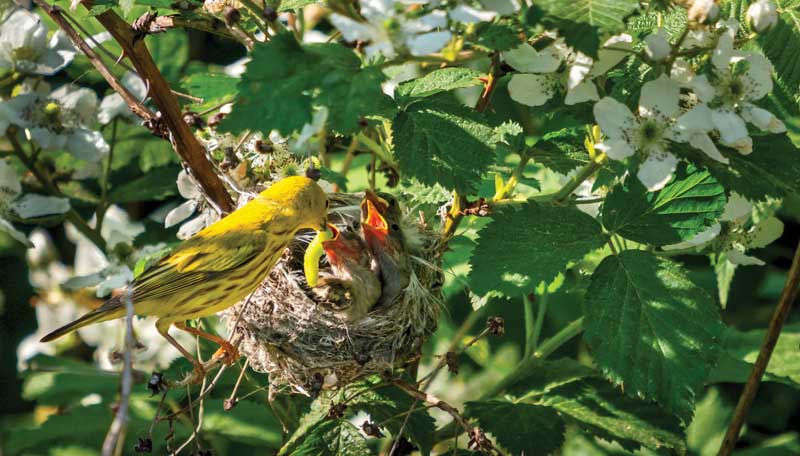
“I’ve made some unique images of yellow warblers feeding their chicks,” he said. It’s always extremely hard to find their nests. They hide. I must have stayed focused on that nest for five hours. But in the end, I ended up with a handful of images that were decent.
“When I was starting out, I would sit in the garden near the hummingbird feeder and practice shooting hummingbirds for hours as they fed. They’re so small and so fast, I thought if I could grab a clear picture of a hummingbird at the feeder, I was probably figuring out how to move my camera when tracking the subject. And then I would try to shoot the hummingbirds feeding at the flowers around the garden, where I didn’t know where they were going. Once I found I could get clear images of hummingbirds flitting between flowers, shooting a diving osprey with a 6-foot wingspan became a whole lot easier.”
“There’s a quote attributed to Dorothea Lang, the iconic photographer, which goes, ‘The camera is an instrument that teaches people how to see without a camera. While there is perhaps a province in which the photograph can tell us nothing more than what we see with our own eyes, there is another in which it proves to us how
little our eyes permit us to see,’” Lowe recalled. “And that’s starting to come to life now in the work that I’m doing. So, whether I am down on the ocean beach or in the kayak, it’s about being present, being observant, and seeing more than my eyes permit.”
✮
Ted Hugger is a freelance writer living in Damariscotta. Come summer, he cruises out of Southport Island with his wife and a very spirited Cardigan Welsh corgi aboard their Grand Banks 42.
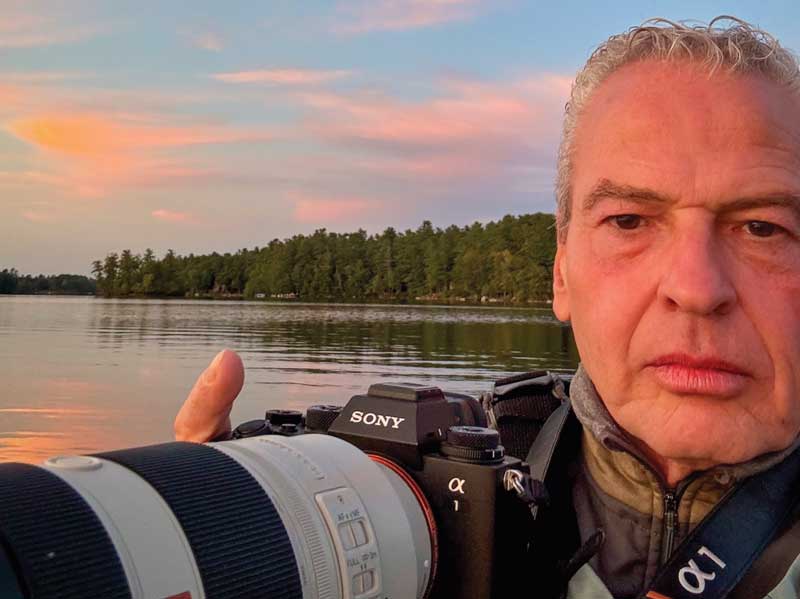
For More Information
Duane Lowe lives in Damariscotta, Maine.
His images can be viewed at his site online at DuaneLowePhotography.com and on Instagram: @n2light.photo.