

All images are from the Collections of the Maine Historical Society
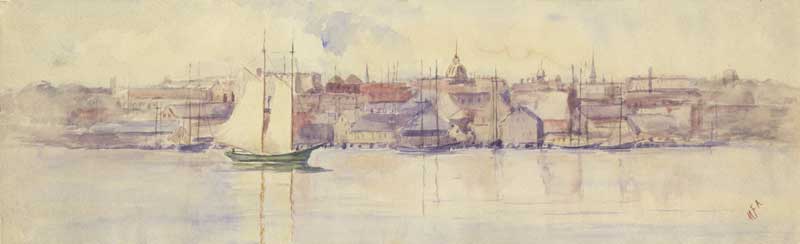
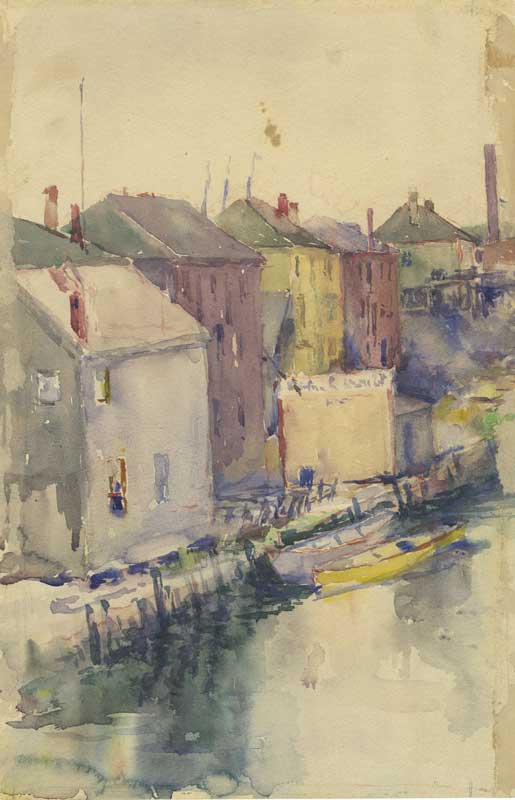
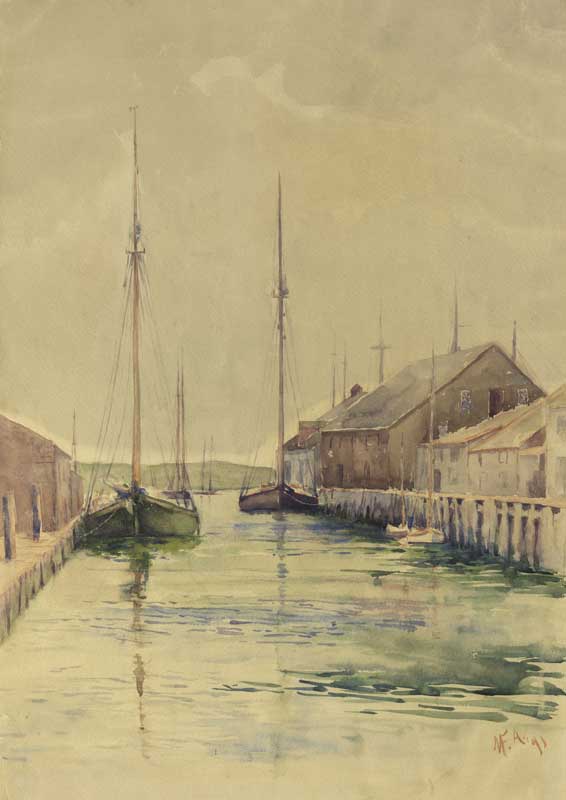
Portland’s stature as Maine’s largest seaport is defined in part by the many wharves that line its long waterfront. Beginning in the mid-19th century, these picturesque wooden structures and the vessels they served became subjects for poets, artists, and photographers.
In 1888, historian John T. Hull counted 30 wharves extending from India Street to Fish Point.
Recalling the waterfront of his childhood in his 1855 poem “My Lost Youth,” Henry Wadsworth Longfellow wrote, “I remember the black wharves and the ships, / And the sea-tides tossing free, / And the Spanish sailors with bearded lips, / And the beauty and mystery of the ships, / And the magic of the sea.”
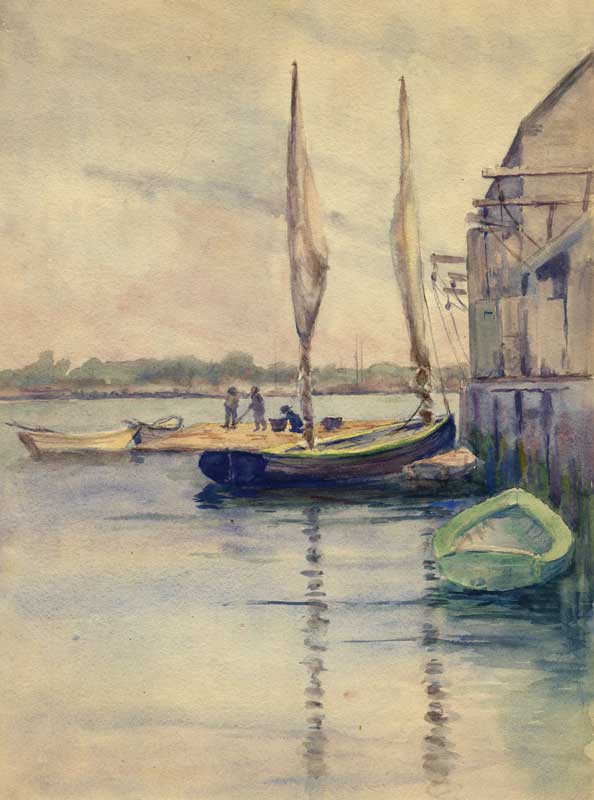
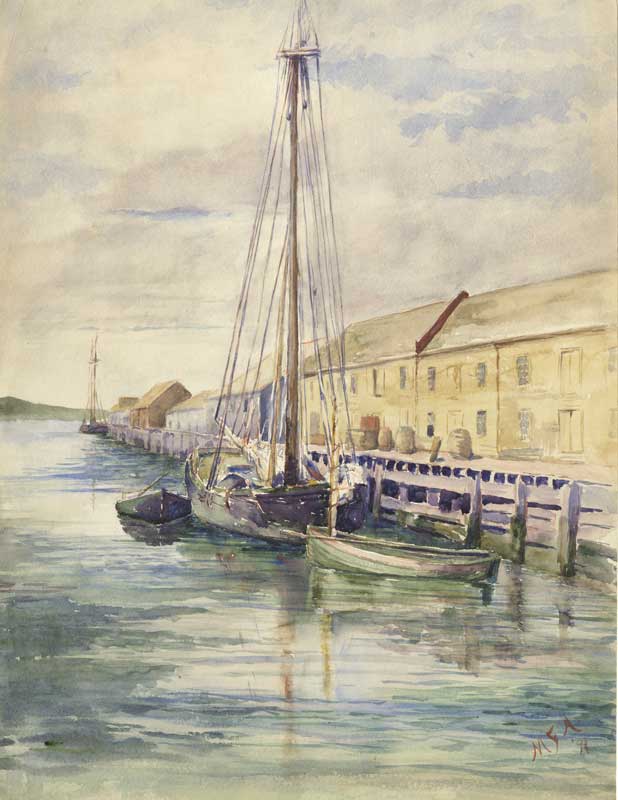
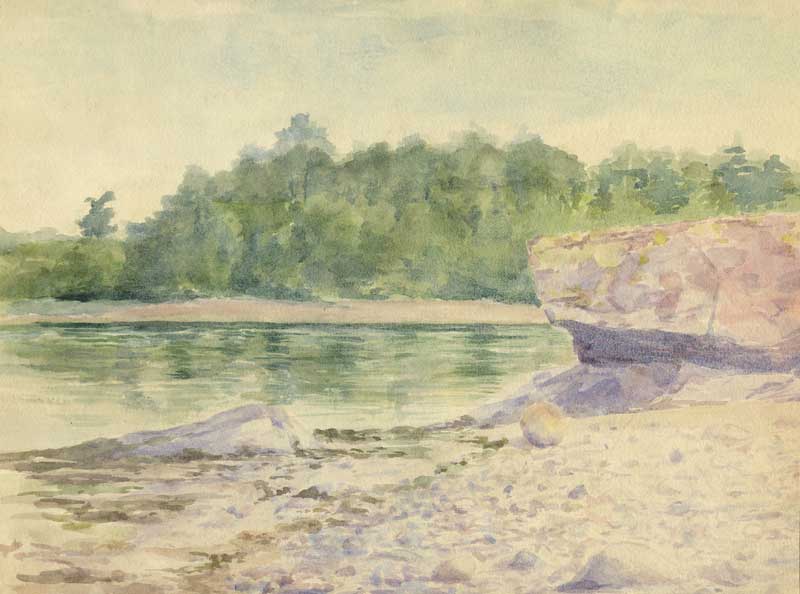
One of several 19th century artists to depict the waterfront was Medora Frances Atwood, who was active as a watercolorist from 1880 to 1910. Upon her death in 1950, she bequeathed her watercolors to her attorney, Robert L. Cram, and his wife, Emilie. Recently, James and Anne Cram donated many of Atwood’s watercolors to the Maine Historical Society, including those of the waterfront. These colorful paintings successfully capture the essence of this distinctive part of Portland.
Atwood was born in Portland in 1855, the daughter of Levi and Ellen Atwood. A native of Wellfleet, Massachusetts, her father came to Portland in the 1850s to operate Atwood’s Oyster House, a popular restaurant that started on Congress Street and later moved to Center Street. He also engaged in the wholesale oyster trade.
Medora Atwood grew up in comfortable circumstances in a household that consisted of her parents and her younger sister Nancy. How she acquired her artistic training is unknown. Period accounts describe her proficiency in oils, watercolors, china painting, and photography.
From the 1880s to the early 1900s, Portland artists flourished and many of them were talented women, including Mary King Longfellow, Catherine Porter Talbot, and Harriet Cammett Shaw. Atwood was among those who showed their work in the exhibitions of the newly formed Portland Society of Art, predecessor of today’s Portland Museum of Art.
Reviewing a PSA exhibition in 1883, the Portland Daily Press described a picture by Atwood as “the interior of an old-fashioned room, with old books, and other articles faithfully painted.”
In 1891, Atwood and two sister artists, Sarah Coolidge and Alice Hewes, held a show of watercolors and china paintings in the Atwood home on Oak Street. Two years later, the founding of Portland’s China Decorators’ Club provided the female practitioners of this art with the opportunity to display their work in more venues. The club reflected the popularity of china painting in Maine and across the country. Between 1893 and 1904 the club held periodic exhibitions, and Atwood exhibited her work in all of them.
Press accounts praised her painted decoration of plates, vases, wall plaques, figurines, a bon-bon box, and a punch bowl with cups. Alongside these objects, she showed examples of her watercolors and her photographs.
With the death of her father in 1900, Atwood sought to supplement the family income by offering lessons in watercolors, china painting, and drawing at her home on Oak Street. The 1900 and 1910 censuses list her profession as an artist, as do Portland directories of the period. However, the 1910 directory marks the beginning of her listing as a stenographer.
Between 1920 and 1924 she lived with her sister Nancy in Falmouth. Upon Nancy’s death in 1924, she returned to Portland, where she resided until her death in 1950 at the age of 94. Atwood was buried at Evergreen Cemetery with her family.
Although she had not been called an artist since 1910, her obituary in the Portland Evening Express on July 13, 1950, recalled that “Miss Atwood gained considerable prominence as an artist working with watercolors, oils, and china painting.” This sentiment was echoed by the Bath Daily Times of July 21, 1950, which remembered her as “artist of no mean reputation and her collection of hand painted china was beautiful.”
✮
Earle G. Shettleworth Jr. directed the Maine Historic Preservation Commission from 1976 to 2015, and he has served as Maine State Historian since 2004.