

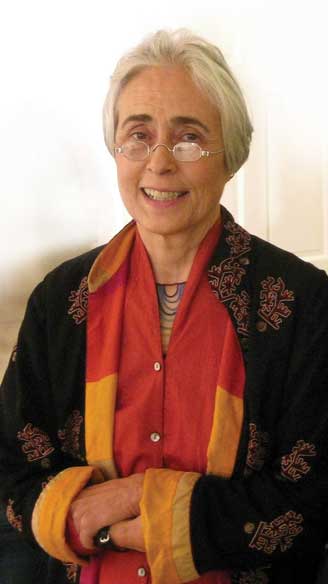
Katherine Bradford remembers attending a Milton Avery exhibition at the Payson Gallery of Art at Westbrook College some years ago. She found herself standing next to a man who was looking at a seascape by Avery, who is sometimes referred to as the “American Matisse,” and whose work blends abstraction and representation. “Well,” the man said very disgustedly, “this guy doesn’t know much about sailboats.”
Bradford was disturbed by the comment: “I felt he was asking of Avery something that [the artist] wasn’t prepared to give and wasn’t interested in giving,” she said.
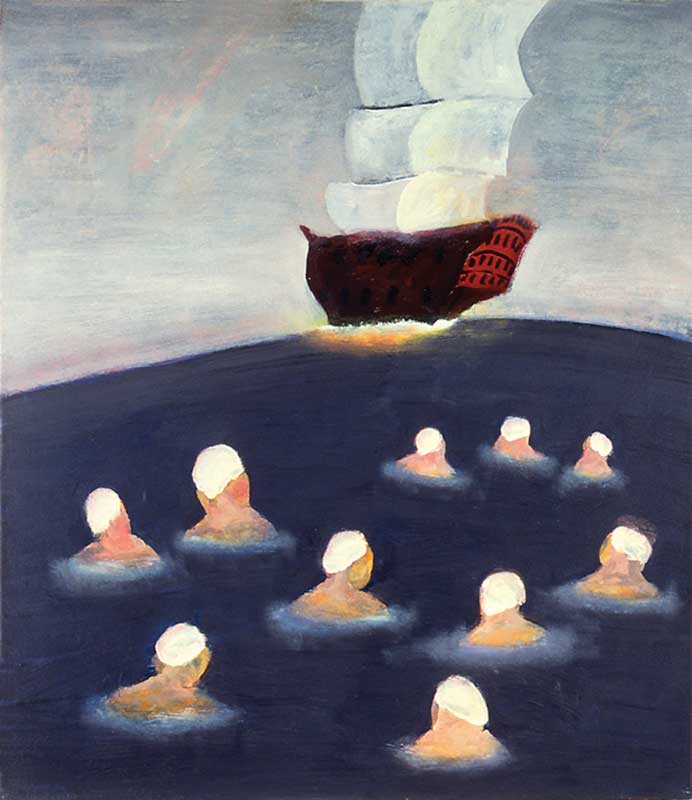
When Bradford began to paint her own images of boats, she wondered if she would be open to the same criticism. “I couldn’t help but notice that I wasn’t giving boat people much boat,” she said.
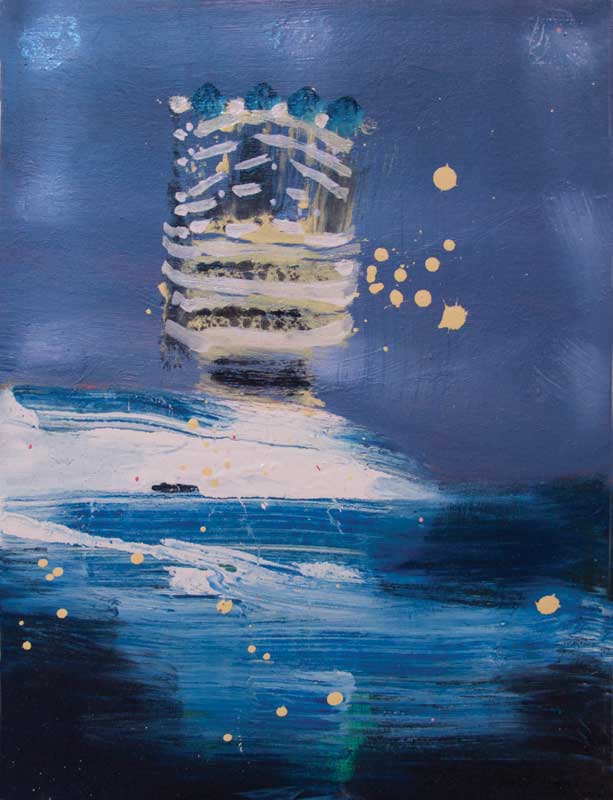
While it’s true that Bradford’s vessels have little descriptive detail, you recognize them right away. In the small painting Ferry Boat (2009), for example, the painter captures the essence of the tall passenger carrier, its lit-up shape moving through the fog. The painting won a purchase award from the American Academy of Arts and Letters last year and was given to the Worcester Art Museum in Massachusetts.
The appearance of boats in Bradford’s work is connected to the way she puts on the paint; she uses horizontal strokes, the result of which often ends up looking like water. Inspired by these painterly seas, she introduces a shape drawn from her memory of what boats look like. Soon ocean liners, galleons, sailboats, and ferries are crossing her watery plains.
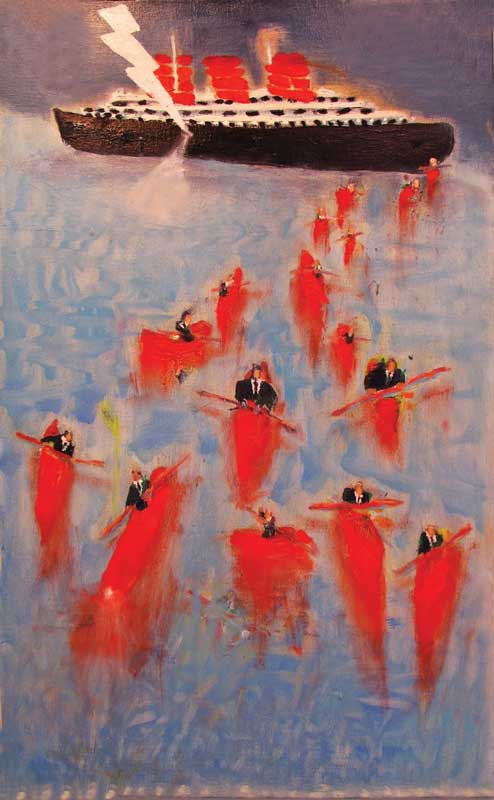
Sometimes these pictures suggest narratives. The 2011 Kayak Evacuation shows a group of men in tuxedos paddling kayaks away from an ocean liner that has been struck by a lightning bolt. Bradford said she didn’t set out to make a comment about our time, but one could read this absurdist image as an allegory about wealth or Wall Street—a humorous high-seas bail-out.
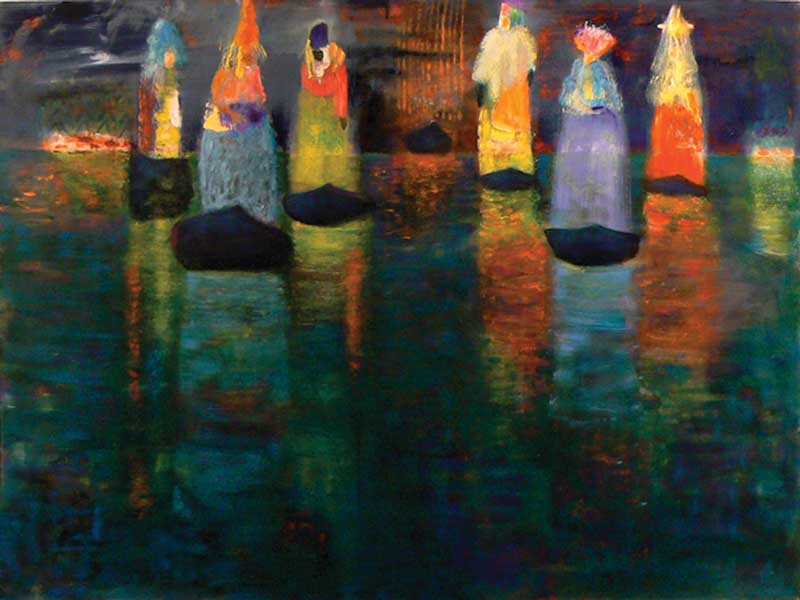
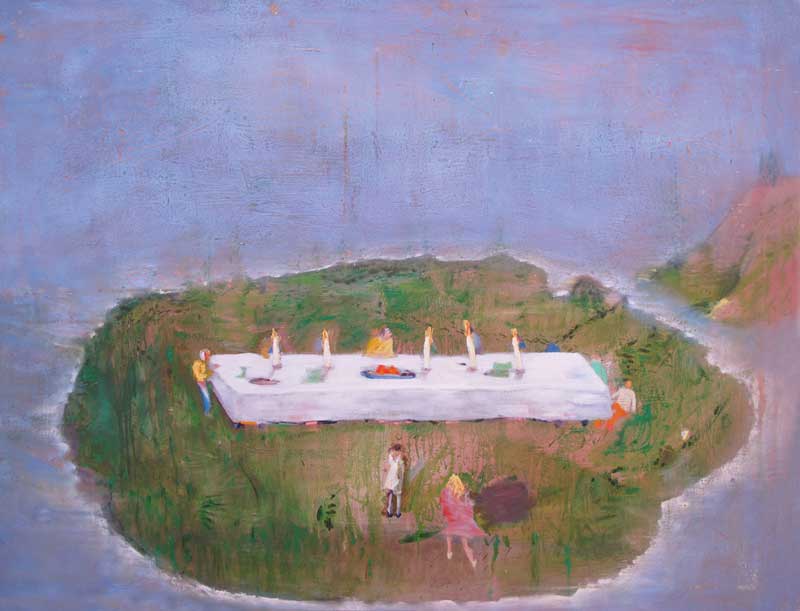
While a Bradford painting may occasionally provoke an out-in-out laugh, most of her pieces have a quality of mystery. Consider Desire for Transport (2010), for example. What appear to be tall shining figures are standing in boats that float across the night water, conjuring something you might see in Venice as a part of a religious enactment. Using suggestion and a lively palette, Bradford subverts the conventional seascape. She merits the praise that New York Times critic John Russell once applied to the aforementioned Milton Avery: “marvelous positioner” and “innovative colorist.”
Bradford’s eye for boats derives, in part, from her friendship with the late Maine writer Douglas Stover, of Alna and Damariscotta (and the author of the book Eminent Mainers). The painter met Stover through mutual friends in the Brunswick area back in the 1970s and went out sailing with him on a number of occasions. From time to time during the summer, Stover and Bradford would meet in such coastal towns as Belfast and Rockport, have dinner, and then stroll around the harbor looking at boats.
“He would always point out to me which boats had good lines,” Bradford recalled. She gradually came to understand that Stover meant that these boats had “a certain grace and harmony” to their form.
Stover especially loved wooden boats. He also had an obsession with the Titanic because, Bradford explained, “among other things he thought he resembled the captain, which in fact he did.”
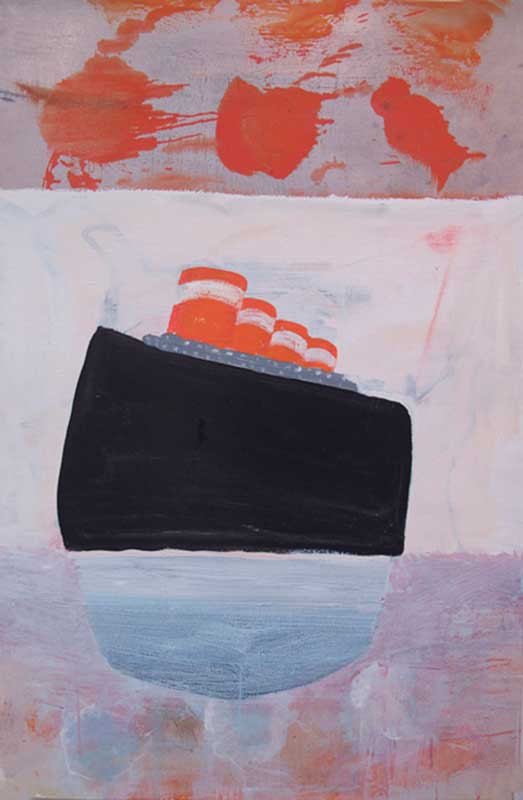
Stover’s obsession may have influenced the artist’s seven-minute video, “Story of the Titanic.” Bradford began the piece while teaching at the Skowhegan School of Painting and Sculpture in 2009. During her six weeks there, she has recounted, “everything started to look like an ocean liner—the chips of Styrofoam used to test the fresco, the hunks of wood on the floor of the sculptors’ workshop, and the pointed pencil holder I found stuck to the wall of an abandoned studio.” She added paint and smoke stacks to these objects, which became the props for the 2010 video.
Bradford took a playful approach to the well-known story of the ocean disaster: the climax takes place on a snowy sidewalk near her winter home in Brooklyn, New York, while other scenes were shot in a tub of water filled with ice cubes. “It seemed the best way,” she has explained, “to show the smallness of this great ocean liner that eventually proved to be so vulnerable in the open seas.”
In her earlier years, Bradford was an abstract painter. She attended the Concept Center for Visual Studies, a school established by William Manning and other artists in the late 1960s in Portland, Maine, as an alternative to the more structured Portland School of Art.
“The Concept Center was mostly about abstraction,” said Bradford. “They encouraged us to paint directly on the canvas.” The school was also accommodating: “You could go there and spend the day painting,” she recalled. Fellow artists at the Concept Center included Don Voisine, Alice Spencer, and Maury Colton.
“As students,” Voisine said in an interview last year, “we learned as much from each other as we did from the teachers.” He also vividly remembered the school’s location, above a cosmetology school on Congress Street. “The smell of hair products... mingled with the smell of paints,” he said.
In her early days, Bradford noted, she was a “mark maker,” working in purely abstract modes. She was drawn to such painters as Joan Snyder, Cy Twombly, and Brice Marden. Later, her work reflected the Maine modernist tradition. She remembers a review by Maine Times critic Edgar Allen Beem who noted the influence of Marsden Hartley and John Marin on her work. “I took [his response] as a challenge,” she recalls, “I knew that it wasn’t great to be too influenced by them.”
By the time Bradford had her first solo show, at the Victoria Munroe Gallery in New York City in 1989, her work had moved away from pure abstraction. Asked in a 2007 interview to explain this shift, she noted that she had “reintroduced images” into her paintings because she “wanted more emotion” and “wanted to tell stories.”
“My work is mostly about painting,” Bradford said, “which is a hard thing for people who don’t paint to understand.” A mark or a shape on the surface will suggest an island, or a swimmer with a bathing cap, or art students throwing paintings off a bridge—or an ocean liner. This wonderful sense of intuition and play activates her art and is a part of its immense appeal.
Katherine Bradford was born in New York City in 1942. She attended Bryn Mawr College in Pennsylvania, a school that didn’t have much in the way of studio classes, but did have a strong art history department. Bradford received a BA degree in that discipline in 1964.
Bradford’s connections to Maine date to the late 1960s. Her husband, Peter Bradford, was an advisor to Governor Kenneth Curtis from 1968 to 1971. The couple first rented a house in Wiscasset and then, in 1972, purchased a home on Mere Point in Brunswick. A barn on the property became her studio.
In 1969, the Bradfords became parents to twins: Arthur, who is now a filmmaker (most recently of the documentary “6 Days to Air: The Making of ‘South Park’”), and Laura, an intellectual property lawyer, who is married to David D. Kirkpatrick, Cairo bureau chief for the New York Times.
Katherine Bradford remembers Maine in the early years as a “lively place—people were coming from the cities as part of the back-to-the-land movement.” For the first time in her life, she slowed down enough to begin to think she could become an artist. She began to paint in the 1970s while raising her children. “Like so many mothers,” she said, “I painted as much as I could. As my kids got older I had more time.”
In 1975 Bradford helped found the Union of Maine Visual Artists with Bowdoinham painter Carlo Pittore and others. “I think artists felt the need to get together and organize things,” she recalled. In addition to advocating for artists, the UMVA hosted exhibitions and artist presentations. “It was a wonderful time,” she said. The Union remains active today as advocate and convener.
Bradford helped produce the journal Vision: A Journal of the Visual Arts in Maine, in part to address the lack of art writing in the state. “Those kinds of publications help artists get a start,” she said, “and a lot of artists got a start.” She was also one of the first people to write about art on a regular basis for the Maine Times, the esteemed weekly. Peter Cox was the editor at the time; “When I handed in my reviews,” she recalled proudly, “he printed them all.”
Through her art writing, Bradford came to know the artists and the state. “I went all the way up to Cape Split and met Norma Marin and John Marin, Jr.,” she recounted—“it was a pilgrimage.” This past winter she was excited to have five of her paintings in “Land, Sea, and Sky: Contemporary Art in Maine” at the Addison Gallery of American Art in Andover, Massachusetts, at the same time as the exhibition “John Marin: Modernism at Midcentury” was on view in the same venue.
Bradford and her husband divorced in 1978. She relocated to New York City in 1980, but she kept the house in Brunswick (she rents it to Bowdoin College students during the academic year). She returns every summer, bringing her work to Maine in a rental truck. “It’s pretty seamless,” she noted.
In 1987, Bradford received an MFA from the State University of New York in Purchase, after attending on a scholarship that included teaching beginning painters. After her children entered college, she had stints at Illinois State University, Ohio State University, College of New Rochelle in New York, and SUNY Purchase as a visiting professor. In 1995 she became an adjunct faculty member at the Fashion Institute of Technology in New York City; two years later, she joined the MFA faculty at the Pennsylvania Academy of the Fine Arts in Philadelphia. She continues to teach at both places.
In 2009 Bradford was invited to teach at the Skowhegan School of Painting and Sculpture, which pleased her greatly. Early in her painting days in Maine, she would drive up to the school to attend lectures. On these trips she became aware of, and friends with, a community of artists, including Lois Dodd and Yvonne Jacquette, who came to Maine from New York City every summer.
Over the years Bradford has embraced teaching. “People imagine that artists are very alone doing their work, and it’s true, but they’re also part of a larger community,” she explained. “I think teaching and going to other artists’ studios and having them to mine is a way of keeping in touch with what’s going on.”
Bradford is a member of a lively art scene in the Williamsburg section of Brooklyn, where she lives during the winter. When in Maine, she enjoys visits with fellow artists. She is especially fond of painters Natasha Mayers and Mark Wethli, who, she said, “are terrific at coming to your studio and saying just the right thing to help you realize what you’re doing.”
Bradford has had numerous exhibitions and received her share of honors, including a Pollock-Krasner Foundation grant and three successive appearances in the Portland Museum of Art’s Biennial exhibition. Her work is in the permanent collections of a number of major museums, including the Metropolitan Museum of Art.
In 2011 Bradford won a Guggenheim fellowship, one of the most prestigious awards in the art world. Thanks to this fellowship, these days she is doing a little less teaching and spending more time in the studio. The fellowship has also made Bradford feel “just a little bit stronger” about who she is and what she is doing.
“I want to stay in my dreamy world,” the artist, casually clad in a t-shirt with the Batman insignia on it, said in a video interview in her Brunswick studio in 2008. In the same video, she described her return to Maine after a winter in New York: the re-entry into her barn studio, Bradford said, was a “visceral event.” Then she held up the note she wrote to herself when she left the year before: “You can always be stranger.”
Now there is something to strive for.
Carl Little’s latest book is Eric Hopkins: Above and Beyond. He lives and writes on Mount Desert Island.