

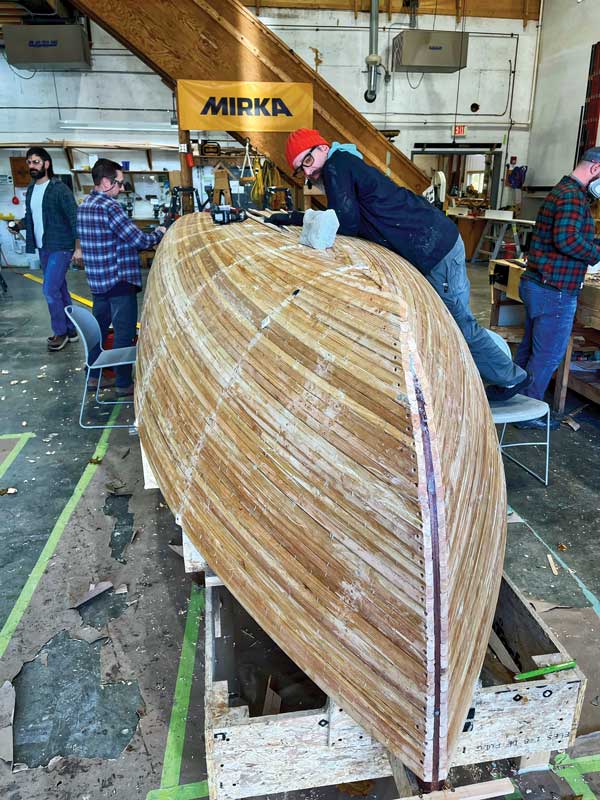
Some boats are built for fishing, others to sail. At the Landing School in Arundel, Jericho Bay Lobster Skiffs are built to teach, though nearly all go on to provide new owners with a tough little vessel that can punch well above its weight, even in open waters and on days when things get snarly.
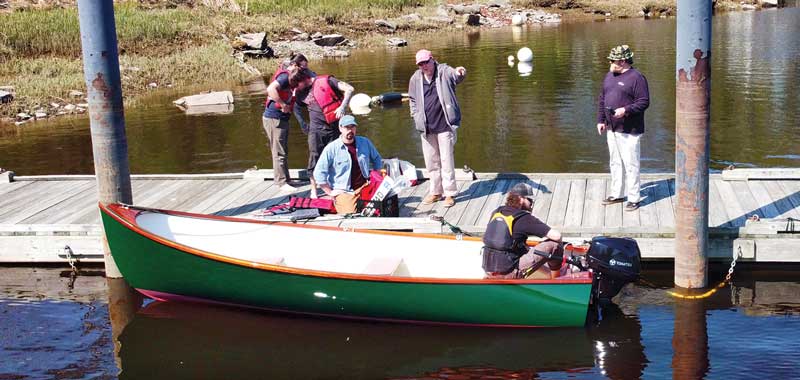
This past year, the school launched a pair of the skiffs, one built from wood, with varnished trim and transom, and the other a composite model, finished off without frills, in plain workboat style, and painted white. Both are powered by 20-hp Tohatsu outboards, and when sold, go for right around $17,000. The sale price, noted wooden boatbuilding instructor Jake Greiner, covers the cost of materials, engine, a Load Rite trailer, and basic safety equipment. Labor—about 2,000 student hours per boat—is on the house, so to speak.
On a visit to the school last fall, the composite boat was still on site, sitting outside the boatshop on a trailer, ready for use by students, some of whom had built it and returned for other courses. Its sistership, meanwhile, had already been sold, but three new skiffs—all wooden—were under construction by this year’s boatbuilders in training.
Greiner said last year’s skiffs were open boats with tiller steering. This year’s will be powered by 25-hp Mercury outboards and will have wheel steering and a throttle on an offset helm console. He anticipates that will add $1,000-$2,000 to the price.
The Jericho Bay Skiff is a sharp looking little runabout with an interesting downeast connection to Brooklin, Maine, and noted boatbuilder Joel White, who designed it in the 1970s to be a workboat built by local builder Jimmy Steele for area fishermen.
In a boat profile that current Professional Boatbuilder editor Aaron Porter wrote for a 2012 issue of Small Boats, he described having found one of the original Steele hulls in 2005 that had been stored for years in a barn on Deer Isle. Two years, a minor refit, and many compliments later, he and boatbuilder Tom Hill went looking for drawings for the boat, but none were to be found. Instead, another Brooklin boatbuilder, Eric Dow, took measurements from Porter’s boat and came up with a new set of plans intended for use by amateur builders.
Greiner said when the Landing School went looking for a new design to use in its wooden boat curriculum, they chose the Jericho Bay Skiff because it was relatively easy to build but taught students the skills they would need to work on other projects. Dow’s lines were further tweaked by yacht design instructor Duane Branch to slightly modify the hull and to account for the weight of modern outboards.
Last year, the Branch version was used for both wooden and composite boatbuilding instruction; this year, the composite class was put on hold because of lack of an instructor. But in the wood shop, students were busy finishing up the planking of one boat and starting the sanding and fairing of the other two.
The Landing School attracts a range of students, some young, some older, some looking for a career in the marine trades, some just curious. When classes begin in the fall, the first couple of weeks are a crash course in woodworking and tools, Greiner said. By week three, students learn the basics of lofting a hull. Then stems are laminated and strips of planking are cut and get screwed onto strongback frames.
Once planking has been completed, layers of fiberglass cloth and epoxy are used to cover the hulls inside and out. By the time that the molds are removed and thwarts, seats, and trim are in place, the boats are ready for the paint shop—and the students are prepared to move on to their next build. This spring they’ll be finishing off a peapod, another Joel White design, built with steamed oak frames and cedar planks.
But back to the Jericho Bay Skiffs for a moment. I’ll let Porter leave us with his thoughts after having spent a sporty day in his Lobster Skiff, running across a windy and choppy Penobscot Bay.
“Boaters with better sense had already quit the Reach as I made my way down to Brooklin, feeling a bit foolish for being out in those conditions and lucky at my choice of boat,” he wrote. “By the time I reached my mooring I had shipped only a few bailing scoops’ worth of spray.
“This is a forgiving boat.”
✮