

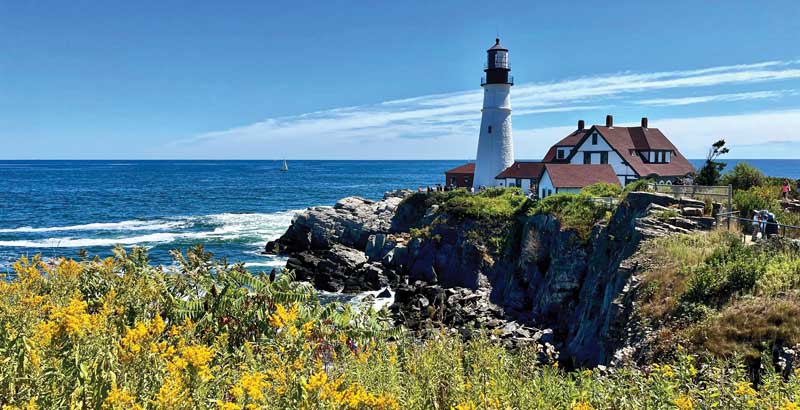
“All hands turn out! There’s a ship ashore in the dooryard!”
With that shocking announcement, the 1886 Christmas Eve festivities in Keeper Joshua Strout’s family quarters at Portland Head Light came to an abrupt halt. Incredibly, a British three-masted bark named the Annie C. Maguire had crashed onto a rocky outcropping a mere 100 feet from the 80-foot-tall tower on the edge of Cape Elizabeth. It’s thought a veil of blowing rain and snow may have caused the captain to misjudge his position just a few miles southeast of Portland harbor.
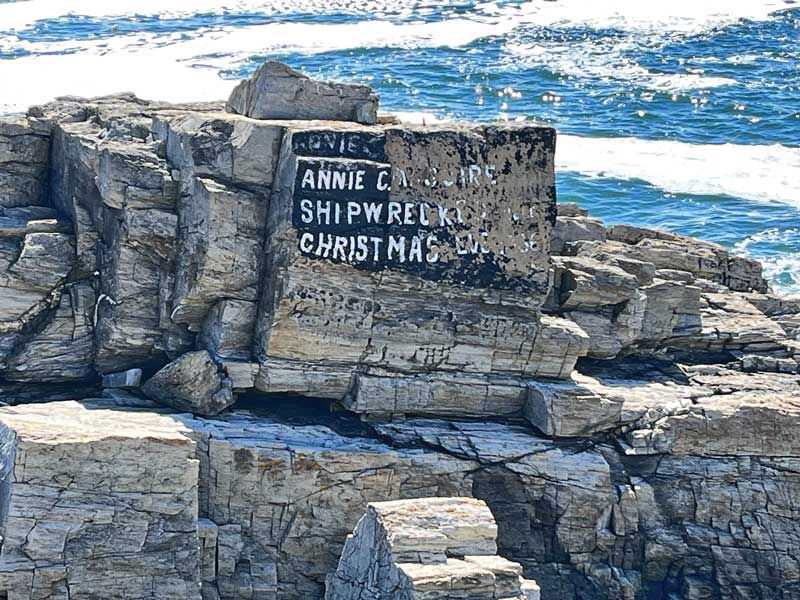
A simple bit of graffiti reminded me of the calamitous event when we visited the lighthouse in August, 2025. Painted in large white letters on a good-sized rock beside the tower, it read, “Annie C. Maguire shipwrecked here Christmas Eve 1886.” I later learned that Strout’s grandson, John, first put it there in 1912. It’s been renewed repeatedly ever since.
On that fateful evening in 1886, Keeper Strout and his family rallied quickly, bridging the roiling waves between the shore and the rocks with a simple wooden ladder. Aided by a few volunteers, they rescued everyone aboard the ship—the captain, his wife, and about a dozen crew. They then provided warm clothes, shared their holiday meal, and invited the unexpected strangers to stay. Contemporaneous accounts say that over the next few days, the visitors consumed nearly all of the family’s food and became drunk and unruly on two cases of whiskey salvaged from the ship. They were soon relocated to a Portland boarding house. By New Year’s Day, a storm had destroyed the Maguire.
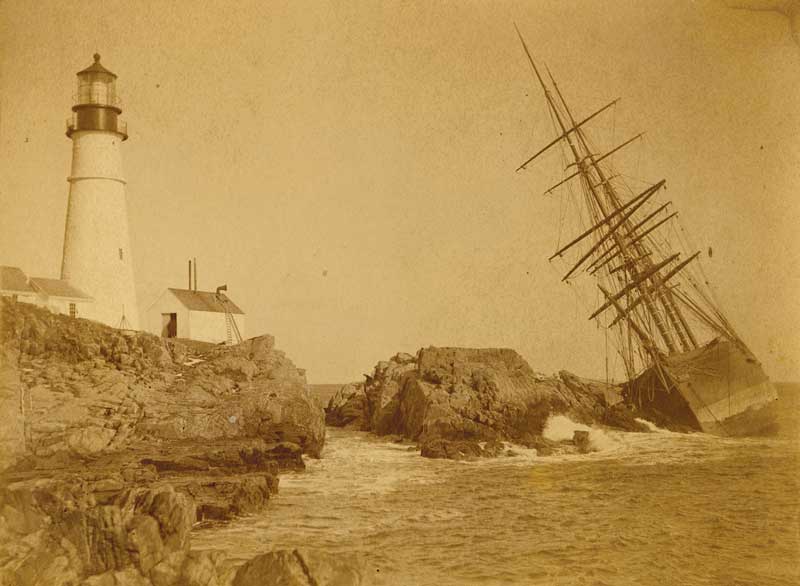
The Strouts’ keepers’ quarters were replaced in 1891. Nearly a century later, in 1989, automation of the light meant resident keepers were no longer needed. Today, the rooms at the base of the tower are home to an excellent small museum.
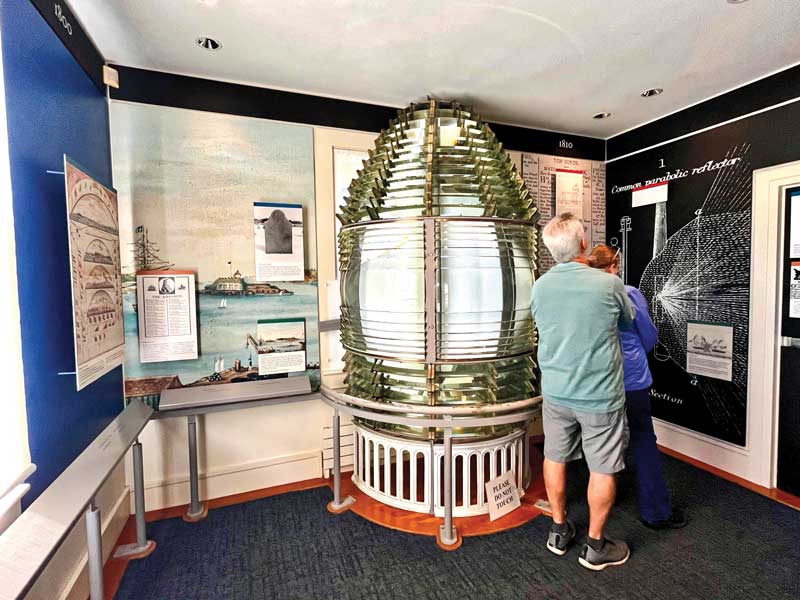
When I entered, I was immediately struck by the size and complexity of the second-order Fresnel fixed lens that was on display. It once sat atop the tower, from 1865 until 1958, when a rotating, flashing beacon was installed. The impressive, beehive-shaped assembly of reflective glass prisms stands some 10 feet tall. Studying the museum’s numerous artifacts, models, and vintage photos, we gained insight into the history of the lighthouse, the keepers and their families, and maritime events that played out in surrounding waters—including several other shipwrecks.
Portland Head Light is Maine’s oldest lighthouse. It was commissioned by President George Washington and built in 1791. Designated a national landmark, it’s said to be among the world’s most photographed lighthouses—a claim reinforced by all the visitors snapping selfies around us.
When the Strout family’s surprise Christmas visitors descended on them in 1886, the first structures of a large U.S. Army fort had already risen just up the hill from the lighthouse. In 1899, the growing complex was named in honor of Augusta, Maine, native and Civil War officer Seth Williams. It was completed by 1906.
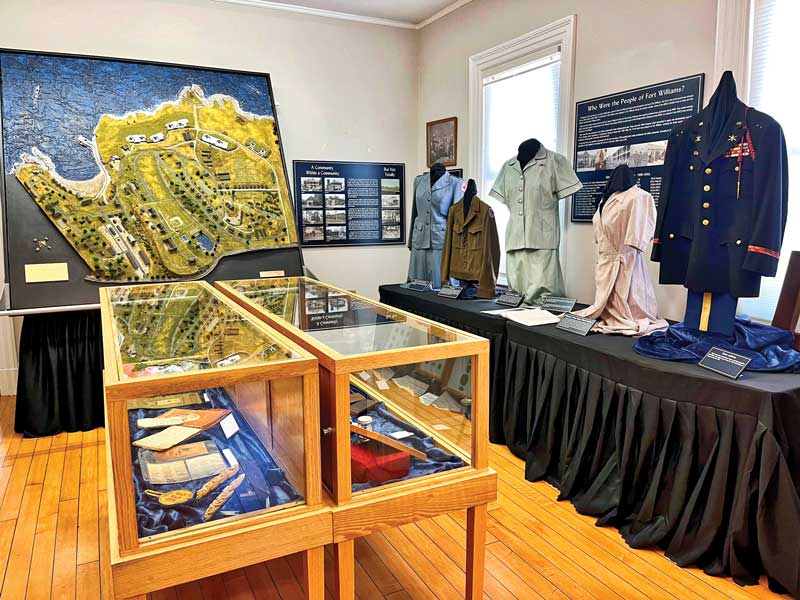
We learned much more at the Fort Williams Museum and Cape Elizabeth History Center, which occupies a red brick building that was once the bachelor officers’ quarters. A knowledgeable guide greeted us at the door and explained that prior to the Civil War, Williams served as adjutant under Robert E. Lee, during Lee’s tenure as superintendent of the U.S. Military Academy at West Point. After war broke out, Williams joined Lieutenant General Ulysses S. Grant’s staff as inspector general. When Grant decided to encourage Lee to surrender at Appomattox, he chose Williams to carry the message and terms of surrender to the Confederate leader. At the surrender, Lee shook hands with Grant, and then with his former associate, Williams.
During World Wars I and II, Fort Williams played a major role in guarding vital shipbuilding and military operations in Portland Harbor. Among its armaments were six main batteries. Battery Blair, the largest, was equipped with two breechloading guns capable of firing 12-inch diameter, 1,070-pound shells a distance of up to 8 miles. They sat on disappearing carriage mounts that rose from a low, hidden spot when deployed; when discharged, the recoil caused them to retract to their original position. Intended for use against battleships, the guns became obsolete with the development in the 1920s of longer-range, ship-mounted artillery, and the advent of aerial warfare.
Following the fort’s decommissioning in the early 1960s, many of the buildings and much of the infrastructure were removed. The batteries, including Battery Blair, were partially buried, but can still be seen today; there are plans in the works to uncover them. They, along with the fort’s remaining buildings and the lighthouse, lie within Fort Williams Park, a rolling 90-acre, oceanside expanse owned by the town of Cape Elizabeth and opened to the public in 1976.
As we explored the park, numerous visitors were thoroughly enjoying the serene summer day in this beautiful
setting. Couples, friends, and families visited the lighthouse and the Fort Williams museum, walked the cliff walk, inspected the remains of the batteries, and picnicked on lobster rolls, snacks, and gelato purchased nearby. Not far from the lighthouse, children played on a small, pebbly beach in Ship Cove. Along its inland perimeter lies an abandoned stretch of tramway track that was used during wartime to transport strings of mines to a wharf where they were loaded onto vessels that set them in Casco Bay. I couldn’t help notice the juxtaposition, and be grateful for the peacefulness.
✮
Contributing editor Mimi Bigelow Steadman lives on the Damariscotta River in Edgecomb.
If You Go To Fort Williams Park and Portland Head Light
Do
It’s easy to while away several hours at Fort Williams Park. In addition to visiting the lighthouse and its museum ($2 admission), as well as the Fort Williams Museum (donations encouraged), you can join a free walking tour (11 a.m. daily, weather permitting), visit the Children’s Garden’s beautifully landscaped grounds, take a gander at the stone ruins of the old Goddard Mansion, or simply relax on a bench with broad views of the ocean. Visitors may only enter and climb the tower—and numerous other lighthouses throughout the state—on Maine Open Lighthouse Day, held annually in September. For information visit the American Lighthouse Foundation.
Eat
Bite Into Maine, the popular purveyor of variously dressed lobster rolls, got its start on the grounds of Fort Williams, with its first food cart. There are now four locations in and around Portland, but this one has the best views. Choose from the Connecticut, with warm butter; the Picnic, with coleslaw, butter, and celery salt; the Wasabi, with zingy mayo; the Curry, with curry mayo; and, for purists, the Maine, with mayo and chives. The menu also includes a few sandwiches and sides, as well as whoopie pies. C-Salt, a Cape Elizabeth gourmet market, sells sandwiches in a kiosk beside the lighthouse. You’ll also find the Gorgeous Gelato kiosk nearby. Feel free to bring your own picnic, too. All of these vendors close for the winter.
Shop
Pop into the little gift shop beside the lighthouse to browse a good selection of lighthouse-related gifts and other Maine mementos.
Hike and Paddle
The Cliff Walk loop within Fort Williams Park runs for nearly a mile. It is mostly flat, with surfaces ranging from paved concrete and asphalt to packed gravel and dirt. The Stonegate Trails connect the park to Cape Elizabeth Land Trust’s Robinson Woods trail network, which runs through woods and wetlands and transitions from level ground to hilly, narrow sections. Portland Paddle offers rentals of kayaks and paddle boards at Crescent Beach State Park. It’s located a drive of less than 20 minutes south along the Cape Elizabeth shore from Portland Head Light. Only experienced ocean kayakers are permitted to paddle beyond a demarcated zone near the beach, so it is not possible to go all the way to the lighthouse.
On the Water
Portland Head Light sits atop a bold, rocky shoreline, with no safe access from the sea. Several sightseeing cruises based in Portland harbor offer trips that pass Portland Head as well as other nearby lighthouses. These companies include Portland Discovery Land & Sea Tours, Casco Bay Lines, and Casco Bay Adventures. Sights along the routes include Spring Point Ledge Light, Portland Breakwater Light (fondly known as Bug Light), and Ram Island Light. The boats also motor among the Casco Bay islands and close to Civil War-era Fort Gorges.