

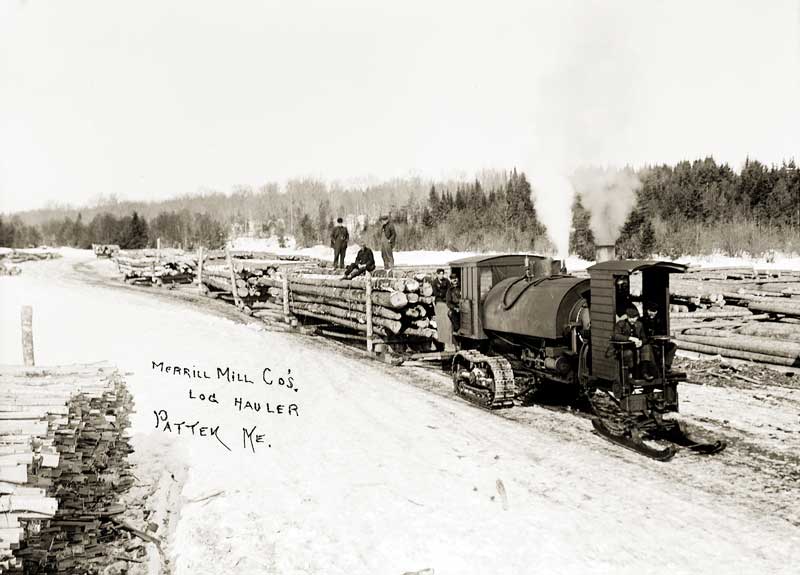
The Lombard steam log-hauler was invented and manufactured by Waterville’s Alvin O. Lombard. Patented in 1901, it was the first commercially successful track-laying vehicle. Lombard was motivated by the heavy losses of woods horses, attributed in part to the increasing demand for birch bolts, which do not float and had to be hauled long distances. Despite the inevitable problems, especially when operating in sub-zero temperatures, Lombards quickly gained favor—one big woods operator claimed that three log-haulers did the work of 60 horses. A 20-ton Lombard could haul 175 tons of birch bolts. The haulers required improved roads, iced nightly by horse-drawn sprinklers. There were no brakes, and the steersman—or two steersmen, as seen here—was sitting in a very poor place if a train of heavy sleds jackknifed. Log haulers operated around the clock, their shrill whistles echoing from distant hills on cold, still nights. More than 80 steam Lombards were built at Waterville through 1917. A gasoline-engine version was introduced in 1914.
✮
The photo “Merrill Mill Co.’s Log Hauler Patten, Me.,” LB2007.1.112337, is part of the Eastern Illustrating & Publishing Co. Collection at the Penobscot Marine Museum in Searsport. It was included in the museum’s publication Maine on Glass, by W.H. Bunting, Kevin Johnson, and Earle G. Shettleworth Jr. More on the Lombard hauler can be found in an online article from Northern Woodlands, northernwoodlands.org/articles/article/lombard-log-hauler.