

Safe Harbor adds another yard
The private equity giant Blackstone is in the process of acquiring Belfast’s Front Street Shipyard via its international marina holding company, Safe Harbor.
According to a news report in the online Midcoast Villager and a letter from Safe Harbor to the Belfast Planning Board, Safe Harbor signed a purchase and sales agreement with Front Street last April and planned to close on the sale by December 2025. News of the deal came to light in the letter Safe Harbor sent to the planning board asking for an amendment to the yard’s contract zone agreement to change ownership of the site from Dubba LLC to Safe Harbor.
According to the letter, Safe Harbor then plans to transfer its interest to a wholly owned subsidiary, SHM Front Street LLC, a Delaware limited liability company. The letter was signed by Greg Glavin, Safe Harbor’s regional vice president for its marinas in Maine, Massachusetts, and New Hampshire.
Founded in 2015, Safe Harbor owns 149 marinas across the Caribbean, Central America, and the United States, including in Maine: Safe Harbor Rockland, Safe Harbor Great Island in Harpswell, and Safe Harbor Kittery Point.
Front Street was started in 2011 in the former Stinson Seafood plant by J.B. Turner, Steve White of Brooklin Boat Yard, and Taylor Allen of Rockport Marine. Over the years the yard has expanded into a thriving business, with multiple storage sheds and work bays, a 485-ton lift, and a world-class reputation for serving both small boats and superyachts. The planning board letter estimated annual operating costs for the yard at $5.5 million to $6 million.
Glavin said the company plans to keep Front Street as a marina and boatyard while investing $5 million in employees and assets within the next three years.
Safe Harbor, which was bought last year by a division of Blackstone for over $5 billion, plans to fund the operation through a combination of cash flow generated by the business and its own capital, Glavin said.
Charge it
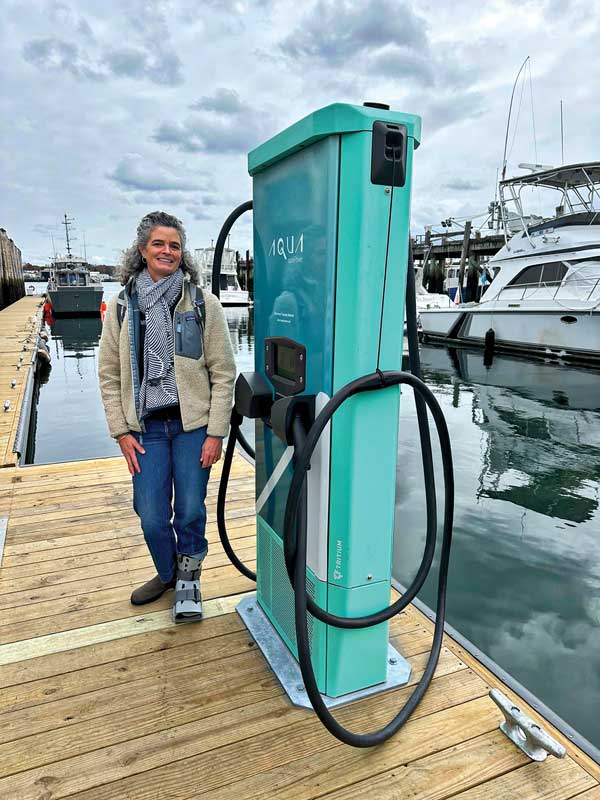
Advocates for electric boat propulsion are celebrating the installation of a new fast charger at Wright’s Wharf on the Portland waterfront.
The 75-kilowatt charger is the first such device in Portland’s harbor and can serve any high-voltage vessel currently on the market, according to a news story on Maine Public Radio. Built by Aqua superPower, it cost nearly $100,000 to produce, ship, and install. It’s owned by the Gulf of Maine Research Institute.
Lia Morris, who researches electric vessels for the Island Institute, told the radio reporters that infrastructure like the charger helps overcome a chicken- and-egg problem for the transition to electric vehicles.
“One of the questions that we get asked a lot is, I’m really interested in this, but one, how am I going to pay for it? And two, how am I going to charge it?,” Morris said. “So this feels like the beginning of finding that solution is having some fast-charging infrastructure that people can access.”
The charger is part of a $1 million pilot project coordinated by Greater Portland Council of Governments that also helped purchase a 28-foot all-electric aluminum barge operated by Maine Ocean Farms, an oyster company in Freeport.
Coast Guard delays buoy removal
Thousands of new England mariners spoke, and at least for now the Coast Guard seems to have listened. The federal agency abruptly announced in October that it had suspended a controversial plan to remove hundreds of navigational buoys and markers along the Northeast coast.
The Coast Guard first announced the plan last spring, and after receiving over 3,000 comments—mostly in opposition—released a revised plan in September listing some changes and asking for new comments by a November 15 deadline. But on Oct. 21, the agency issued a press release saying that the comment period had been closed, and the project had been suspended.
“After receiving over 3,200 public comments, the Coast Guard will be conducting further analysis of the aids to navigation (ATON) system. There will be no changes to ATON in relation to the proposal until further analysis is complete,” the release said. “The Coast Guard will continue assessing waterways and provide the most effective changes to support a resilient marine transportation system.”
It is unclear what happens next. But this delay seems to meet what everyone from recreational boaters to harbormasters to elected officials was requesting. Boaters opposing the proposal, which initially called for removing more than 300 buoys, noted that not everyone has a GPS device on their vessel, and marine electronics can fail.
Lobsters overfished
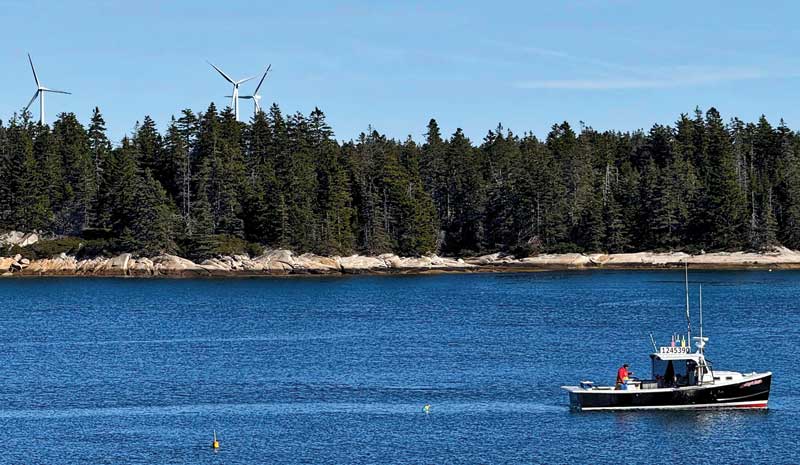
A new report says America’s lobsters are being overfished off New England, according to a story by the Associated Press.
The report by the Atlantic states Marine Fisheries Commission found that lobsters have declined by 34 percent since 2018 in some of the region’s most important fishing grounds. The commission said it now considers overfishing of the species to be occurring, which could result in new restrictions on fishing.
Thanks to a higher per-pound price, Maine lobstermen took home $528 million in 2024. But the 86 million pounds landed was 10 million pounds less than the previous year, and a 15-year low for the fishery.
Regulators’ attempts to enforce new rules aimed to stem the decline in recent years were met with resistence.
3D printing project
A new company in Brunswick plans to offer 3D printing of boat molds and other large objects for Maine’s marine and defense industries.
According to a story in Mainebiz, Evergreen Additive Inc. is a spinoff of University of Maine’s Advanced Structures and Composites Center. Led by composites center alumni, Evergreen aims to streamline boat mold and component production while supporting Maine’s advanced manufacturing workforce, according to the story.
“One of our goals is to take the technology and make sure it works for people in the state of Maine and to create jobs in Maine,” said Habib Dagher, the center’s executive director.
The 3D technology could help to address challenges facing Maine’s maritime industry, including skilled labor shortages and long manufacturing lead times, the company told Mainebiz.
“Large-format additive manufacturing offers a path forward by automating production while maintaining the quality and performance Maine manufacturers are known for,” said Kyle Warren, Evergreen’s CEO.
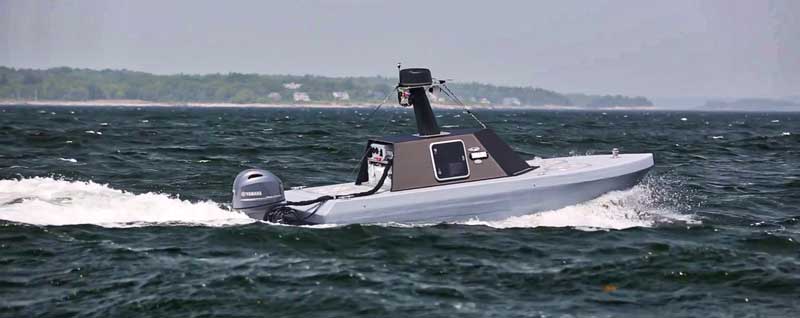
The Advanced Structures and Composites Center, led by Dagher, its founding executive director, has spun off numerous companies. Earlier this year, a large group of Composites Center personnel tested an unmanned surface vessel built using large-format additive manufacturing, according to Mainebiz. The project was funded by a contract that the University of Maine won through the U.S. Office of Naval Research.
Stuck in the mud
A man hunting along the shore this fall in Brunswick’s Maquoit Bay found himself in a sticky situation when he sank up to his waist in mud.
The 31-year-old Topsham man called 911 when he became stuck while retrieving ducks that he had shot, according to a news release from Brunswick police. Officers used the department’s Marine Patrol air boat to reach the man. It took two men to break the suction and get the muddy hunter into the boat, according to the release. The ducks were retrieved later. The release did not say whether they, too, had to be freed from the mud. The unfortunate hunter was treated and released from Mid Coast Hospital.
The Brunswick Police Department cautioned that coastal mudflats are unstable and can have “honey pots” that act like quicksand—the more a person moves, the deeper they sink.
Good thing the hunter had his phone with him.
Boat school on the rebound
A group of supporters say they hope to reopen the Eastport Boat School as the Maine Marine Technology Center within the next few years, according to a story in the Working Waterfront.
Since its earliest years in Lubec, the Boat School has been a lifeline for students involved in boatbuilding and its various associated industries. The group, known as the Friends of the Boat School, are steering the course toward a $4.2 million restoration project. To fund the first phase, the Friends won a $675,000 grant from the U.S. Environmental Protection Agency and a $120,000 grant from the Maine Department of Environmental Protection, both of which enabled the replacement of the main building’s roof and asbestos removal, work that began last spring.
Next will come infrastructure updates, followed by the acquisition of equipment, fixtures, and furnishings. Along with incorporating traditional components, the new curriculum would focus on developing its composite education and composite design and construction offerings, tying into everything from aircraft to automobiles, supporters told the Working Waterfront.
Statue honoring seafarers
A new 9-foot bronze statue erected this fall at the Penobscot Marine Museum in Searsport honors the town’s seafaring heritage. Cast in bronze in Hong Kong, the statue traveled aboard a ship to the U.S. eastern seaboard, following a route that would have been familiar to many seafaring Searsport families.
Unveiled in November, it stands at full height on a granite plinth in front of the museum’s Fowler-True-Ross House. This site was chosen both for its prominence on Route 1 and for its place in front of a home that preserves and shares the stories of Searsport families’ life and work at sea, the museum said.
The house’s first namesake, Miles Fowler, purchased the property in 1815, and it remained in the family until it was sold to PMM in 1937. Its walls housed four generations of Fowler-True-Ross families, including many sea captains, their wives, and children.
New weather buoy
Those seeking a better understanding of storms and the Gulf of Maine got a new tool this past fall with the launch of a sophisticated oceanographic buoy off Camp Ellis in Saco. The device is designed to document storm waves and other data.
The buoy, which belongs to the University of New England, will transmit wave, wind, temperature, ocean current, and dissolved oxygen levels back to the university laboratory for analysis, according to a news story in the Portland Press Herald.
The Gulf of Maine already has a network of oceanographic buoys that monitor waves, but these buoys are located offshore in deeper waters.
While a federal buoy costs about a half-million dollars, UNE’s commercial SOFAR spotter buoy is a small, solar-powered buoy that costs about $15,000, with an extra $10,000 of gear tacked on for other university departments that wanted to collect marine data.
Camden Harbor partnered with Northeastern University to deploy a similar wave buoy in 2023, according to the Press Herald. (You can read MBH&H’s coverage of the Camden buoys and monitoring program HERE.)
Localized data will help communities better prepare for individual storms and, over time, decide which coastal defenses work best for the kind of storm waves they are most likely to see, university officials told the newspaper.
Ahoy matey
You might have read stories about pirate treasure in Maine. So far none of that mythical loot has been found. But on Vinalhaven, a lowkey game organized by a mysterious “captain” has been rewarding treasure hunters weekly with a $10 booty.
According to a story in the Midcoast Villager, the island-wide weekly game has become an unofficial pastime on Vinalhaven over the past year or so. People solve riddles and clues to get treasure maps directing them to where X marks the spot. The game is called “$10 Dollar Treasuahh,” according to the Villager. It has its own website at vh-tdt.com and it’s administered by one “Captain James Bartholomew Hook.” No one contacted by the Villager would reveal his identity.
Each round begins when a new clue is published in the island’s weekly newspaper, The Wind, directing readers to a website where a few missing words from the clue riddle are provided at 10 a.m. on Saturdays. Whoever solves the riddle gets a secret map and when they find the treasure, they can contact Captain Hook on Facebook to let him know. The riddles pause between late fall and spring, leading some to believe that Hook might be a seasonal resident.
Solar-powered ferry
Lyman-Morse, which has a division that produces metal-hulled workboats, has won a contract to design and build three solar-powered, aluminum ferries that will run on the Merrimack River in Massachusetts.
The ferries will provide passenger service back and forth on the river for the first time in nearly a century, according to a story in the Midcoast Villager. The project is funded by a $4.2 million federal grant, according to the news story.
Lyman-Morse’s Workboats division in Thomaston is partnering with Newburyport naval designer William Lincoln of Response Marine, while Norwegian firm Evoy Vita Power will supply the electric propulsion systems, the Villager reported.
The 33-foot long catamarans will be powered by twin 120-hp electric outboard motors. They will be able to carry up to 22 passengers and cruise at up to 12 knots, according to the news story.
Onboard batteries will be supplemented by solar panels on the roof. Demonstration runs are expected to begin in 2026, with full service projected for 2027, connecting Haverhill, Amesbury and Newburyport.
✮