

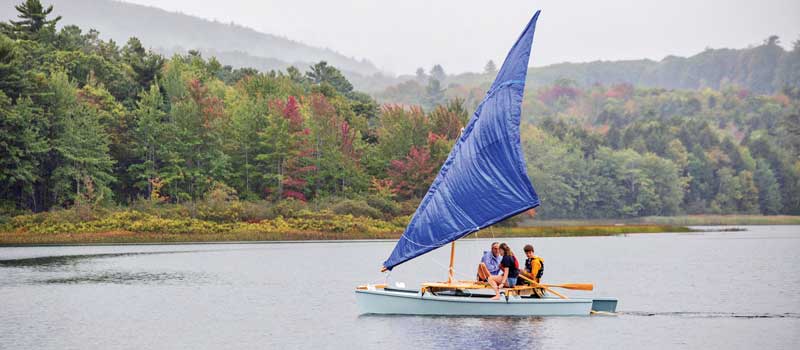
On a rainy day in late September, a crew of builders escorted a decidedly South Pacific-styled 16-foot catamaran into the placid waters of Hobbs Pond in Hope, Maine. Sporting a crab claw sail—a fore-and-aft triangular rig with spars along upper and lower edges, the vessel was definitely an unusual sight for this small Midcoast town.
More unusual is that the vessel was designed (with the help of parents) and fashioned by students, mostly 11- to 13-year-olds, in the electric tool-free Tinker Lab at the nearby Sweet Tree School. The design work began in April and construction continued through the summer. This is the third of the school’s growing fleet of vessels, which includes a sailing skiff and an 18-foot, fabric-covered arctic Umiak design that can carry 10 to 12 people.
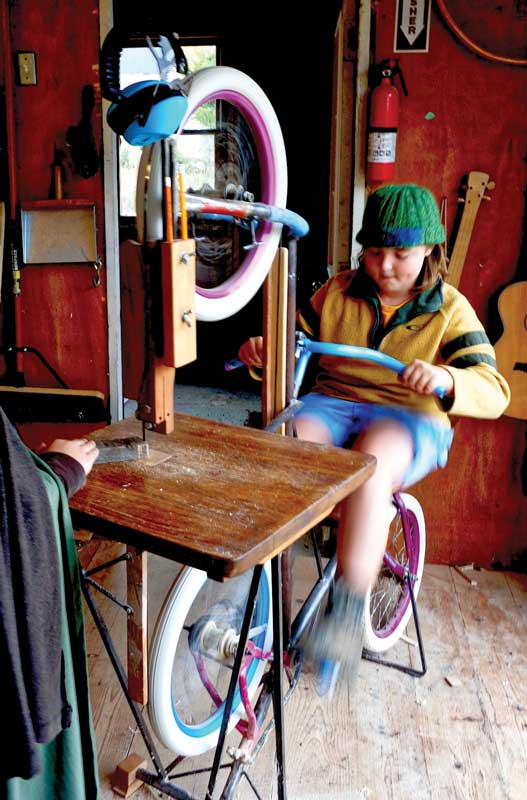
The Sweet Tree School is a progressive, kindergarten-through-eighth-grade independent school that integrates creativity, critical thinking, and the arts into its curriculum. The Tinker Lab is what used to be called a shop and probably now would be known as a maker’s space. It is a remarkably busy place, with students working away at a plethora of projects. The walls are covered with traditional hand tools: saws, squares, Yankee screwdrivers, spokeshaves, and more. On the floor is the standing milling equipment—all human powered. Tools on hand include a lathe, a jig saw, and a two-person bandsaw constructed from recycled bicycles. These are creations of instructor Paul Cartwright.
Cartwright, who joined the staff at the school in 2019, has worn many hats over the years: musician, engineer, inventor, and a long-time builder of watercraft, albeit larger commercial vessels. Boats include the 60-foot St. George, built in Lincolnville in a 100-foot-long chicken barn, and a redesigned steel replica of Joshua Slocum’s Spray, built with compound-curved quarter-inch steel plate, that crossed the Atlantic.
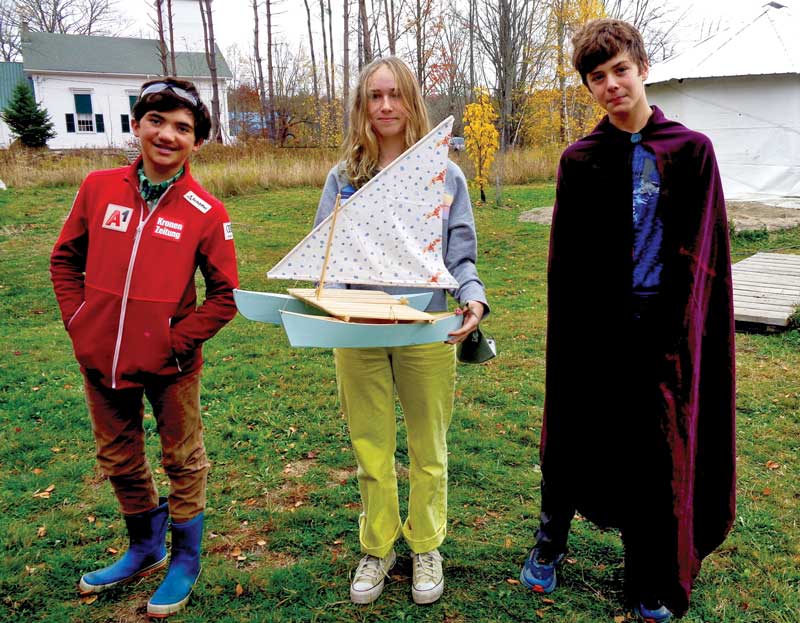
Said Cartwright of his students’ latest project, “The concept was that the catamaran would be easy to build. There were no plans. Instead we worked from a model.” He added, “We hardly used a measuring device. In many ways we built in the traditional fashion, by eye, bending battens around central molds to generate the curves”.
There was also plenty of team building along the way. It took many hands to run those panels through the human-powered band saw, Cartwright said.
Before work could be started on the full-size cat, however, a model was flotation- and tow-tested by the students to see how it performed.
The 16-foot catamaran has mirrored asymmetrical twin hulls—flat on the inward-facing sides. “The vessel is similar to a Hobie Cat but with more buoyancy,” Cartright said. “The catamaran is fitted with oarlocks and carries 2 oars, one of which is used for steering.”
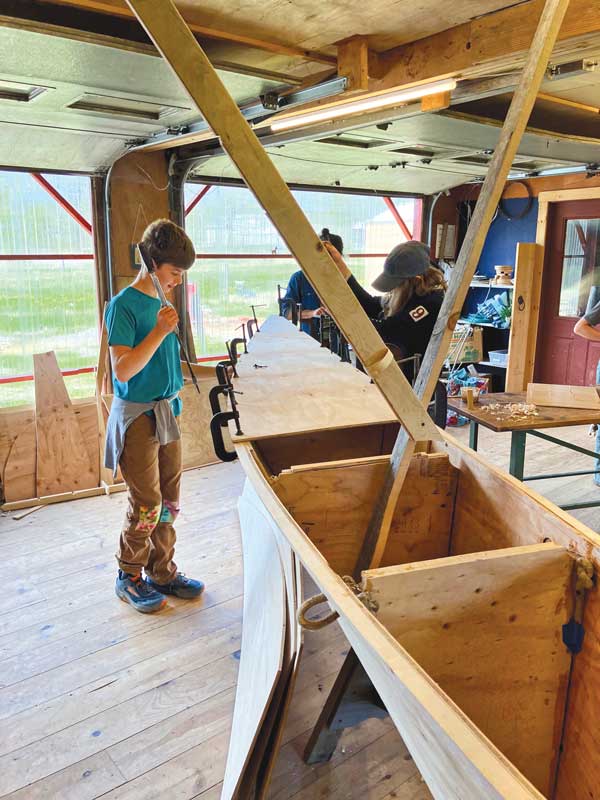
The students’ boat was built on a budget, Cartwright said. “We used 3/8-inch CDX plywood for the bulkheads, sides, and hull decks. The keel board and connecting deck were 1-inch pine, and the spars are local spruce. Fastening was done with epoxy and dry-wall screws.”
The sail rig, as mentioned, is the lesser-known “crab claw” style—the traditional and highly efficient sail of Pacific proas. It is a low-tech rig with essentially no hardware or high-stress attachment points.
The catamaran’s sail has a 20-foot long upper yard, a 17-foot lower yard, and 14 feet of leech between yard tips. The prototype test sail was fashioned from the ubiquitous blue tarp. Some shape is introduced into this sail because the flexible spruce spars bend under load. A used Dacron sail has been donated to the school, which, when recut, will have built-in aerodynamic camber.
Under sail, Cartwright said, “The rig is ‘jibe only.’ The two widely spaced back stays preclude coming about in the usual way. The upper yard acts as a head stay, with its lower end tied to a bridle between the two bows. This gives the rig widely spaced, low-tension support. It also makes it easy to raise and lower. To beat to windward, you fall off and head down wind, allowing the sail and lower yard to swing forward of the mast and flop over to the other side, where it is sheeted in on the new tack. The sail has a continuous sheet tied to the lower yard, encircling the mast.”
Put another way, student builder Imogen Egenson writes, “Instead of swinging from left to right, like a sail usually does when it tacks, our catamaran’s rig does jibes only. Basically, the entire sail flips 270 degrees over the top of the mast and comes around to the other side.”
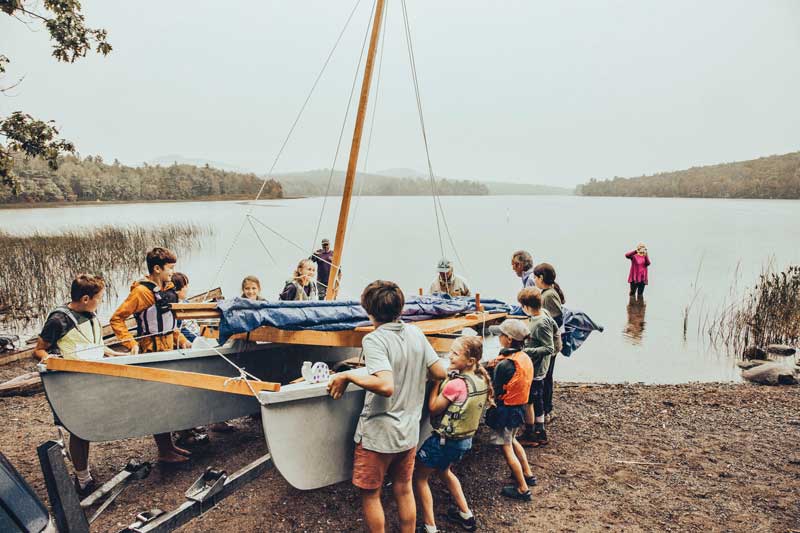
And how do student boatbuilders feel about the project? Taking time out from their classes, Egenson, Seamus Kelly, and Santino Porco-Burman—the lead mechanics on the build—noted that this was their first time building something on this scale. And they are still enthusiastic about the project despite the fact there was so much to do in a short time.
“I like putting things together,” noted Santino.
Egenson observed, “Making a boat is tons of fun. I would definitely recommend it.”
All agreed that they want to build more boats and are already planning a camping trip to an island. Indeed, it’s all a bit like Swallows and Amazons in Polynesia.
✮
16-foot Catamaran Specifications
LOA: 16'
Draft: 8" light / 12-14" loaded
Disp: 265 lbs. dry
The boat was built without any lofting or offsets, and very little use of a tape measure. Fairing battens and measuring sticks were employed. No power tools were used.
BUILDER:
Tinker lab at Sweet tree school
Hope, Maine
www.sweettreearts.org
Greg Rössel lives in Troy and is a boatbuilder, instructor at the WoodenBoat School and its “Mastering Skill” video series, author, and host of “A World of Music” on WERU FM.