

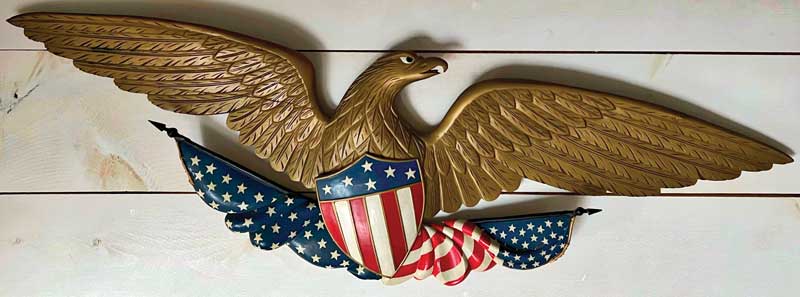
Billowing sails, graceful ships’ lines, elegant eagles, and welcoming pineapples. Such were the subjects that Camden joiner and woodcarver Lloyd Hansen Thomas brought to life with his tools and keen eye for details.
Born in 1910, as a young man and into his adult years, Thomas was an avid outdoorsman who successfully hunted deer, pheasant, and partridge, and fished for trout, bass, and other local game fish in area lakes, ponds, and streams. An equally talented artist, he also carved their images and others, including dolphins, as freestanding objects.
By day, Thomas was employed as a joiner at Camden Shipbuilding and Marine Railway Co. and later at Wayfarer Marine. Joiners are those craftsmen who make and apply finishes to the wood cabinets, tables, seating, and interior trim for boat interior installations or repairs that a carpenter would install. His part-time artistic side, however, led him to carve and paint bas relief panels of well-known clipper ships, as well as elegant gilded eagles for stern trail boards and home display.
His father, Fred Thomas, owned a shop on the harbor side of Main Street in Camden, where he collected and sold antiques, repairing them as needed. Seeing wood-carving prowess in his teenage son, he suggested that Lloyd carve some three-dimensional panels to place into the oval walnut and mahogany picture frames accumulating in the store.
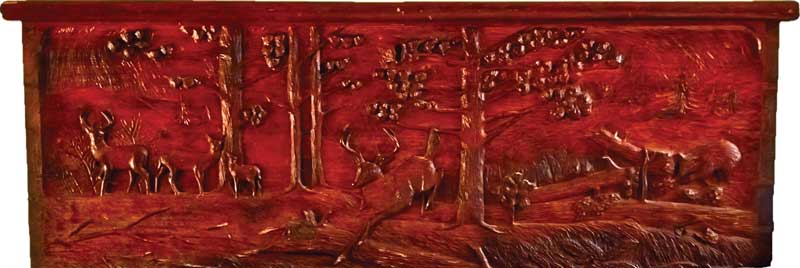
At about age 30, Thomas began carving seamen’s chests, mostly with sailing ships incised on the face, and often eagles sculpted into their tops. Occasionally, he carved deer and bear into surfaces of trunks to create woodland settings.
Thomas rarely put his work on consignment in any shop or store, the three exceptions being his father’s place in Camden, at Abercrombie & Fitch in New York City for one year in the 1930s, and at a bookstore in North Hampton, Massachusetts, operated by his good friend Marion Dodds.
In deciding not to sell his work through consignment, he explained to Jeff Gibbs, in a Camden Herald story dated August 30, 1973, “They wanted so much for them that I decided to keep them out of shops so anyone could buy one.”
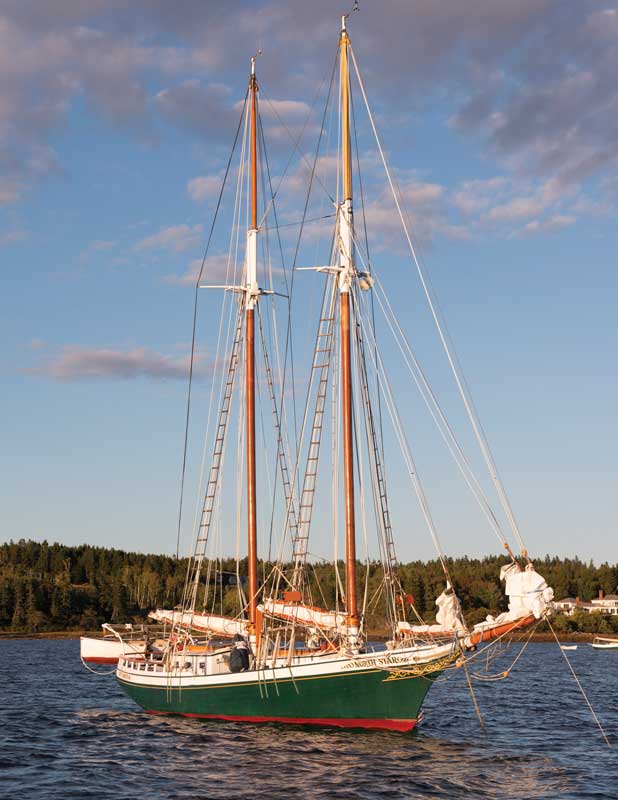
During his 37-year career with the Camden Shipbuilding and Marine Railway Co. and its successor shipyard, Wayfarer Marine, Thomas carved transom eagles and trail boards, as well as the vessel documentation boards required by law. Two of the trail boards he produced were for the handsome Murray Peterson-designed and Malcolm Brewer-built traditional coastal schooners, the 42-foot North Star and the 36-foot Silver Heels.
Camden Shipbuilding president William “Pete” Peterson praised Thomas’s skills at applying gold leaf gilding. “When it came to gilding, Lloyd was one of the very best. No matter, if Lloyd gilded the name and hail [home port] on a yacht’s stern, or carved trail board scrollwork, eagles or figureheads, his work would withstand the rigors of wind, weather, or sea for years and years.”
Thomas once estimated that between 1928 and 1973 he had carved and painted about 200 eagles, most of them gilded, with many placed in private homes over fireplace mantles. The largest had wingspans of about 7 feet.
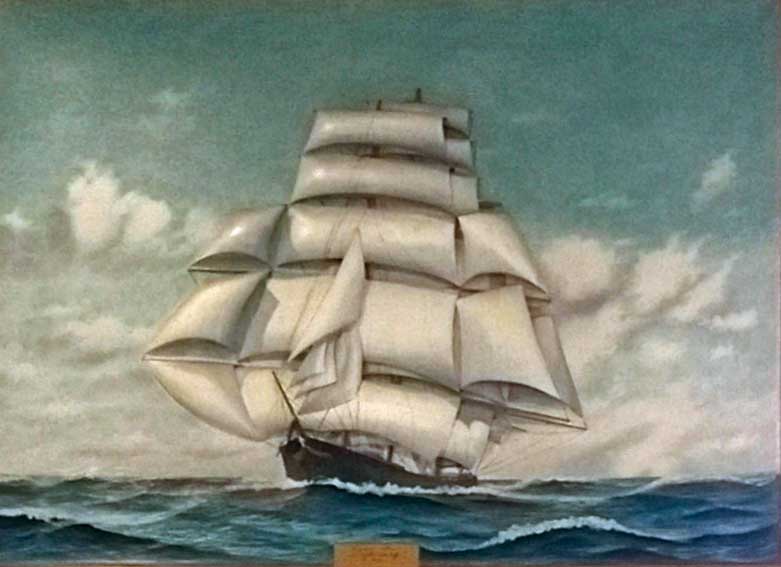
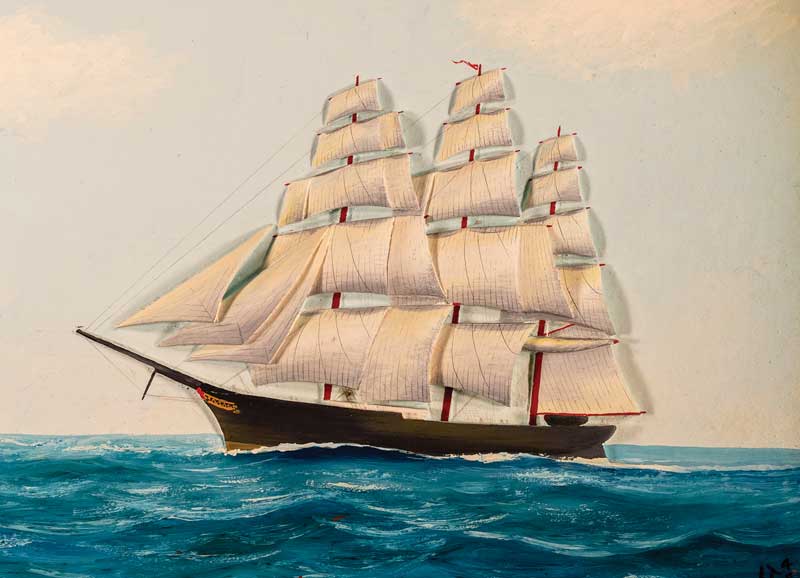
Wide recognition was also given for Thomas’s bas relief carvings of clipper ships under full sail; he called them “panels.”
Camden Herald reporter Doug Hufnagel wrote in the December 24, 1985, edition of the newspaper that Thomas “finds a suitable piece of wood, sketches the scene onto it, and visualizes how it should look. He begins carving to raise the image from the plane surface of the wood, and his creative process ends with painting the image.”
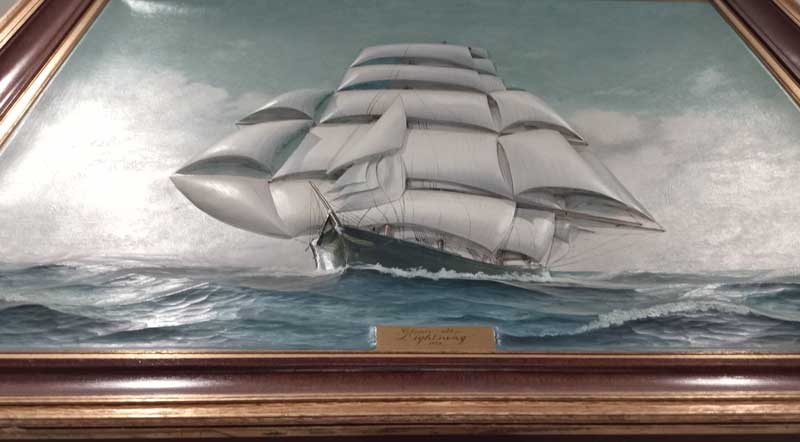
Thomas’s largest work, that of the three-masted clipper ship Lightning, which he sculpted from a single piece of 4-by-5-foot California pine in 1934, is hung in the Camden Public Library’s reading room.
Upon seeing the Lightning carving at an exhibit of the piece in Portland in 1934, art critic Edward Carlson wrote in the Portland Sunday Telegram, “In its 4-foot by 5-foot frame, the ship comes tripping across white-capped seas ‘with all her washing out’—her white sails swollen with wind—and the wave under her graceful forefoot froths and foams before her swift advance. Looking at the painted panel is like standing on the forecastle head of another ship in mid-ocean and watching the lofty Lightning bear down on a course which has brought her close aboard and about two points off your own port bow. The carving has life, and motion, the power of the gale and of gale-driven seas—and the spell of the ocean is upon it. Lloyd Thomas has done a marvelous thing with his Lightning panel; one need not be a connoisseur to understand it.”
Over his lifetime—he died in 1990—Thomas carved and painted about 100 bas relief clipper ship panels, some of which are in the collections of the Maine Maritime Museum and Penobscot Marine Museum, and many are held in private collections. Several of Thomas’s grandchildren and a great grandson live in Midcoast Maine and own examples of his clipper ship panels, sea chests, and pineapples.
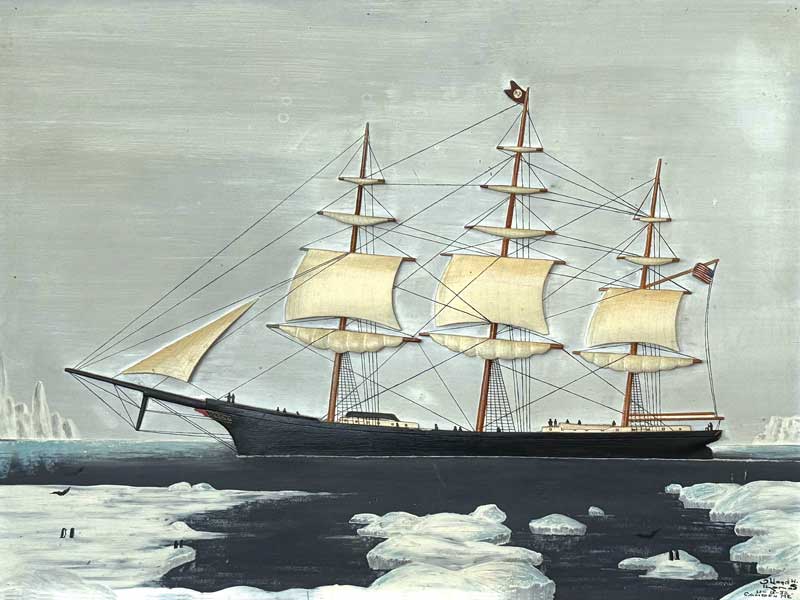
Thomas understood clipper ship proportions so accurately that he could readily transcribe a ship from even a small photograph onto his large panels for carving.
Portland Press Herald reporter R. J. Sawyer Jr., wrote in an October 11, 1934, article reviewing Thomas’s artistic talent and creative work (reprinted in the Camden Herald a week later), that the artist dramatically oversimplified his creative carving process in describing it as “taking a piece of California pine, drawing free hand a ship from some oil painting, carving out his bas relief of the ship, the sea, and possibly a lighthouse in the background, and then painting his creation.”
Sawyer continued, “His subjects are ships and fish. His revived art is the decoration of seamen’s chests by carving. His new art may be described as creating panels by carving and painting together.
“So Mr. Thomas (junior) commenced his new work. The first creations were a bit crude, but soon the true artistic ability took command and Lloyd Thomas was turning out work that began to bring recognition. These ship carvings are cleverly wrought out of one piece of wood, in bas relief, and painted in the most natural and convincing manner. Each panel is accurate in detail, complete in atmosphere, and a mirror of the day when silver ships sailed the seven seas. The work has been exhibited in both New York and Boston where critics were warm in their praise for the originality and skill displayed.
“These panels do not take the place of great paintings by any means, but they do create a new field for art and give new life to the days of old, making the ships perhaps more realistic than any method or art devised to recall past glories,” Sawyer concluded.
Thomas also carved many pineapples in mahogany and teak as gifts to family and friends, apparently relishing the challenge of carving this intricate fruit. As it spread throughout Europe and North America, the pineapple’s exotic nature and rarity led to its association with welcome, hospitality, and good fortune. The pineapple’s spiky exterior was also considered as conveying a sense of protection.
Indeed, Thomas’s demeanor was that of a gentleman: highly principled, modest, and forthright. He was not given to self-publicity and probably would have thought this article rather unnecessary.
✮
Roger Moody is a retired municipal manager, school business manager, and county commissioner who writes about the history of Maine’s coastal and inland waters. He has written a Lloyd Hansen Thomas biography that contains a number of examples of the carver’s work; copies can be ordered via directly from the author at: info@rogerallenmoody.com.