

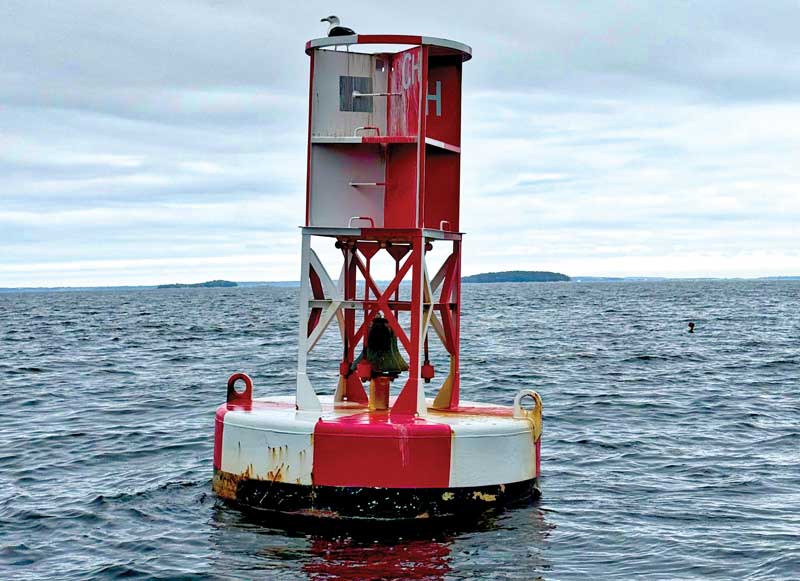
Bye bye buoys: Round 2
After its plan to remove more than 300 navigational buoys along the New England coast prompted howls of outrage from commercial and recreational mariners, the Coast Guard amended the plan and re-opened the comment period this fall.
The agency first announced its plan last April and received a record-breaking 3,000 responses before the end of the comment period. After U.S. senators Angus King and Susan Collins, along with fellow senators from coastal New England asked the agency to hold off on the changes, the agency said it would pause and adjust the plan. In late September it announced that a new public comment period would be reopened through Nov. 15.
As a result of the feedback given already, 121 navigational aids were removed from the proposed discontinuations in the amended plan; 71 aids to navigation remain proposed for discontinuation with supporting changes to nearby buoys, and 162 buoys remain proposed for discontinuation without additional proposed changes.
The buoys included in the amended proposal range from those marking harbor entrances to others marking hazards. The Coast Guard has said the plan to discontinue buoys is part of an effort to modernize its system of 5,600 navigational aids across the Northeast, arguing that many of these markers predate modern GPS systems, which make them superfluous today.
The Coast Guard’s “main objectives remain to ensure long-term buoy system sustainability at the most navigationally critical locations for mariners while better understanding how navigation practices are changing through tools like GPS location, radar, AIS, electronic charts, and navigation apps,” the Coast Guard said in its September release. “The (proposal) update seeks to balance the use of physical aids with other navigation tools.”
In their comments on the new plan, mariners should include the size and type of their vessel, how the buoys are used to locate good water in relation to hazards, shifting shoals, strong currents, narrow passages/entrances or reduced visibility. They should refer to Project No. 01-25-015 and submit comments directly in the body of the email (in lieu of .pdf/excel attachments) to maximize analysis effectiveness (D01-SMB-DPWPublicComments @uscg.mil).
A map of the proposed changes can be found at www.bit.ly/BuoyProposal.
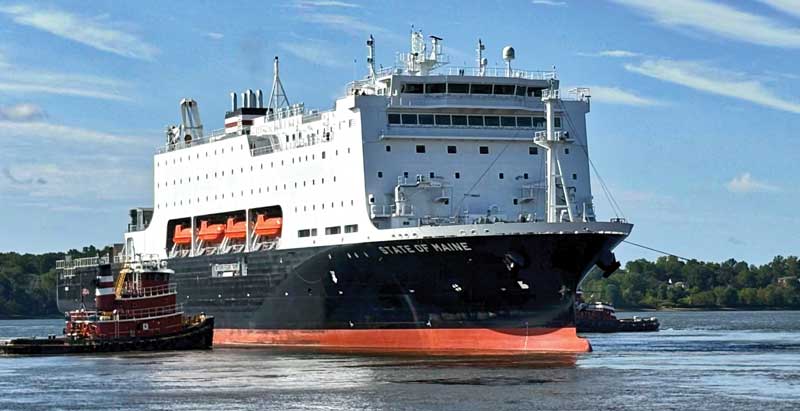
New training ship launched
The Maine Maritime Academy in Castine will soon have a new training ship. The U.S. Maritime Administration celebrated the christening of the State of Maine, the third of five cutting-edge, national security multi-mission vessels, at Hanwha Philly Shipyard in Philadelphia last August. The vessel will serve as a next-generation training ship, supporting both the academic development of cadets and America’s humanitarian relief, according to a press release. MMA President Craig Johnson said the “vessel represents a major step forward in our mission to train the world’s finest mariners. It’s a game-changer for our mission and a powerful reflection of what’s possible through strong partnerships and shared vision.”
At 525 feet long, the new State of Maine can accommodate 600 cadets and up to 1,000 people in times of humanitarian need. The vessel includes eight classrooms, labs, a training bridge, auditorium, helicopter pad, advanced medical facilities, and roll-on/roll-off and container capacity, ensuring cadets get unmatched hands-on training.
The new State of Maine has a 21-foot, 4-inch draft, with a beam of 88 feet, 7 inches, a speed of 18 knots, and a deadweight of 8,487 metric tons. The vessel replaces the Maine Maritime Academy’s current training vessel, also named State of Maine, which has served the academy since 1997. That vessel is 499 feet, 10 inches long with a beam of 72 feet.
Boat launching in Hall Quarry
More than 70 workers, family, and friends gathered on the shores of Hall Quarry at John Williams Boat Company last summer to celebrate and christen a newly built Stanley 28 named Tres Connie.
According to the MDI Islander newspaper, the vessel, which takes its name from three women in the owner’s family named Connie, took more than 15 months and 9,000 hours to build.
The owner, who lives in Santa Barbra, California, and spends summers on MDI, said he had wanted this type of boat for a long time. The smaller size allows him to run it without a crew, he said, noting that he worked with the yard to customize the boat. Features include cockpit side doors for quick entry and exits, a full Garmin GPS package, and a custom teak cockpit and cabin soles, according to the newspaper report.
The Stanley 28 features a Yanmar 250-hp diesel engine, housed inside a fiberglass body, giving the vessel a cruising speed of 16 to 17 knots, with a max speed of 22 knots.
The Stanley 28 was originally designed by Lyford Stanley in 1983, and approximately 10 have been built by the John Williams Boat Company, with the most recent one launched 20 years ago, according to the newspaper.
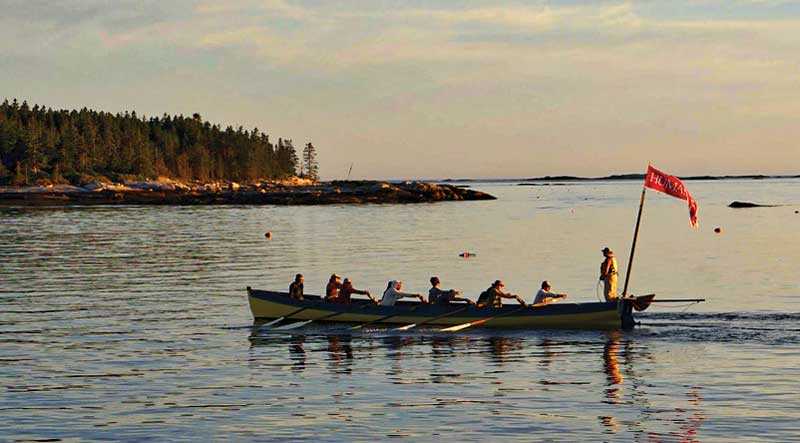
Island circumnavigation
Two Bantry Bay gigs rowed by students at Atlantic Challenge spent three days last summer rowing around Vinalhaven. The Belfast-based group is part of Atlantic Challenge International, a global network dedicated to the development of young adults. The gigs are 38 feet long and powered by three, dipping-lug sails and 10 oars.
The group spent the first two days camping on Greens Island off Vinalhaven and getting used to the boats. They then set out for the circum-island row, stopping for two nights in Seal Bay before passing through the Fox Island Thoroughfare and back to Greens, finishing at dusk.
The Belfast group is in the process of raising money for a new gig to be built at Lowell’s boatshop in Amesbury, Massachusetts. For information visit atlanticchallengeusa.org/new-gig.html.
Oh, the Shark, babe, has such teeth, dear...
Some of you might have read the news stories last summer about shark sightings along the coast—the videos posted online got lots of views. But a Hancock fisherman found a bit more substantial evidence: one of those pearly whites to be precise. Lobsterman Jordan Piper found a large shark’s tooth stuck in one of his buoys last August, according to a report in the weekly Ellsworth American newspaper. He was hauling his traps near Sorrento when he found the 2.5-inch-long tooth embedded in one of his orange buoys. He sent photos to the Maine Department of Marine Resources, which confirmed the tooth came from a great white shark.
Piper told the newspaper that he could still see a tinge of red at the base of the tooth from where it came out of the shark’s mouth and there were cracks through the buoy where it was bitten.
Sharks have been known to bite buoys before, Maine Department of Marine Resources scientist Matt Davis told the newspaper. “Some sharks, including white sharks, have been known to bite inanimate objects,” he said. “These are usually situational cases, but in the case of a fishing buoy, it’s possible the shark bit out of curiosity.”
Piper said the discovery has not made him worry about where he hauls his traps. “To actually have a tooth from [a shark] is pretty cool,” he said.
Coastal quake
Island residents in Penobscot Bay, as well as some folks along the Midcoast, were shaken awake August 26 at 7:49 a.m. by a small earth quake. The magnitude 2.5 temblor was centered about 2.5 miles southwest of Vinalhaven, according the U.S. Geological survey.
A story in the Bangor Daily News reported that there have been more than 150 recorded earthquakes in Maine since 1997. The strongest quake in recent memory occurred on Oct. 16, 2012, when a 4.5 magnitude earthquake shook the ground in East Waterboro, the BDN reported, adding that recorded quakes tend to be clustered near Passamaquoddy Bay, the Dover-Foxcroft-Milo area, and southwestern Maine.
Center for Resilience
Colby College is launching a program based in Port Clyde intended to better prepare Maine communities for the impacts that natural disasters have on infrastructure and local economies.
Set to open in 2026, the Center for Resilience and Economic Impact will use interdisciplinary research to search for solutions before and after natural disasters like severe storms, flooding, and wildfires, according to a story in the Portland Press Herald. The center is being formed in response to a state report that identified an urgent need to prepare for climate-related disasters.
College officials said they chose Port Clyde because of its access to two islands where the school already has research labs and because of the major impacts climate change has had on the community, the Press Herald reported.
Flying cleat hits car
At first, they thought it might be something falling out of an airplane but the object that smashed the windshield of a Casco Bay Ferry employee’s car last summer in Portland, while it did fly through the air, actually was launched from a boat.
A Casco Bay deckhand was at work when a 35-pound yellow metal pipe fell from the sky and smashed into his car’s rear hatchback, according to a WGME news report. The FAA investigated, and along with Casco Bay lines officials, determined that the object was part of a cleat that had broken off a nearby tugboat.
A Casco Bay Lines employees told WGME that the tug was tied up to the dock nearby and as the tide dropped, taking the boat with it, the tension on the line grew until the cleat snapped, a piece of it flying high up over a building and onto the car.
The car’s owner told the station that his vehicle could be repaired and that he was glad the car was all that the flying cleat hit.
Lobster processing plant reopens
Three partners have announced plans to launch a new seafood processing business in the former sardine canning factory in Prospect Harbor. The three, Curt Brown, Betsy Lowe, and Pete Daley—all former coworkers at lobster processor Ready Seafood in Saco—have bought the factory and started a company named Bold Coast Seafood. Their goal is to expand Maine’s seafood processing capacities, according to a story in the Portland Press Herald. The company also plans to run a research lab to improve understanding of lobsters and the lobster resources, according to the news story.
The new facility is housed in what was the nation’s last functioning sardine cannery. Built in 1906, and run for years by Stinson Seafood, the cannery was last run by Bumble Bee Seafood before closing in 2010.
Bold Coast plans to process lobster and Jonah crab, including butchering, picking, cooking and freezing lobster and crab meat.
Mussels in decline
The wild blue mussel beds that once thrived along Maine’s intertidal waters are disappearing and scientists at Portland’s Gulf of Maine Research Institute want to know if this is because the blue mussel population is in decline or because the local beds are shifting from easy-to-spot intertidal areas into the colder waters of the subtidal zone, according to a story in the Portland Press Herald.
A 2017 study estimated Maine’s wild blue mussel population has dropped 60 percent since the 1970s. It could be, however, that the mussels are still around but just further out and harder to find. So, GMRI is asking citizen volunteers to help find and track these subtidal beds, the edges of which are only visible at extremely low tide, in order to document the health of the local population, especially in a changing climate, the newspaper reported.
GMRI wants people to monitor their coastal areas on minus tide days, take a photo of what they see (whether that includes blue mussels or not), and share it by entering the data into GMRI’s Ecosystem Investigation Network (investigate.gmri.org). GMRI scientists will use that information to investigate further.
Tropical bird spotted downeast
If a snowbird is someone who goes south in the winter, what do you call a bird that goes north, way out of its range in the summer? We wondered that after reading in the Bangor Daily News about a roseate spoonbill that apparently spent time in Cutler, way downeast, last July. These pink wading birds are normally found in the southeastern United States, particularly in Florida, Texas and Louisiana.
Nick Lund of Maine Audubon told the newspaper this was an extremely rare sighting. The bird, which was photographed wading alongside a Canada goose, likely had wandered far from its normal range, possibly influenced by climate-driven range expansion. This appears to be the second sighting of a roseate spoonbill in the state, with the first occurring in 2018.
✮