

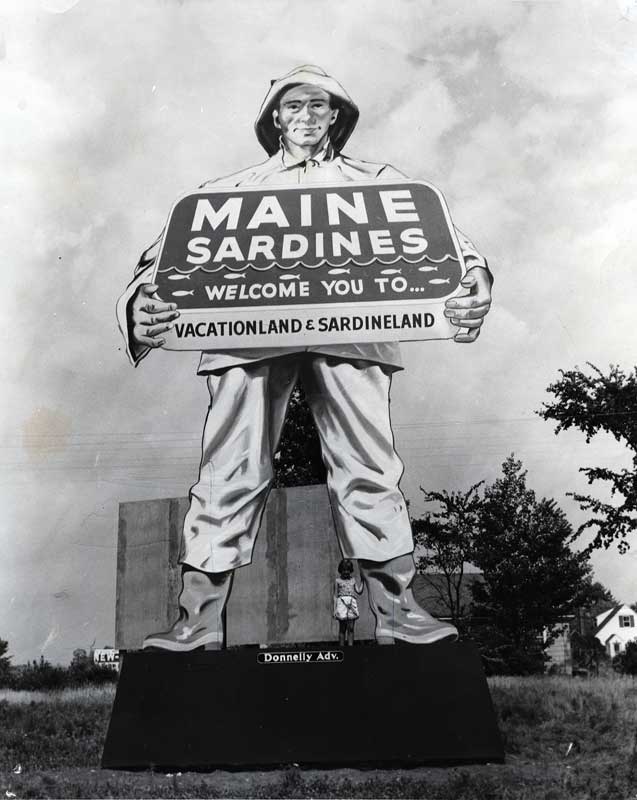
He was very tall and clad in sea boots and yellow oilskins, with a sou’wester rain hat to keep water from running down his neck. The deep-sea fisherman, holding a tin can of sardines, welcomed Maine-bound motorists to “Vacationland & Sardineland” in the state’s southernmost town of Kittery, starting over a half century ago.
Towering over Route 1, the illuminated billboard couldn’t help but capture the imaginations of Mainers and vacationers after it was erected in 1959. The 40-foot-tall fisherman became like an old friend to look for when motorists crossed the Piscataqua River Bridge to Kittery from Portsmouth, New Hampshire. But less than two decades later, Maine’s fishing industry—and America’s eating habits—had changed, and the billboard was banished to near obscurity in the downeast town of Gouldsboro, where he has stood sentinel ever since over what would become the state’s last sardine cannery.
But better times are ahead for Big Jim. The weather-beaten mariner is getting a new lease on life thanks to a partnership struck between Bold Coast Seafood, owner of the site where the statue now stands, the Penobscot Marine Museum, and the Gouldsboro Historical Society. In November, the parties forged an agreement in which the museum will borrow the iconic sign for one year and move it piece by piece to Belfast for restoration. The museum will finance the work through a $30,000 fundraising drive that is now underway.
Come spring, the rejuvenated Big Jim will be installed at a prominent spot near the museum along Route 1 in Searsport to alert visitors to the second season of the PMM’s two-year special exhibit, “Sardineland.” Then, after the show closes in mid-October, Big Jim will be returned to his Gouldsboro perch at Prospect Harbor.
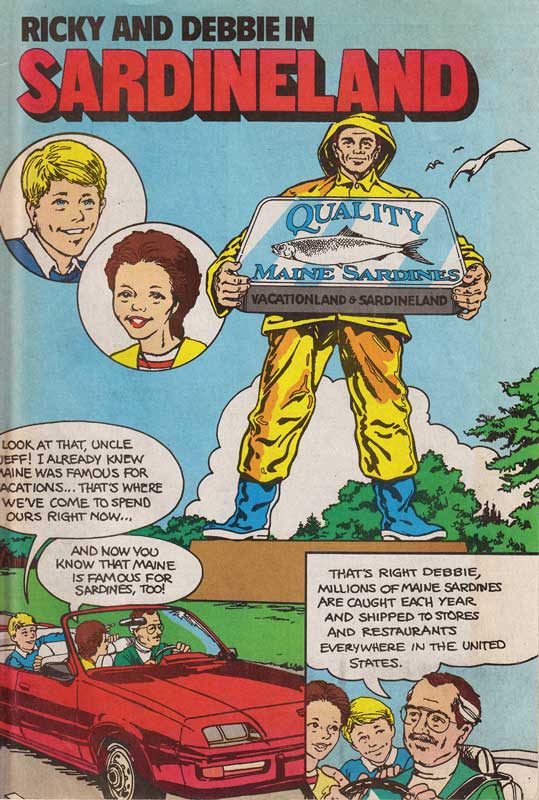
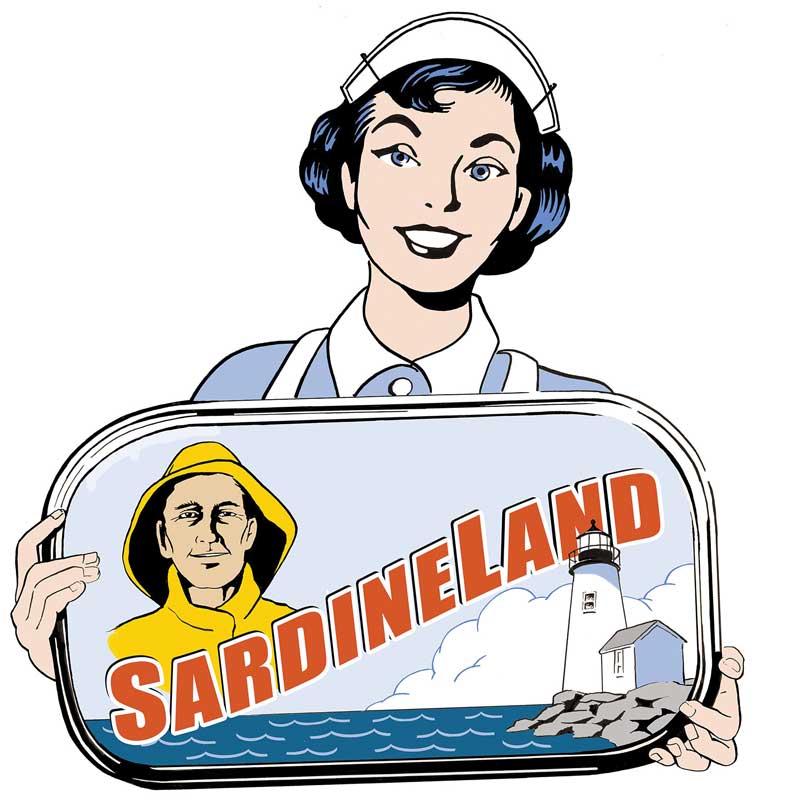
Using the former sardine ambassador to attract attention to “Sardineland” comes about thanks to PMM’s longtime photo archivist Kevin Johnson, who saw the sign’s visual potential to draw in visitors and spark interest in the industry that once drove Maine’s coastal economy.
Johnson is known for mounting roadside visual installations on the museum’s front lawn to spur motorists to check out special exhibits. Among them have been a giant, walk-in pinhole camera to highlight the 2015 show “Exploring the Magic of Photography: Painting with Light.” Visitors got to make their own pinhole pictures. The 2017 “Gone Fishing, The Net Result: Our Evolving Fisheries” featured a full-scale weir—the wooden-stake and net enclosures used to trap schools of fish—on the lawn.
“I have created spectacles to draw attention to the museum and whatever is on exhibit,” Johnson said.
The museum, however, must raise funds to cover the cost of dismantling Big Jim by crane and transporting him to and from the Midcoast region where he will be reinforced and repainted to withstand the elements for years to come.
Johnson invites Mainers and seasonal residents and visitors to help fund Big Jim’s restoration and preservation.
“Big Jim just represents an era of Maine history at a time when there were plenty of jobs. If you worked as much as you could, you could eke out a living,” Johnson said, adding the billboard also reflects Mainers’ pride in their work ethic. “I thought how cool it would be to bring him down and display him.”
Belmont Boatworks’s owner Dan Miller has stepped up to assist with the gigantic sign’s removal and return to Gouldsboro.
In addition, Castine engineer and naval architect David Wyman has pitched in and designed a structure to mount Big Jim on, which can be lowered in case of a hurricane to keep him safe.
Meanwhile, the Maine Midcoast region’s WOW Collective, whose four area artists recently painted Bahner Farm’s four-season mural in Belmont, is poised to paint and restore Big Jim close to his original self.
A Welcoming Highwayman
“The fisherman! Almost there,” Bill Littlejohn would exclaim as a boy spying the striking fisherman after his family crossed the Piscataqua River Bridge en route from McLean, Virginia, to Moody Beach in Wells in the 1960s. Seeing the roadside sign meant the 11-hour journey, wedged with his five siblings in the white 1965 Ford Country Sedan, was nearly over.
“It is a memory that will live forever and made the trip feel like I was on a great expedition,” Littlejohn reflected last spring from his San Diego home. Now 67, he and his family “still go to Moody Beach for vacation—the kids love the lobster rolls—however we do it by plane.”
In recent years, Littlejohn posted a black-and-white snapshot of the lanky seafarer, sparking 212 comments, on the “Old Pictures of Forgotten Maine” Facebook page. They varied from vacationers expressing their fondness for “Big Jim,” as many call the giant figure, to former packers’ recollections of working at Maine’s long-gone sardine canneries.
From age 18, Patricia Hammond of Harrington cut heads and tails off frozen herring, cleaned, and did other jobs at the former Stinson Canning Co. in Prospect Harbor. She and her maternal grandmother, Betty Lou Faulkingham, who worked at Stinson for 50 years, figure that 21 family members earned their living at the former cannery.
“My mom, dad, grandmother and grandfather and great grandmother, and three aunts all worked there. It was almost a rite of passage,” Hammond mused on the Facebook page. “I miss that smelly damn place.”

Erected by the Maine Sardine Council in 1959, Big Jim celebrated the state’s then premier herring fishery and its top-selling canned sardines. But Kittery’s strapping mariner vanished from Route 1 over half a century ago. By the early 1970s, Mainers and vacationers were taking the more direct, faster Maine Turnpike rather than the scenic, meandering coastal highway. Canned tuna fish had replaced sardines as Americans’ top lunchbox staple. Also, rapid advances in fishing methods, far greater catches, and the influx of foreign factory trawlers offshore depleted herring stocks.
No longer a roadside attraction in Kittery, the gigantic fisherman managed to escape demolition and instead moved to an S-curve on Route 186 in Prospect Harbor. The state highway winds through the Gouldsboro village on the downeast highway’s Schoodic Peninsula. Behind Big Jim looms the former Stinson Canning Co., the nation’s last sardine cannery, which shut its doors in 2010.
Since relocating, the once ruggedly handsome fellow had to adapt to Americans’ changing palate—as Maine fishermen do—and endured some indignities over time. His chiseled jawline became puffy and his once ruddy complexion turned putty grey.
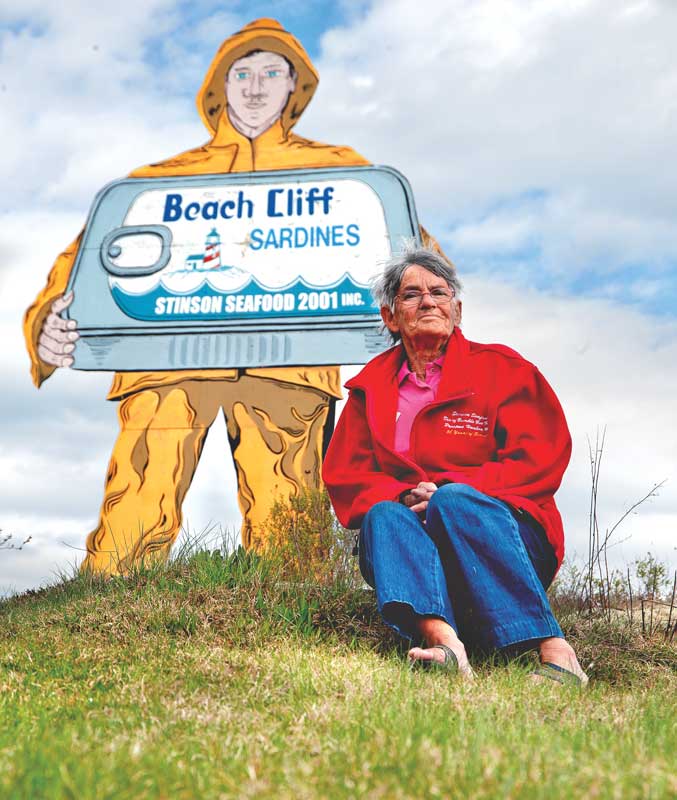
Decades before Stinson’s closure, the company’s treasurer, Calvin Stinson Jr., learned the sign was to be taken down from Kittery, and he salvaged it at company expense. In the mid-1970s, the plywood fisherman was dismantled and brought to Prospect Harbor, where he became the “Stinson Man.”
Stinson’s top machinist, Malcolm MacGregor, reinforced the weather-worn billboard with steel I-beams driven into the granite ledge atop Stinson Hill. The machinist further strengthened the fisherman’s body, replacing its 12 plywood pieces with a dozen aluminum panels. The other change was painting the company name and Stinson’s “Beach Cliff” brand on the generic can the figure holds.
In subsequent years, the Stinson Man underwent two paint jobs. In the first, his sea-blue eyes became paler and his strong jaw, nose and high cheekbones softened. Then in 2010, the cannery’s then new owner, Live Lobster, hired Gouldsboro’s former You Name It company to replace the fisherman’s sardine can with a wooden lobster trap and spiny crustaceans.
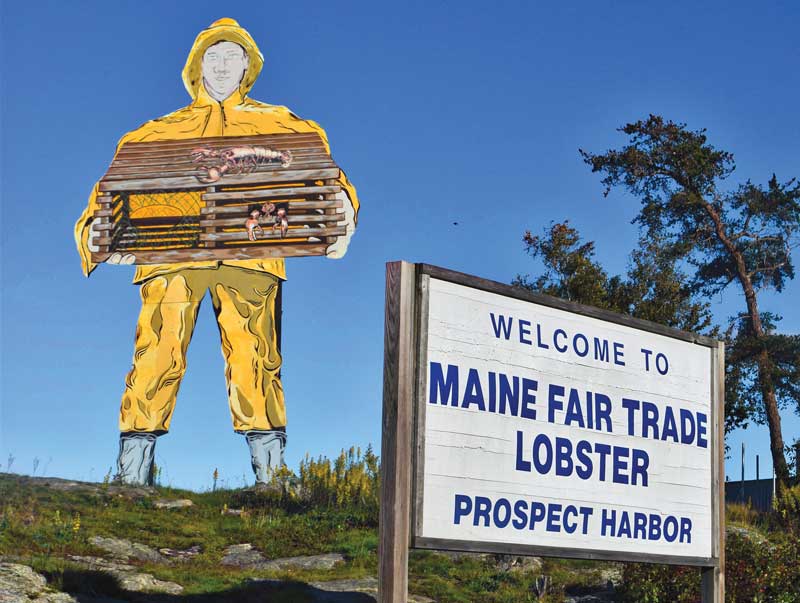
In September, 2025, Bold Coast Seafood acquired the seafood plant property. It is already buying freshly harvested seafood and is gearing up to process lobster and Jonah crab there. Co-owners include Curt Brown, a longtime Cape Elizabeth lobsterman and Maine lobster industry advocate, who previously was Ready Seafood Co.’s marine biologist in Saco. For 20 years, the other two partners, Pete Daley and Betsy Lowe, worked as wholesale lobster buyers for Ready Seafood in Sorrento and another two decades for Garbo Lobster in Hancock.
Bold Coast Seafood aims to boost Maine’s seafood-processing capacity and create jobs for the local workforce. The company also plans to create a research lab to study the lobster resource and stocks.
“We are working hard to write the facility’s next chapter,” said Brown who has collaborated on lobster-related projects with the University of Maine, Gulf of Maine Institute, and other institutions for years. “We want to make sure the next generation has the same opportunities that we enjoyed.”
Once a Way of Life
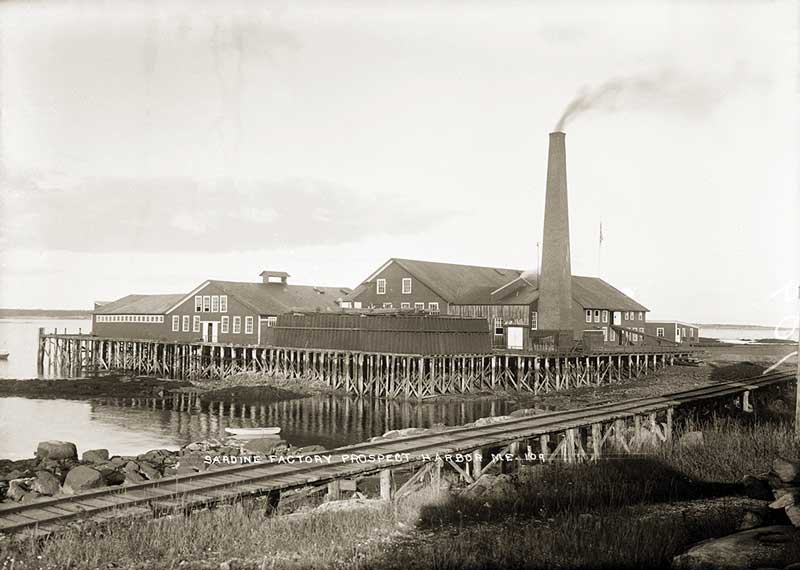
Big Jim’s nickname is a nod to the former Maine Sardine Council’s second director, James Warren, who had the idea to create him. The memorable seafarer symbolizes a major chapter in Gouldsboro and state history. For over a century, the coastal town was a hub in the state’s sardine industry. As far back as 1869, juvenile Atlantic herring (Clupea harengus) were a major source of income for the local workforce. Until 16 years ago, the seasonal, migratory herring were processed, canned, and trucked to market from the Prospect Harbor factory.
Of the nine companies that once canned sardines in Gouldsboro, Stinson Canning Co. had the longest run, 65 years. At its peak, Stinson owned and operated 10 sardine factories in coastal Maine—from Bath to Lubec—and was based in Prospect Harbor.
Local resident Dana Rice Sr. got hooked on fishing as a toddler accompanying his grandfather to tend a herring weir in Jonesport. The late Birch Harbor seafood dealer made his living from the sea. The 78-year-old especially enjoyed owning and operating the 83-foot sardine carrier Jacob Pike to transport herring from offshore to sell as lobster bait and supply the Prospect Harbor cannery during the 1990s and early 2000s.
Rice, who died last April, saw Big Jim as a symbol of Gouldsboro’s still vibrant working waterfront and the herring industry that powered the local economy for decades.
“I love the herring industry more than anything I did,” Rice told this writer in 2022.
Big Jim Belongs in Gouldsboro
Big Jim has been on the Gouldsboro Historical Society’s radar of local relics at risk since 2021, when Norwegian-backed American Aquafarms announced plans to buy the Prospect Harbor property and turn it into a salmon farm. At the time, it was owned by New Bedford, Massachusetts-based East Coast Seafood, whose affiliate Maine Fair Trade had processed over 9 million pounds of lobster there. The billboard already featured a lobster trap. The fear was the trap would be replaced with a basket brimming with Atlantic salmon and its greater significance lost.
“First of all, it is part of Maine and town history,” the society’s president Don Ashmall said at the time, referring to the days when “Big Jim” greeted motorists pouring into Maine. On the Schoodic Peninsula, he noted, the sign “has become a minor tourist attraction in its own right. It’s a connection to Gouldsboro’s maritime history. We face the ocean more than we face the land.”
American Aquafarms, ultimately, abandoned its plan to raise up to 66 million pounds of salmon annually in nearby Frenchman Bay after Maine regulators terminated the project’s application. So Big Jim never became a salmon farmer, but the billboard has been further battered by storms.
Needless to say, the Penobscot Marine Museum’s offer to restore Big Jim was welcomed by the society.
“Bangor has Paul Bunyan. We have Big Jim. He signifies the seafood industry’s importance to our community,” said Jennifer Stucker, the historical society member who has spearheaded the Big Jim project. “Thanks to Penobscot Marine Museum’s initiative and its collaboration with Bold Coast Seafood, he is being restored before he comes home.”
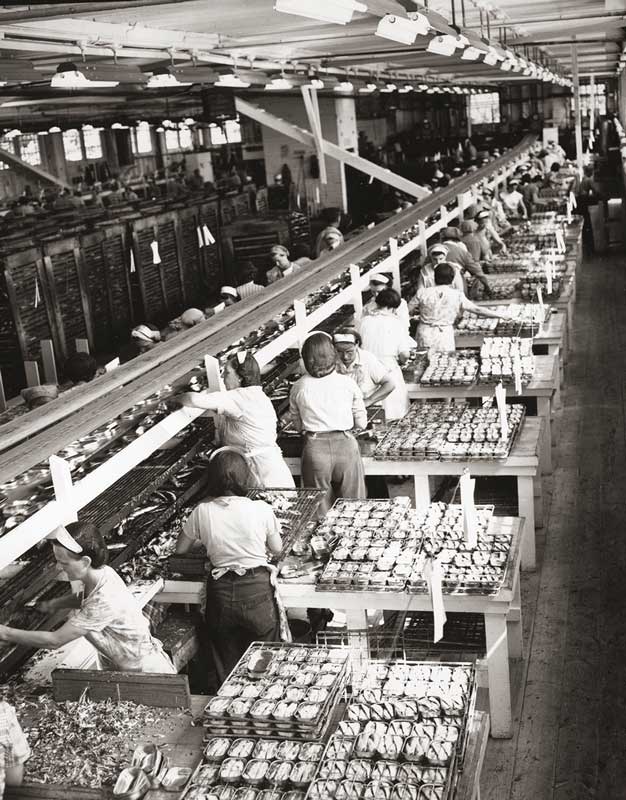
From her house’s porch, Betty Lou Faulkingham has witnessed Big Jim’s various incarnations throughout her life. The 86-year-old Prospect Harbor resident worked as a sardine packer and in other capacities at the former sardine cannery. Her late husband, Gene, known for whittling the Gouldsboro town office’s mini, multi-color lobster buoys representing local lobster fleet members, worked as foreman in the factory’s can shop.
At age 15, Faulkingham started packing sardines at the L. Ray Packing Co. in Milbridge. She later got married and moved to her present home, a stone’s throw from the former Prospect Harbor factory. As a young mother in the late 1950s, she was allowed to begin her sardine-packing shift at 8 instead
of 6 a.m. until her children were old enough to get on the school bus by themselves.
A petite, sprightly woman, Faulkingham was delighted to hear there’s a future for both Big Jim and the fish plant. She has fond memories of working there and still sees a few of the dwindling number of her former co-workers at a weekly Beano game. She especially enjoyed the pranks they played on each other. Like the time they nailed someone’s lunch pail to the floor.
“You’d hear the whole packing line roar,” she remembered. “I miss the people more than anything. It was like a family. Everyone got along.”
✮
Letitia Baldwin is a freelance writer who lives in the downeast towns of Gouldsboro and Cranberry Isles. She previously worked as the Arts & Leisure Editor at The Ellsworth American and style editor at the Bangor Daily News.