


In today’s world of online media, it seems as though anyone with a smartphone can cite “facts” gleaned from the Internet and become an influencer with a digital audience. But in many ways, I am glad to have made my start in an earlier era, where I got to take in all the personalities and excitement that were to be found in a newspaper’s newsroom.
Following my admission to membership to the Maine Historical Society in June 1963, I enjoyed two summers of researching the history of Portland’s architecture and art in the Society’s library. These studies culminated in my first article for the Portland Evening Express, an account of the city’s old post office at Middle and Exchange Streets. This stately Neo-classical marble building was slated for demolition in 1965, and I viewed my article as a form of obituary for a prominent landmark.
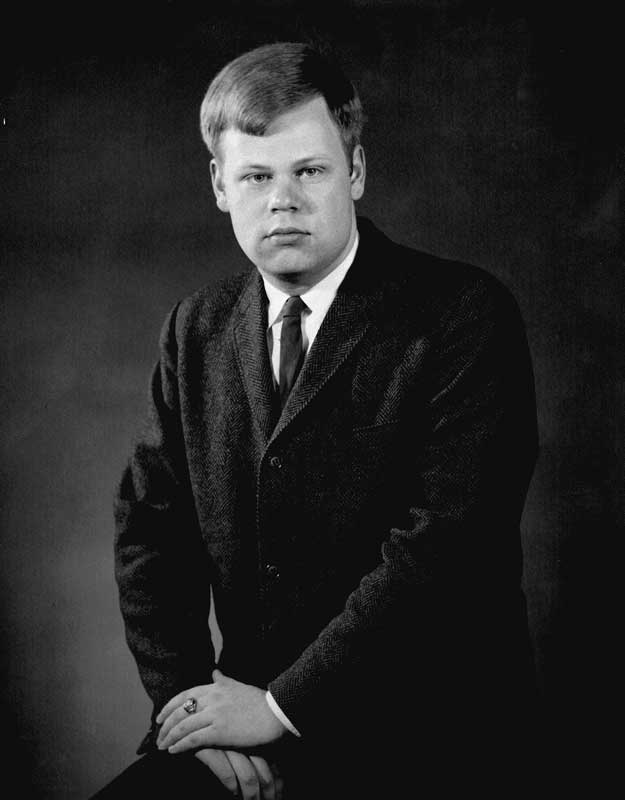
When I offered the piece to the Evening Express, I was directed to William Chapin, the newspaper’s assistant managing editor. Chapin worked in a glassed-in office at the one end of the newsroom on the second floor of the Gannett Building on Congress Street. His office fronted the larger glassed-in office of managing editor Ernest Chard. Chapin accepted my article, and it appeared in the January 20, 1965, issue of the Evening Express.
As I finished my junior year at Deering High School in the spring of 1965, I looked forward to another summer of research at the Maine Historical Society. However, to my surprise, my parents informed me that I must find a summer job to contribute to my future college expenses. I could not imagine mowing lawns or bagging groceries. My mother suggested that I use my growing knowledge of Portland’s past to write a series of newspaper articles about the city’s historic homes and buildings. This would be a logical extension of the many lectures I had given about local architecture since 1964 in support of the city’s emerging historic preservation movement.
Gauging a burgeoning interest in Portland’s architectural heritage, Chapin embraced the idea of a local building series. He informed me that the Evening Express hired summer reporters and that I could write my articles as part of my employment with the newspaper for $60 a week.
My parents and I viewed this offer as a great opportunity to continue my personal interests while earning money for college. On June 30, 1965, the paper announced that 16-year-old Deering High School student Earle G. Shettleworth Jr. would author a series of 20 articles entitled, “Portland’s Heritage.” Covering the period from the Revolution to the Civil War, these articles featured such familiar landmarks as the Wadsworth-Longfellow House, the McLellan House, the Cumberland Club, and the Portland Observatory.
In 1965 the Gannett Publishing Co. produced the Portland Press Herald, the Portland Evening Express, and the Maine Sunday Telegram in its seven-story building at Congress, Exchange, Federal, and Lime Streets. The Federal Street end of the building dated from 1923, while the Congress Street end was added in 1948. In 2015, the complex was converted into the Press Hotel.
The Evening Express, founded in 1882, was published six days a week as the city’s afternoon daily paper. While it carried state and national news, its focus was the Greater Portland area.
With the presses in the basement and the corporate offices on upper floors, the second-floor newsroom was the heart of the operation. At its center was a double row of reporters’ desks, typewriters, and chairs arranged to face each other. Beyond this bank of desks were the glassed-in offices of the two managing editors. At the other end of the reporters’ desks were desks for proofreaders and editors. Other sections of the newsroom were occupied by the sports and features departments. Also located on this floor was an extensive reference library comprised of envelopes of clippings covering thousands of subjects and individuals. Many of these clippings were decades old and contained a fund of information for reporters.
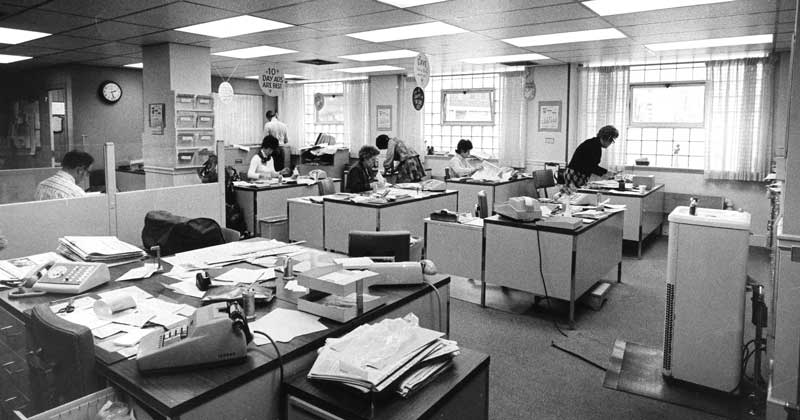
That summer of 1965, I worked for the Evening Express from 7 a.m. to 3 p.m., Monday through Friday. My summer job proved to be a valuable learning experience in writing. Reporters typed their stories on 8-by-10-inch cut-up sheets of unused newsprint, marking the beginning of each paragraph with a curved pencil line. Working against the pressure of daily deadlines, they wrote quickly in a clean, concise, easy-to-read style. For a 16-year-old high school student who excelled in history and English, this was a chance to develop a writing style that I would use for the rest of my life.
I was quickly adopted into the fraternity of the newsroom, my age and inexperience notwithstanding. I received my assignments from two seasoned editors, Stephen Riley and John Murphy. My work consisted of two historical articles a week, miscellaneous features, and routine reporting on subjects such as the police blotter. Sometimes I became so absorbed in my work that one of the copy editors would remind me to go home before I exceeded the hours in the union contract.
At the end of my first summer with the paper, I was asked to return the next year to work for $70 a week. I accepted this offer with the understanding that I would continue writing the “Portland’s Heritage” series to cover the period from the Civil War to World War I. A second summer at the Evening Express in 1966 led to a third and fourth in 1967 and 1968, each with a $10-a-week increase. In 1967 my column covered more local historic buildings, while my 1968 column documented the life and work of 19th century Portland artists.
In 1964 Eddie Fitzpatrick had become the arts and features editor for the Maine Sunday Telegram. Coming from England, he transformed the features section into a lively forum for Maine arts and culture. He recruited such talented writers as attorney Philip Isaacson to cover the fine arts and noted antiquarian bookseller Francis O’Brien to review Maine books.
Fitzpatrick also approached me to write feature articles about Maine. These included a three-part series on the state’s most well-preserved communities. After consulting with O’Brien, I chose Wiscasset, Castine, and Paris Hill. I researched the history of each location, interviewed residents, and photographed local landmarks. Fitzpatrick published the series in double-page spreads in September 1968.
One of the most rewarding experiences of my four summers with the Gannett newspapers was the opportunity to interview interesting individuals. In 1966 I wrote about John Small, a 96-year-old lobsterman from Cliff Island, and Gorham native Raymond E. Davis, one of the world’s foremost experts on construction materials. These articles were followed in 1967 by interviews with Alice Libby Brown, who grew up in the Victoria Mansion, pioneer aviator Harry Jones, and Loren E. Haskell, who went to sea as a child in 1898. In 1969 the Maine Sunday Telegram published my conversation with the multi-talented Buckminster Fuller. Most of those I interviewed welcomed the opportunity to share their stories. However, the poet Robert Lowell declined to speak with me for my 1968 article on Castine.
When I entered junior high school in the fall of 1961, my mother gave me a copy of “Webster’s New Collegiate Dictionary”, in which she inscribed, “Cut deeply into life with the 26 carving tools of the English alphabet.” These prophetic words became a reality during the four memorable summers in the 1960s when I wrote for the Portland newspapers.
✮
Earle G. Shettleworth Jr. directed the Maine Historic Preservation Commission from 1976 to 2015, and he has served as Maine State Historian since 2004.