

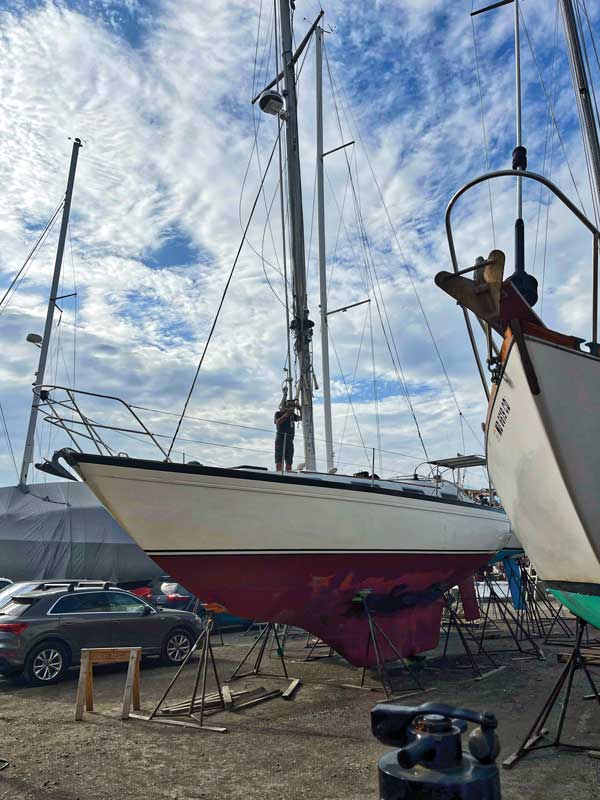
When we bought a new-to-us sailboat two years ago, it came with fairly spartan navigation tools. The previous owners, a couple who had sailed the sloop far and wide, had relied on a binnacle-mounted compass and either paper charts or two iPads that plugged into receptacles near the companionway, one running navigation cartography and the other paired via WiFi with a radar mounted on the mast. She steered; he navigated.
Like the proverbial shoemaker whose children run around barefoot, the boat we had just sold didn’t offer much more. While my job takes me aboard a wide range of new boats loaded with the latest marine electronics from a variety of manufacturers, we got by well enough with an ancient green-screen Raytheon radar buried down below at the nav station and an old chart plotter with a display a wee bit smaller than a smartphone’s, mounted near the wheel.
What can I say? They came with the boat when we bought it 15 years earlier and we mostly got where we were going.
Still, for the new boat, I was willing to splurge, at least a little bit.
While all the latest doo-dads would be nice, my desires were more modest: I wanted a readable chart plotter near the wheel, a wind instrument that worked (the old one had quit, and ditto the speedo, though the depth gauge still worked), and a hard-wired radar so I could look at the blips overlaid on the chart to see if they were a rock, a buoy, or a boat.
Having had the opportunity to try a few different systems, I chose a 9-inch Zeus chart plotter from B&G, their Halo radar, and their mast-top wind instrument, the latter two of which needed cables that were best run with the mast down.
Unfortunately, I waited a bit too long to order the gear and it arrived too late to be installed for our first summer in the water. So last winter, the new boat landed in a yard where its mast could be pulled and the necessary wires run during the off season. I’m not a big fan of sailing videos, but I found one about a guy replacing the same sort of radar on a mast that was stepped. Boy, he made it look easy, with just one or two trips aloft in a bosun’s chair. With our mast on sawhorses, what could go wrong, I thought.
When after an unusually wet spring the spar was finally removed from the storage shed, two helpers and I had at it. Removing the old radar dome was easy; just four bolts held it on a bracket near the spreaders. We tied a messenger line to its power cable, which ran down the inside of the mast in a plastic conduit containing several other wires, secured it with zip ties and tape, and had the cable out in no time.
The slightly larger-diameter new radar cable was then attached to the messenger, and with a little tugging from me at one end and a helper at the other, we had it in place in a jiffy. We drilled holes in a piece of marine starboard, matching those in the bracket and new radar, and presto, the installation was done—a piece of cake after a winter fretting about how it would all go. All that remained was running a new cable for the wind instrument.
Working at the foot of the mast this time, we again attached a messenger and pulled the old wire up to the top. We hit a few snags in the process, but jiggling the messenger up and down from either end, we got it accomplished. It was when we tried pulling the new wire down that our work came to a screeching halt. Pull as we might, the cable made it to about the spreaders before it jammed. The more we tugged, the less it moved. Thinking the other wires in the conduit were perhaps the problem, we attached messengers to them and pulled them up the spar and out of the way.
Still no luck.
Finally, with visions of having no deck, steaming, or masthead lights working all summer, never mind radar or wind sensor, a helper reached in and with a grunt tore out the conduit in the hopes it was the problem. It was packed with rotten wood, old messenger lines, a knot of wires. A mess. But with it out of the way, we easily unsnarled the tangle of cables, pulled everything back in place, and breathed a collective sigh of relief.
Unexpected difficulties? A moment of sheer panic? Yes. But then again, it’s a boat.
✮